T-Bar Row Load Calculator
Estimate plate-stack weight, handle force, strict-row equivalent, training max, and work-set volume for landmine and T-bar row setups.
📌Presets
Presets fill realistic plate counts and lever distances so you can compare sleeve load with the force felt at the handle.
⚙Calculator
T-bar row load snapshot
Enter your plate stack and lever measurements to estimate the actual handle load.
📊Fitness Metrics Comparison
📑Reference Tables
| Setup | Typical ratio | Best input | Notes |
|---|---|---|---|
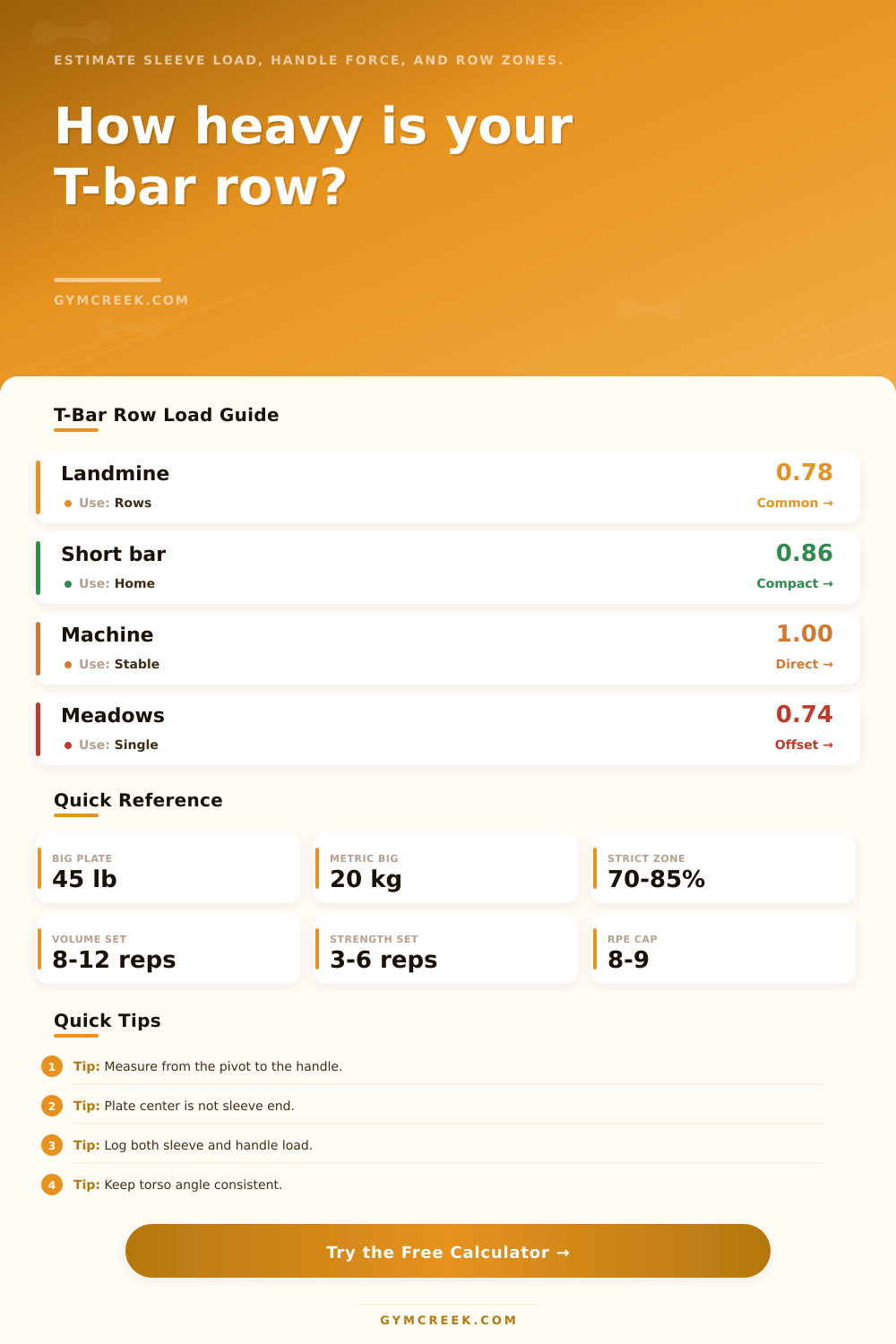
| Landmine T-bar | 0.70-0.85 | Measure handle and plates | Plate stack feels lighter than sleeve load because it is closer to the pivot. |
| Short bar landmine | 0.80-0.95 | Short handle distance | Compact setups usually increase the effective handle load. |
| T-bar machine | 0.95-1.05 | Machine resistance | Some machines feel almost direct; use the carriage rating if listed. |
| Meadows row | 0.68-0.82 | Offset grip style | Single-arm rows are harder to compare because torso rotation changes leverage. |
| Training zone | % estimated 1RM | Common reps | Use |
|---|---|---|---|
| Technique | 50-65% | 10-15 | Practice range of motion and torso position. |
| Hypertrophy | 65-80% | 8-12 | Most back-building T-bar row work lives here. |
| Strength | 80-90% | 3-6 | Use stricter bracing and avoid heaving the handle. |
| Near max | 90%+ | 1-3 | Reserve for controlled testing, not routine volume. |
| Plate stack | Sleeve load | Handle estimate | Scenario |
|---|---|---|---|
| 1 x 45 lb | 45 lb / 20 kg | 35-45 lb | Beginner strict rows |
| 2 x 45 lb | 90 lb / 41 kg | 70-88 lb | Moderate work sets |
| 3 x 45 lb | 135 lb / 61 kg | 105-132 lb | Heavy hypertrophy |
| 4 x 45 lb | 180 lb / 82 kg | 140-176 lb | Advanced strength sets |
| Formula | Inputs | Output | When to use |
|---|---|---|---|
| Moment balance | Load x distance | Handle force | Landmine and levered T-bar rows. |
| Epley estimate | Load and reps | Estimated 1RM | Sets from 1 to about 12 clean reps. |
| RPE adjustment | RPE to RIR | Rep buffer | Submaximal sets that stop before failure. |
| Relative load | Load/bodyweight | Strength ratio | Comparing lifters or tracking progress. |
💡Tips
How many plates do you have on the bar? It is loaded up with two forty-fives and a ten to make it even heavier. Your shoulders burns. The weight feels heavy as hell. But the story isn’t all written in the stack of weight sitting atop your hands. Oftentimes the amount of weight crushing down on your hands are much less than the number printed on the plate. And this is particularly true if you’re using one of those T-bar setups or a landmine attachment in which leverage becomes an enormus factor.
Knowing the discrepancy will alter your programming. Once you input your own bar length and plate positions into this calculator, it will do all the math for you. You won’t have to guess about mechanical advantage anymore.
Calculate Your Real Lifting Weight
The majority of us think we’re lifting whatever weight is on the sleeve when doing levered movements which isn’t true. Think of the pivot point of the landmine as a fulcrum. When your hands are located far out on the end of the bar and your plates is positioned near that same pivot point, you have leverage. You’ll be lifting less total force then what the sleeve load indicates. That’s why two-plates on a T-bar row might feel harder or easier than one another… Solely based off how far each set of plates is from the ground contact point.
The other thing is levers; we underestimate their importance. How far away are you gripping from the pivot? That’s the lever arm. The farther out you grab the bar, the longer the lever arm is at your hands so it pulls harder against you. But crowd the bar and keep handle near the pivot, and boom: the load drops like a rock.
So when you see that sleeve load goes up, you think, “I’m making progress!” But did you also move your grip width? Did you change your stance? Then you’re not changing the load, you’re simply changing the mechanical ratio of the tool. The tool normalizes all this by asking for these exact distances. The number it spits out isn’t just a raw plate weight. It’s the actual amount of force on the handles, which is what develops muscle.
Most row records will include some Body English. Heaving the bar off of your chest with your legs isn’t measuring back strength anymore. You’re measuring how well you can generate momentum with a hip hinge and how strong your hips are. This is where the calculator comes into play. You can choose your torso angle and different grip styles to account for this. For example, a dynamic power stance creates a much lower handle force reading than using a strict neutral grip at the same sleeve load.
It’s one or the other so it’s not cheating in itself. But you need to know what mode you’re in. That shifts training zones. With strict form, muscle-building work tends to live in that six to twelve rep range. Strength work go heavy for less reps. Mix them up without knowing your true load and you’ll stall out.
The tool also provides reference tables of expected ratios for various set-ups. A long Olympic bar with plates sitting closer to its pivot point will have a lower ratio (harder per pound). In contrast, a short bar landmine is easier because the plates sits farther from the pivot point relative to the handle distance. A machine T-bar row often has a ratio near one to one, meaning the load is direct. So knowing this you can compare your days more fairly. Without factoring in these mechanics, you can’t really compare a seated cable day to a landmine day. The estimates provide a common way to measure effort.
Finally, keep track of your relative strength. What’s your rowing strength-to-body-weight ratio? While total numbers aren’t necessarily the most important piece of data to gauge long term progress, that’s where relative strength comes in. When your T-bar increases by five pounds while your bodyweight rises by 10 pounds as well, you’re actualy getting stronger relative to yourself. The calculator does all of this math for you. It gives you a snapshot of where you stand while removing the vanity metrics from the equation.
Set reasonable goals using it. Measure the bar and add the plates. Let physics do the dirty work. Keep your mind on the pulling. Having an exact idea of what your back has to pull is like turning guesswork into strategy, and that’s worth more then another plate on the sleeve.