Symmetric Strength Calculator
Compare left-side and right-side strength, estimate side-specific 1RM, and turn the gap into a practical symmetry score.
📌Presets
Each preset loads a different strength pattern and recalculates side balance automatically.
⚙Calculator
Symmetry snapshot
Enter matching left and right sets to calculate your balance score.
📊Symmetry Metrics
📑Reference Tables
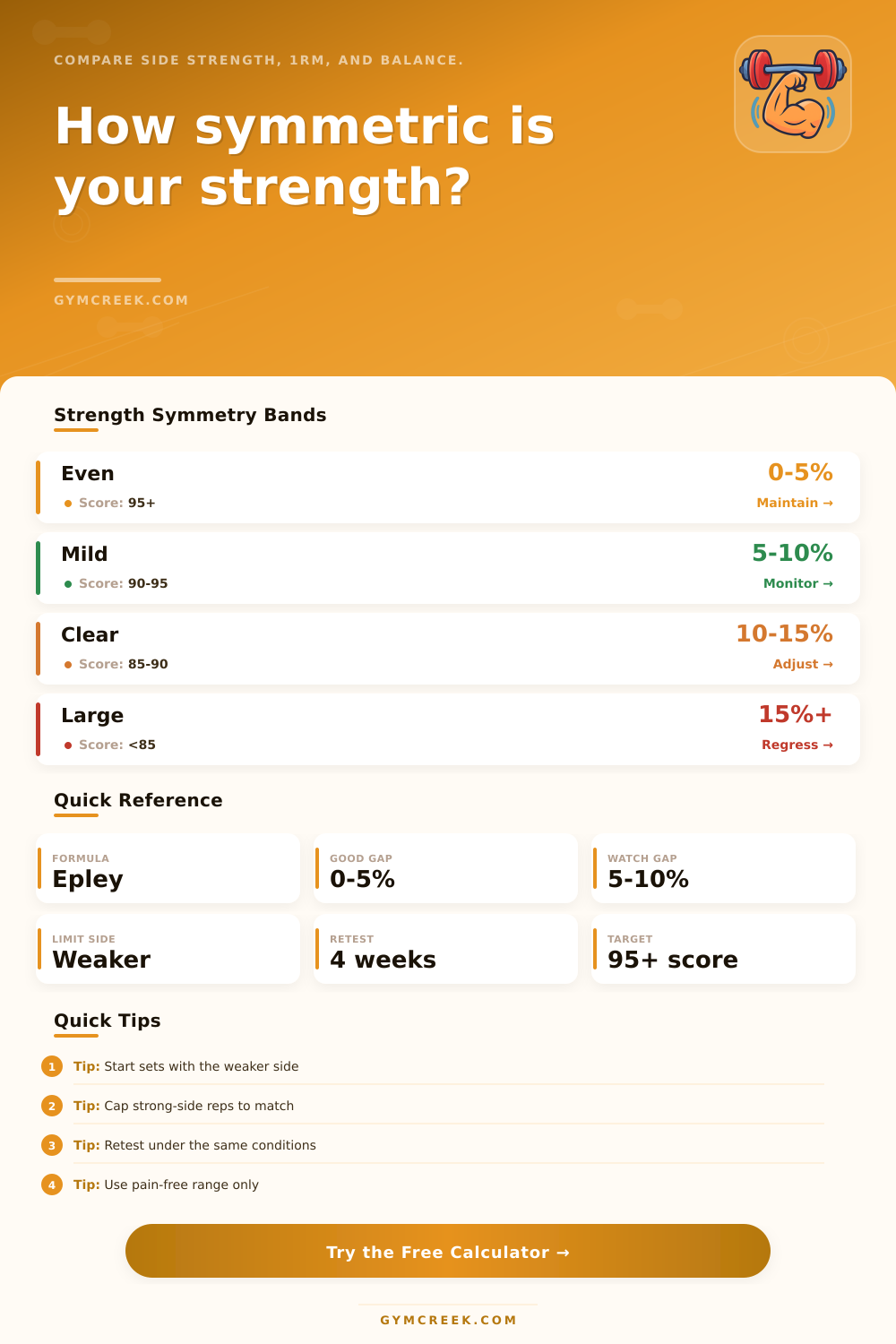
| Band | Gap | Score | Training cue |
|---|---|---|---|
| Even | 0-5% | 95-100 | Maintain loading |
| Mild | 5-10% | 90-95 | Monitor weekly |
| Clear | 10-15% | 85-90 | Limit by weaker side |
| Large | 15%+ | Under 85 | Regress and rebuild |
| Pattern | Example | Common gap | Test cue |
|---|---|---|---|
| Upper push | DB press | 3-8% | Match elbow path |
| Upper pull | One-arm row | 5-10% | Pause at top |
| Knee dominant | Split squat | 5-12% | Same depth |
| Hip dominant | Single-leg RDL | 5-12% | Control pelvis |
| Formula | Use | Equation | Best range |
|---|---|---|---|
| Epley e1RM | Strength estimate | Load x (1+reps/30) | 1-10 reps |
| Symmetry | Side balance | Weak / strong | Any matched test |
| Anchor ratio | Relative strength | e1RM / BW | Barbell anchor |
| Bilateral index | Two-side link | Anchor vs sides | Same pattern |
| Training age | Target gap | Retest span | Note |
|---|---|---|---|
| Novice | Under 10% | 3-4 weeks | Technique shifts fast |
| Intermediate | Under 7% | 4-6 weeks | Use consistent tempo |
| Advanced | Under 5% | 6-8 weeks | Small gaps matter |
| Returning | Under 10% | 2-4 weeks | Respect fatigue |
💡Tips
Many people do not notice a diffrence in strength between there left side of the body versus their right side until they experience some kind of physical issue with that body. For example, an individual may experience an issue with their shoulder after they press, or they may find that one of their leg does not allow for the same split-squat as the other. Strength differences are typicaly normal to individuals, but they can become a problem if those difference in strength are too great in relation to the way that they affect those individuals bodies.
A side by side test can help to reveal the different levels of strength of each of an individual’s limbs before those strength imbalances can become a setback to their strength and performance. The side-by-side test will require an individual to perform a specific movement with each of their limbs. For example, an individual can perform a movement like pressing, rowing, lunging, or hinging with each of their limbs.
How to Test and Fix Left and Right Side Strength
The person can record the loads of each of the limbs, as can the number of clean repetitions that each of the individuals limbs can perform. Based off these measurement, it is possible to calculate an estimate of the one-repetition maximum for each of the individual’s limbs. Each of those one-repetition estimations can then be compared to determine the percentage gap between each limb, as well as the symmetry score of the individual’s strength.
While the exact number that the test calculates is less important than the information that is gained from the result of the test, the percentage gap is an important measurement. A percentage gap that is under 5% indicates that the difference between each limb is normal, and that it could of been created due to factors like grip comfort, warm-ups, or in what order the limbs were tested. A percentage gap that falls within the 5% to 10% range is one that is worth monitoring for those individuals, as such a gap may indicate normal strength dominance without any negative impact.
A percentage gap that is outside of the 10% mark, however, indicates that the individual should begin to make change to their training programs to compensate for the difference in strength between each of their limbs. Within the calculator, each of the fields that are represented in the calculation relate to the variables that will affect the outcome of the test. For instance, body weight and height are one of the fields that can be represented to account for the relative strength of each of the individual’s limbs, as can body weight and height to account for body-mass considerations.
The training age of the individual is another of the fields that can be used to reflect the changes that may occur with time and strength gains. The fields related to which side of the body is dominant allows the individual to determine if any imbalance exist in their natural side of the body or in their non-dominant limb. Finally, the fatigue adjustment helps to account for the difference in strength between each limb when those limbs are tested while fatigued versus while they are fresh.
These fields are not measurements of health or strength, but they are fields that will provide the estimate with accuracy in relation to the individual’s body. Another of the variables in the test is the movement pattern that is used in the test. For instance, movements like pressing can exhibit smaller gaps in strength between each of the individual’s limbs.
However, movements like upper-pull, single-leg, knee-dominant, and hip-dominant movements may exhibit larger differences in strength between each limb of the individual. The movement that is used in the test should be the same as the movement that the individual is to train. Based upon the number of repetitions and the strength calculation for each of the individual’s limbs, the results will provide information as to how the individual should train those limbs.
For instance, if each of the limbs exhibit even symmetry in their strength, then no changes need to be made to the training that the individual is currently performing. A mild imbalance in the strength of each of those limbs may indicate that the individual should continue to monitor those muscle over several weeks. A clear imbalance, however, suggests that the individual should begin their sets with their weaker limb, and that they should begin to limit the number of repetitions of their stronger limb.
A large imbalance suggests that the individual should reduce the range-of-motion or the load that is placed into each limb, and that they should begin to rebuild the coordination of each limb. Another field within the calculator is the bilateral anchor field. This field asks for the individual to calculate the strength of their two-armed or barbell performance of the same movement pattern.
This field can reveal whether each athlete can produce more strength with both limbs performing the same movement than they can with each limb separately, or if they exhibit a deficit in strength with their bilateral tests. While real training may not always be performed within perfect conditions in the body, the test can still provide important information about an individual. For example, retesting each individual every few week will provide information about whether any trends emerge.
While the goal of the test is not for athletes to achieve perfect strength within their limbs, the goal is to ensure that they are aware of the growing strength gap between each limb. This allows athletes to make changes to their training programs before their bodies must make the same changes due to pain or injury. By removing the mathematical components of the calculation, this calculator allows individuals to focus upon the decision that must be made following the performance of the test.
For instance, the individual must make a decision as to which movement they will use to test each of their limbs. They must also set the conditions under which they will perform the test. Finally, the individual must make a decision as to what the number indicate of their bodies.
The five percent gap for an individual’s fresh tests may differ from the five percent gap that they exhibit when they are fatigued. While the numbers will provide the individual with information as to the strength of their limbs, the decision that they make will create the training plan for those limbs. By focusing upon their weaker limbs and training them to perform as many repetitions as their stronger limbs, individuals will begin to experience improvement within their body in around a month or two.