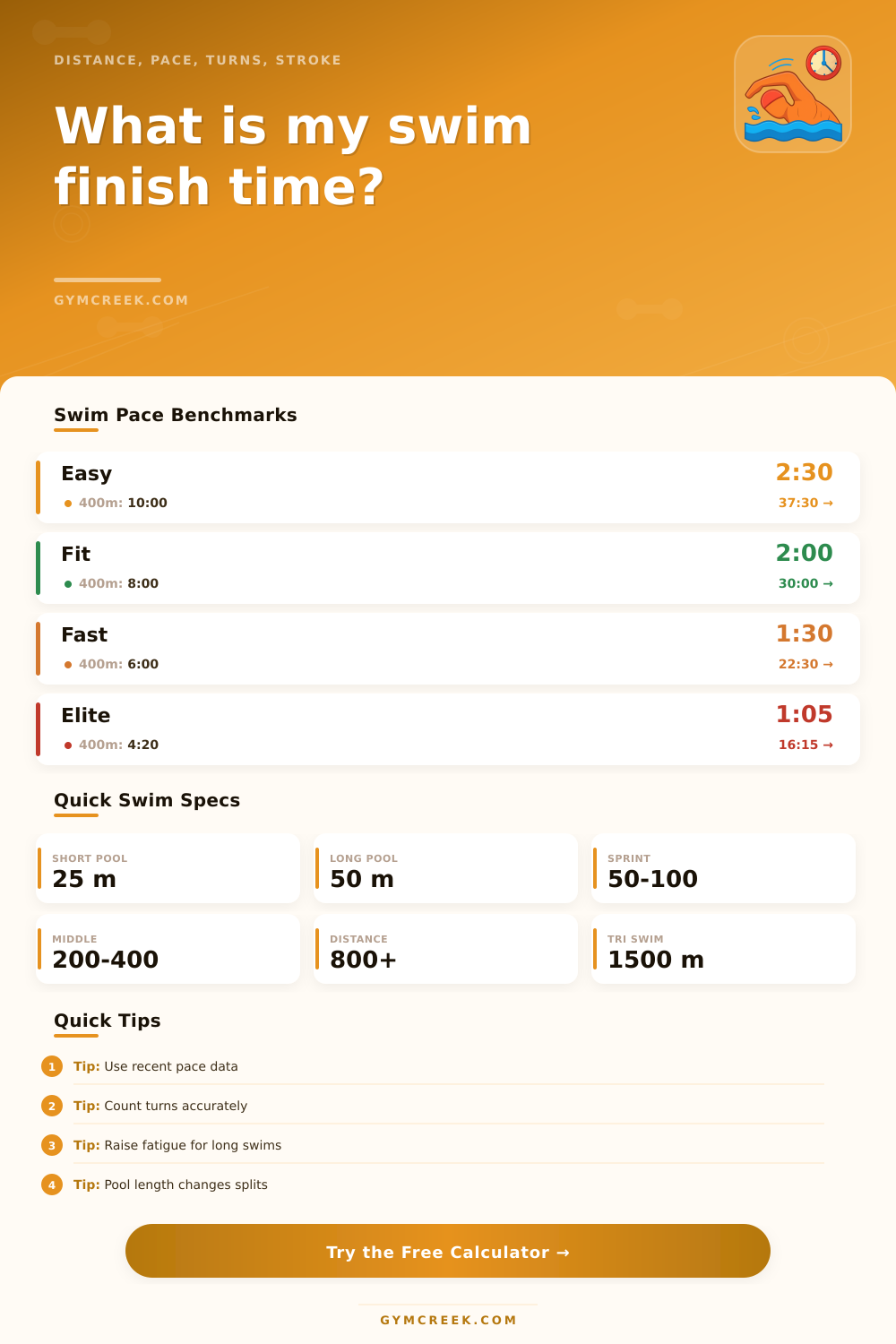
Swimming Time Calculator
Predict a swim finish time from target distance, pace per 100, pool length, turn count, stroke choice, fatigue, and athlete profile.
Predicted finish time
Use the inputs above to estimate the clock.
| Stroke | MET | Fatigue | Turn note |
|---|---|---|---|
| Freestyle | 8.3 | 1.00x | Best flip benefit |
| Backstroke | 7.0 | 1.05x | Wall timing matters |
| Breaststroke | 10.3 | 1.12x | Open turns required |
| Butterfly | 13.8 | 1.20x | Highest fatigue load |
| IM | 10.0 | 1.14x | Mixed stroke changes |
| Distance | Use | Typical pace | Fatigue |
|---|---|---|---|
| 50-100 | Sprint | Fastest | 0-3% |
| 200-400 | Middle | Strong | 3-7% |
| 800-1500 | Distance | Steady | 5-12% |
| 1900+ | Tri/open | Controlled | 8-18% |
| Turn type | Model | Per turn | Best use |
|---|---|---|---|
| Flip | Credit | -0.15 s | Freestyle pool |
| Open | Penalty | +0.10 s | Breast or fly |
| Cautious | Penalty | +0.35 s | New swimmer |
| No wall | Neutral | 0.00 s | Open water |
| Formula | Variables | Use | Output |
|---|---|---|---|
| Pace time | Distance, pace | Base split | Seconds |
| Fatigue curve | Factor, stroke | Slowdown | Time add |
| MET energy | MET, kg, time | Calories | kcal |
| Mifflin | Age, sex, size | TDEE context | kcal/day |
Swimming times can be predicted by using the swimmer’s speed and several other variables. A swimmer may find that their speed is maintain for short distances but may not be able to maintain that same speed for longer distance. A swimmer cant rely on their fitness level alone to determine their time for a particular distance to swim.
Several different variables will change the movement of the swimmer through the water and there performances while swimming. The distance to be swum will impact the performance of the swimmer. The pace per hundred meters will impact the distance the swimmer can swims per 100 meters.
How to Predict Your Swimming Time
The length of the pool will impact the number of times a swimmer hits the walls to turn around to swim the next leg of the pool. Depending on the type of turn the swimmer chooses to perform, the swimmer will be able to maintain more speed with one type of turn compared to other. The type of stroke a swimmer uses will impact how much energy the swimmer expend while swimming.
Because strokes such as butterfly and breaststroke require more energy than strokes such as freestyle swimming, a swimmer using those strokes will fatigue at a faster rate than a swimmer who swims only freestyle. Finally, the conditions of a swimmer’s start will impact the swimmers distance per minute. If a swimmer dive into the pool, they will swim at a faster distance per minute compared to when they start swimming in the water.
Fatigue is another variable many underappreciate when determining swimming time. A swimmer may feel great when beginning to swim, but as fatigue sets in, a swimmer will slow down with long distance. This variable is used to account for the slowdown of the swimmer while swimming the entire distance.
A swimmer may feel great at the beginning of a race but fatigue with long distance. You can adjust the percentage for fatigue to indicate the type of race a swimmer is competing in because an open water race will require a higher percentage for fatigue than a competition in a short pool race. The profiles of the athlete can help determine how much energy the swimmer will use while swimming.
These profiles will include information about the swimmer’s age, weight, height, and activity level to calculate the amount of calories that swimming will require from the athlete. These variables will help to determine the difficulty of the distance that must be swum by the athlete. Reference tables will include information about the energy costs of strokes and the time saved by using a flip turn vs. An open turn.
These tables can be used to compare the different stroke swimmers use and the different types of turns swimmers make while racing. These tables are a replacement for coaching a swimmer but can help them understand how their different choice will impact their time. Many people make mistakes when calculating their swimming time.
For example, many people use the pace that they swim for 100 meters for their 1500 meters time. This does not account for fatigue that sets in with long distances. The fatigue adjustment account for this to help people understand their time for long distances.
People also often do not account for the length of the pool. For example, short pools have more push-offs from the walls compared to long pool. Open water swimming introduces other variables to the equation for calculating swimming time.
For example, in open water swimming, there are no walls to swim turns around and no push-offs from the walls. In open water swimming, people usually begin swimming in the water instead of performing a dive start into the pool. Fatigue is often higher in open water swimming because a swimmer must sight across the water and change the direction in which they swim.
To calculate swimming time in open water swimming, the length of the pool is zero and the start and fatigue values are adjust. The goal of calculating swimming time is to help a swimmer understand their potential time for swimming a certain distance. For example, a swimmer who is racing will have a different time calculation than a swimmer who is training to complete a certain distance.
Additionally, since a triathlon will be longer than a pool race, the swimmer will have different time calculation. However, the calculation is the same. If a swimmer use this tool regularly, they will begin to understand which variables has the most impact on swimming time.
For example, distance and pace will have the most impact on swimming time, but turns and fatigue will also significantly impact swimming time. By using this swimming time calculator, a swimmer will understand how these variables will impact swimming time so that they can make an informed decision about whether the distance that they plan on swimming for a race is realistic for themselves. Additionally, the use of this swimming time calculator will help a swimmer to consider each of the variable that may impact their swimming time.