Stroke Rate Calculator
Analyze swim stroke rate, tempo, distance per stroke, pool-length rhythm, pace gap, and target changes from stroke count, split time, distance, pool length, stroke type, and target pace.
📌Named Swim Presets
Presets load realistic time, stroke count, pool setup, target pace, tempo goal, and distance-per-stroke goal so you can compare stroke rhythm without using a generic template.
⚙Stroke Rate Inputs
Swim stroke rate snapshot
Enter stroke count, time, distance, pool length, stroke type, tempo, DPS, and target pace to calculate your rhythm.
📊Stroke Metrics Grid
📑Stroke Rate Reference Tables
| Measure | Raw Value | Per Length | Use |
|---|---|---|---|
| Stroke rate | --- | --- | --- |
| Stroke | Easy Tempo | Threshold / Race | Watch For |
|---|---|---|---|
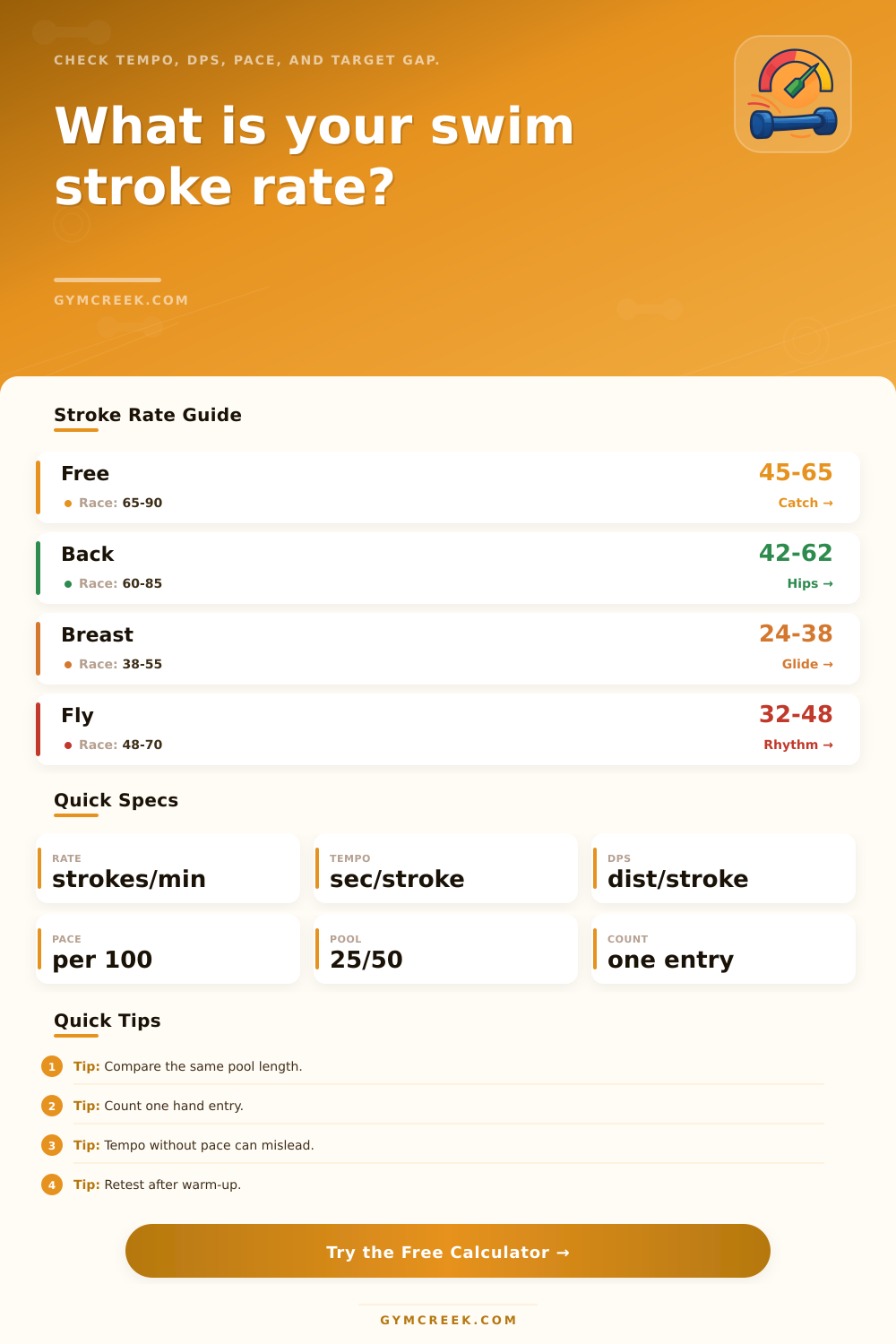
| Freestyle | 45-65 spm | 65-90 spm | Short catch if rate rises and DPS drops |
| Backstroke | 42-62 spm | 60-85 spm | Hip timing and hand entry width |
| Breaststroke | 24-38 cycles/min | 38-55 cycles/min | Glide that stalls between pulls |
| Butterfly | 32-48 cycles/min | 48-70 cycles/min | Rhythm loss before power loss |
| Pattern | Likely Meaning | Helpful Change | Retest Cue |
|---|---|---|---|
| Higher rate | --- | --- | --- |
| Session Goal | Rate Bias | DPS Bias | Best Check |
|---|---|---|---|
| Technique | Controlled | High priority | Same pace, fewer strokes |
| Aerobic | Steady | Stable | Repeatable split averages |
| Threshold | Moderate-high | No collapse | Last repeats match first |
| Sprint | High | Enough water | Rate rises without slipping |
| Race | Specific | Specific | Target pace under fatigue |
💡Stroke Rate Tips
Small changes make a big difference in swimming, and stroke rate is one of those things that makes a difference. How fast do you swim? Pace won’t necessarily tell you if you’re swimming well against current or just turning faster. Swimming is a sport of changing strokes; stroke rate explain how many times you swing your arms in one minute.
All it requires are distance, stroke count, split time, and pool length. And from that the calculator will spit out tempo, rate, and distance per stroke: those three numbers tells if you’re maintaining a good balance between speed and length, or if you’ve traded one off to gain the other. Typically, if the rate go up but the distance per stroke decreases, the math say you’re not making real progress, you’re slipping. You can feed in your target pace as well, and right away see how far apart you were from what you planned.
How to Use the Stroke Rate Calculator
The useful range depend on stroke type. Freestyle and backstroke is typically higher since each hand entry counts as a stroke. Butterfly and breaststroke are slower with a full cycle including both the recovery and the glide. This is why raw numbers from one stroke to another might be misleading. Since the calculator take into account how you enter your hand, the output remains similar.
What else? Pool length. It is not what most people assume, but it does matter. Longer pools (e.g., 50 meters) mean less time spent at the walls compared to shorter ones. Shorter pools (e.g., 25) mean more turns. This means the time spent at the wall is not actualy swimming time. To account for this, the tool estimates your swim-only rate based off wall-time. It’s helpful if you’re curious how well your rhythm holds in the middle of the pool versus just across the whole repeat.
That’s where it gets really valuable; repeat the same distance multiple times. Alter an element, like catch length or tempo, and run that again. You’ll see if your pace increased while still keeping a good stroke count for the distance. That’s the type of pattern that coaches want to see because it indicates the change positively affect the swimmer and didn’t simply shift the numbers around.
Many swimmers concentrate on maintaining a target rate, without monitoring the effect it has on their length. If your stroke shortens and you leak power, having a larger number on the clock doesn’t mean you’ll be going faster. Seeing this tradeoff helps make the choice easier. But it’s also playing a quiet game with effort.
If the athlete believe they are putting out more effort, the distance per stroke drops, but typically the rate increase first. You can input that number into the tool and see if it was fatigue causing the change or an intentional change to your rhythm. After a session or two, the pattern reveals itself: Is your higher rate work sustainable? Or does it just look like that during the first repetition?
And it is this choice of goal that further shapes the interpretation of the numbers. Longer strokes at a controlled rate will get rewarded in technique sessions. A strong, unbroken rhythm that doesn’t cave under the final repeat is what threshold work seeks out. Sprint sets require a higher rate, but it must be a rate that is sustainable and keeps you feeling connected to the water. And that’s where the goal gets moved into the interpretation; the same raw number can have different meanings different than your goal.
Stroke rate stops being a stand-alone goal and instead becomes just another link in an easy-to-follow feedback loop: Swim-swim-measure-adjust-one-thing-measure. Because your inputs are consistent, and your outputs is honest regarding the tradeoffs you actualy made in the water, it’s a neat little loop.