Swimming Stroke Count Calculator
Project total swim stroke count from a measured sample, then compare distance per stroke, strokes per length, pace, tempo, wall effect, and expected fatigue drift.
📌Stroke Count Presets
Each preset loads a different pool, sample count, split, wall distance, target count, and fatigue pattern for realistic swim-count planning.
⚙Calculator Inputs
Swimming stroke count snapshot
Enter a sample stroke count, pool setup, pace, DPS target, wall distance, and drift to project the full swim.
📊Stroke Count Metrics
📑Stroke Count Reference Tables
| Checkpoint | Base Count | With Drift | Use |
|---|---|---|---|
| 25 | --- | --- | --- |
| Stroke | 25m Range | 50m Range | Planning Note |
|---|---|---|---|
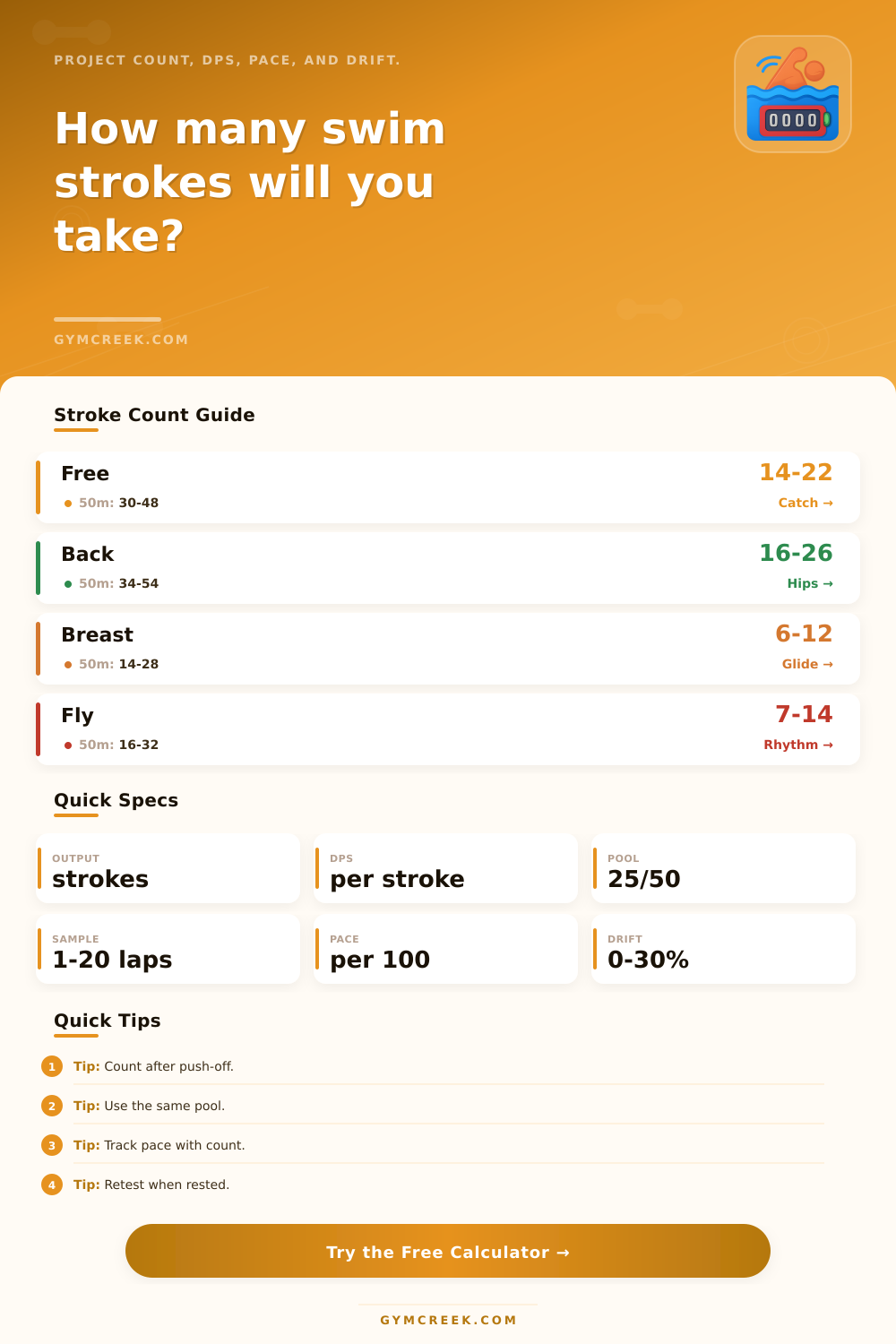
| Freestyle | 14-22 strokes | 30-48 strokes | Efficient count depends on push-off distance and speed |
| Backstroke | 16-26 strokes | 34-54 strokes | Stable hips usually matter more than a single low count |
| Breaststroke | 6-12 cycles | 14-28 cycles | Too much glide can lower count while slowing pace |
| Butterfly | 7-14 cycles | 16-32 cycles | Rhythm decay often shows up before pace fully drops |
| Method | Best For | Calculator Treatment | Watch For |
|---|---|---|---|
| One hand entry | Free and back | Used directly as stroke entries | Always start counting at the same point |
| One pull | Breast and fly | Converted to entries when needed | Compare cycles to cycles in training notes |
| Sample lengths | Any repeat | Scaled to total planned distance | Short samples can understate fatigue drift |
| Tempo estimate | Race planning | Cross-checks count from pace and tempo | Tempo alone does not show catch quality |
| Signal | Likely Meaning | Adjustment | Retest Cue |
|---|---|---|---|
| On target | --- | --- | --- |
💡Stroke Count Tips
Stroke count is a simple measure until you attempt to implement it. When I say “stroke count,” what I mean is that you swim several lengths and when asked how many times you stroked, your response is not as clear as you think. Does 23 strokes per length indicates something different than 17? Is this pace making you tired, or do you need to slow down? Are you still on track with your pacing plan for the remaining distance?
During practice most swimmers counts their strokes for very small portions of time, guessing as to what that equates to across an entire race or set. It’s here where things can go wrong. What you find out about your stroke at the beginning of a workout doesn’t compare to what you’ll observe after you’ve been going for eight or ten length. This difference is what we refer to as drift amongst swimming coaches and it varies based off your stroke type, intent of the workout, and amount of recovery between repetitions.
Why Counting Strokes is Hard
While the math is done for you by the calculator above (if you input your sample size), the grunt work begin prior to opening up the calculator. What exactly are you trying to measure? For example, freestyle and backstroke typically count one hand entry whereas butterfly and breaststroke tend to be more on a cycle basis. This will change base line and thus all subsequent estimates based upon that choice. And of course, pool length matter. A 50-meter length does not have the same type of glide as a 25-meter length and also has different wall effect. So if you switch pool lengths during the season unless you adjust your target number accordingly, your numbers no longer makes any sense.
The other central consideration is distance per stroke. Generally speaking, you’ll get more distance with every stroke if your pace stay the same. Your stroke also needs to become both longer and more effective. If you’re counting down a bit too far, you tend to glide and while it sounds great in theory (look how many strokes I got), it tends to bog down the entire cadence.
That’s where the tension appears in the calculator. It compares what you have entered as your desired distance per stroke and contrasts it with what your actual number is. If they aren’t in alignment then the result tell you if you are gaining length but sacrificing efficiency, or just losing length due to fatigue. Most folks under-estimate fatigue drift. That variable can increase your stroke count by six percent, which might be OK for a 200. It can also add dozens of additional strokes on a 1500 by race length.
The amount of acceptable drift shifts according to the goal selected in the tool. Race rehearsal expects a bit more; technique work almost none. It’s not simply a form setting since it reflects both what you’re willing to accept on the final repeat as well as how the session should of feel.
Then there’s tempo. Even with a low number of strokes at a slow pace, you might not end up where you want to be. The calculator cross-checks the two. This lets you see if your intended rhythm support the pace you desire. If both tempo and count align then typically, that’s a good plan. But if not, then something must give, either the tempo or the count.
For me the best approach to stroke count is to use it as a conversation between yourself and how you swim, not as something that needs to be a specific number. Sample, push off hard, run the numbers, then tweak one thing at a time. Work on tempo for one week. The next on catch pressure. The following on wall distance. Each will be reflected in the next sample and you’ll begin to see a pattern where just looking at a moddern number wouldn’t show it.