Swimming Speed Calculator
Convert swim distance and time, pace per 100, pool length, open water current, stroke type, turns, stroke rate, and distance per stroke into practical speed and efficiency outputs.
📌Swim Presets
Presets load realistic pool and open-water sessions. Pool mode estimates turn influence; open-water mode separates water speed from ground speed.
⚙Calculator Inputs
Swimming speed snapshot
Enter distance and time or pace per 100 to calculate speed, turns, and stroke efficiency.
📊Swimming Metrics
📑Reference Tables
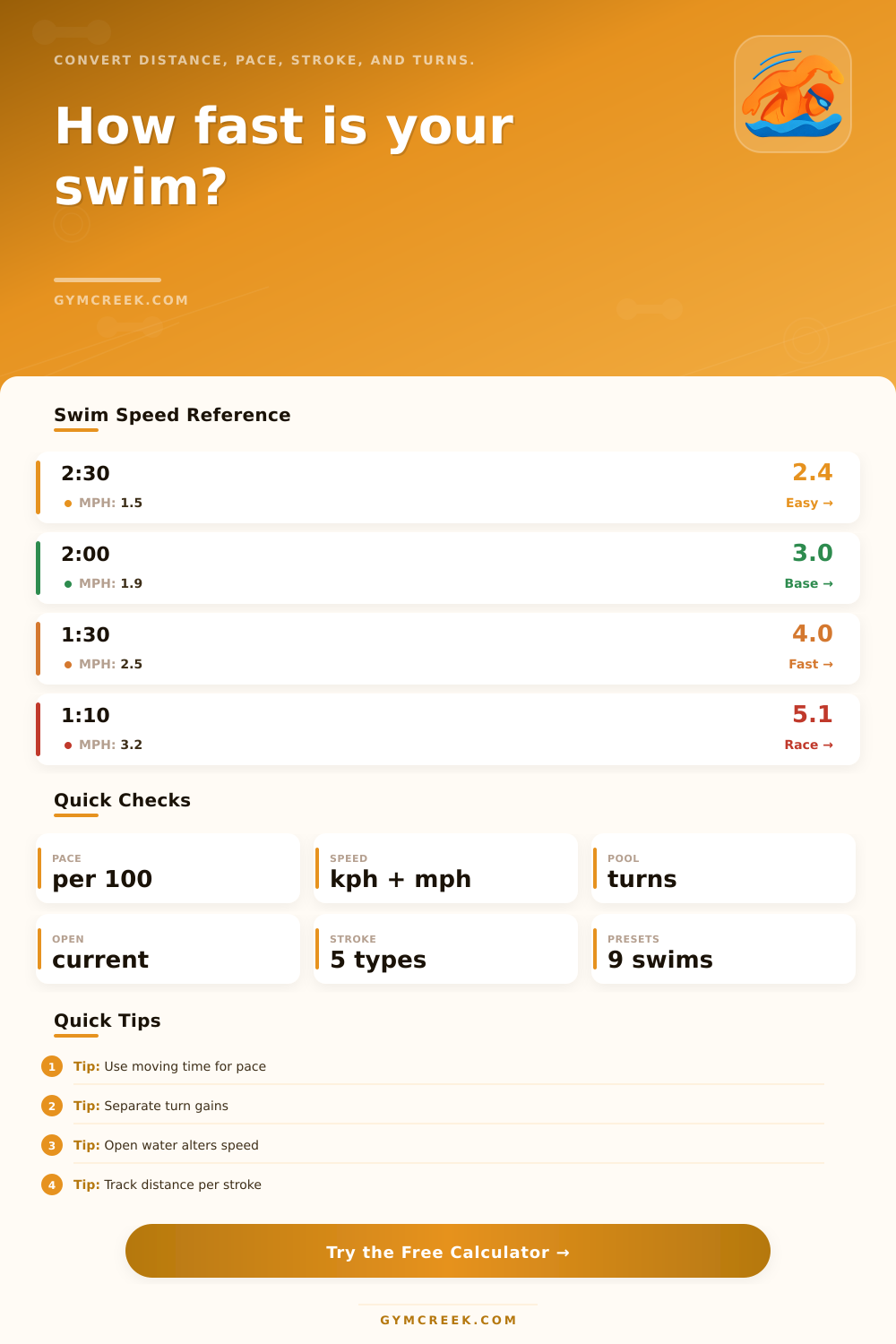
| Pace per 100 m | KPH | MPH | Common use |
|---|---|---|---|
| 2:30 | 2.40 | 1.49 | Easy aerobic swimming |
| 2:00 | 3.00 | 1.86 | Base lap swimming |
| 1:40 | 3.60 | 2.24 | Strong pool pace |
| 1:20 | 4.50 | 2.80 | Fast training pace |
| 1:10 | 5.14 | 3.20 | Race-oriented pace |
| Metric | Lower range | Higher range | Use |
|---|---|---|---|
| Freestyle DPS | 1.1 m | 2.0 m | Distance per cycle |
| Stroke rate | 30 cycles/min | 60 cycles/min | Tempo and turnover |
| Stroke index | 1.0 | 3.5 | Speed times DPS |
| Turn share | 3% | 18% | Wall influence |
| Open water loss | 2% | 15% | Chop and sighting |
| Setting | Input | Calculator use | Best note |
|---|---|---|---|
| 25 m pool | Pool length | More turns | Wall skill matters |
| 50 m pool | Pool length | Fewer turns | Cleaner swim speed |
| Yard pool | Unit selector | Converts to meters | Report both paces |
| Tail current | Current speed | Adds ground speed | Open water only |
| Head current | Current speed | Lowers ground speed | Open water only |
| Formula | Variables | Output | Purpose |
|---|---|---|---|
| Speed = distance / time | Meters, seconds | m/s | Main water speed |
| Pace = time / distance | Seconds, 100 units | per 100 | Pool comparison |
| DPS = speed / rate | m/s, cycles/min | m/cycle | Efficiency check |
| Ground speed | Water, current | m/s | Open water result |
| Mifflin-St Jeor | Age, size | BMR | Energy context |
💡Calculation Tips
Swimming speed are a metric that many people attempt to judge by how a swim feel. However, there are many externals factors that influence swimming speed. A person might use a clock to measure swimming speed.
However, a clock measure only one of the variables that influences swimming speed. Other variables to consider include distance swam, turn, currents, and the types of stroke swam while swimming. The difference between swimming in a pool versus open water can have an influence on the determined swimming speed of the individual.
Things That Affect Swimming Speed
In pools, there are wall every twenty-five or fifty meters, depending upon the size of the competition pool. These pool walls provides a swimmer with a push and a break to rest. In open water, there are no pool walls.
In addition, a swimmer must sight, chop the water, and contend with current while swimming. A calculator can handle the mathematics involved in determine swimming speed in both pool and open water environments. By entering the distance swam and the time it take to swim that distance into the calculator, it can account for both pool and open water variables that impact swimming speed.
Another variable that can impact swimming speed is the type of stroke use by the swimmer. A freestyle stroke is generally the most efficient stroke for most individuals. However, strokes like breaststroke and butterfly requires the swimmer to expend more energy per meter swam than freestyle strokes.
Backstroke is somewhere in between freestyle and breaststroke in term of energy efficiency. By selecting a stroke for the calculator tool, it can modify the speed band for that particular stroke to reflect its energy demand. Another factor that impact swimming speed is the length of the pool in which the individual swim.
In short course pools, there are more turn in the pool. These turns can impact an individual’s total time to swim a distance. Additionally, flip turns are faster than open turn.
More set of swimming laps will incorporate these turn times, so the longer an individual swim in a pool, the more time that can be impacted by the difference in turn speed. The tool also calculate the percentage of an individual’s total time spent turning on the walls of the pool. This percentage, called the turn share, can help to reflect an individual’s total time to swim a certain distance.
If the turn share is fifteen percent or more, it means that the individual’s average swimming speed is impacted by their ability to turn on the walls of the pool. Open water variables will also impact swimming speed. Currents can impact an individual’s swimming speed.
The individual may find that a current help their swimming speed or that it hurt their swimming speed. Factors like the calmness of the water will also influence swimming speed. In calm water, an individual can maintain their swimming stroke.
In choppy water, however, an individual may have to work more to move their body in the water. In rough water, an individual’s swimming speed in the water could potentially drop by ten to fifteen percent. The calculator tool can incorporate these variables as well so that an individual can see the impact of the water on their swimming speed.
Additional variables include stroke rate and distance per stroke. If an individual has a high stroke rate but swims a short distance per stroke, they may be tensioned in their strokes. An individual that swims at a low stroke rate and long distance per stroke may be gliding too long in the pool.
The stroke index for an individual is calculate by multiplying an individual’s swimming speed by the distance they swim per stroke. This number can account for both an individual’s swimming speed and efficiency in the pool. Tracking the stroke index over time will reveal information about an individual’s improving or declining swimming efficiency.
Other variable that may impact swimming speed include an individual’s age, their weight, and their level of activity. An individual may burn six hundred calories swimming in the pool. However, if they are heavier or less efficient with swimming, they may burn seven hundred calorie during that same swim.
Thus, while weight and efficiency will not impact their swimming speed, they will impact the energy level they expend while swimming. This daily maintenance estimate isnt a prescription for the individual. Instead, it will help an individual understand the energy level their body is using while swimming.
The page that calculate swimming speed provides reference tables and provides information on swimming efficiency. These tables are not swim targets for individuals. However, they provide context to an individual’s swimming speed.
For example, one of the reference tables indicate that a swim speed of one minute and forty second per hundred meters converts to approximately three point six kilometer per hour. This information may help an individual to understand if they can achieve such a swim speed. Other reference tables indicate the distance per stroke that individual of different skill level can swim.
These ranges can be used as a means of ensuring that an individual is progressing at a rate that is realistic for their skill level. One of the most common mistake is using total elapsed time instead of total time spent swimming. Any time spent resting on the walls of pools or adjusting goggles will impact an individual’s total swimming time.
However, since the calculator tool assume that an individual wants to use total moving time instead, the swimming speed will be calculated using that time frame. Another frequent mistake is ignoring the difference between water speed and ground speed. The speed at which an individual stroke the water will be at a steady rate.
However, the ground speed may be much slower if there is a head current or if the water is rough to the person swimming. The tool calculate both swimming speeds to provide an individual with an understanding of their swimming speed in the pool versus their ground speed. The value of the swimming speed calculator will show itself over time.
Gains in an individual’s distance per stroke at the same pace or with a lower stroke rate indicate improvements in their swimming efficiency. These improvement will not be readily noticeable each swimming session. However, over time, an individual will notice that their swimming speed has increased at the same level of effort.
The swimming speed calculator tool provides a place for an individual to track these improvement. However, while the tool will make it easier for an individual to compare their swims, it will not replace a coach for that individual.