Swimming Relay Calculator
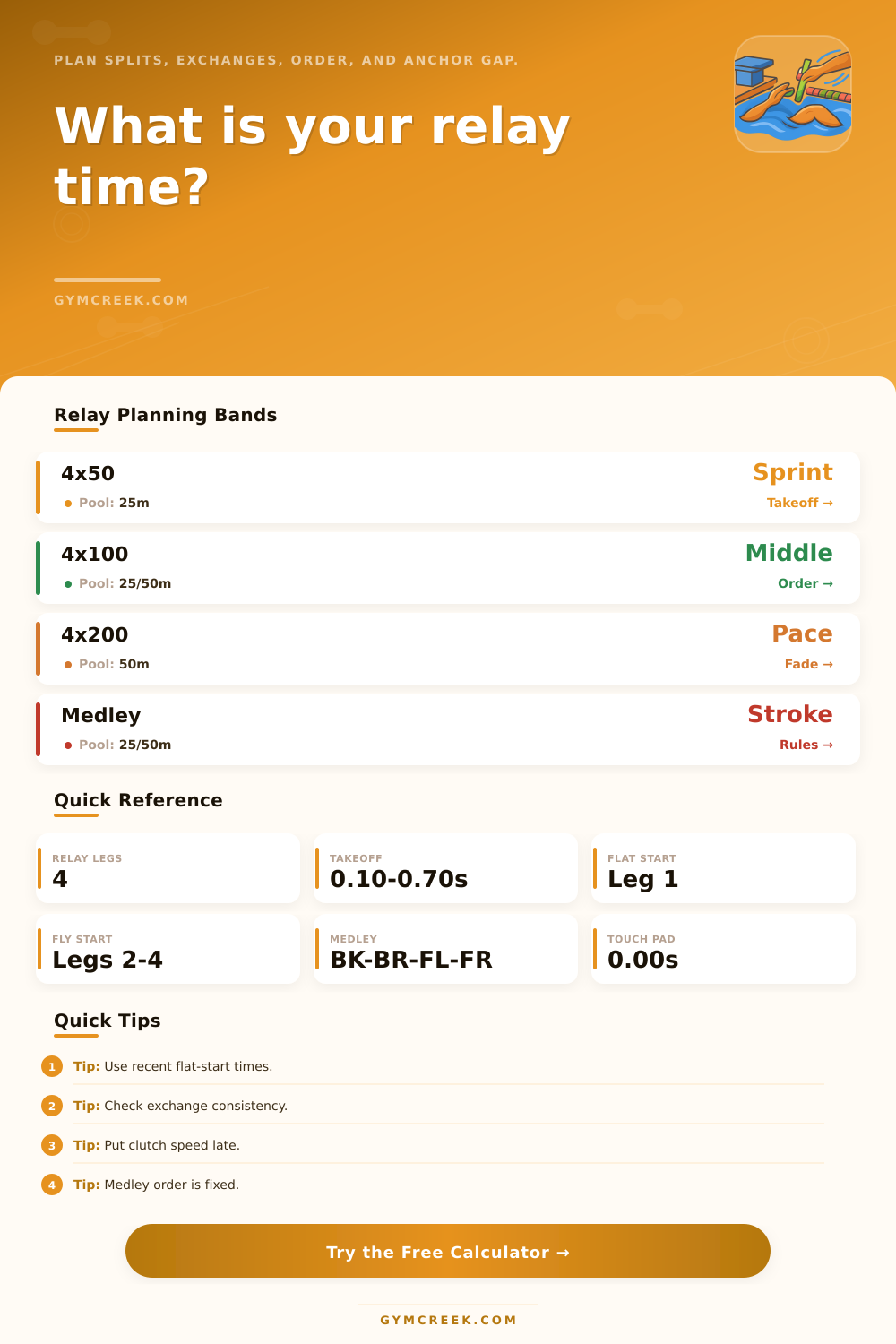
Estimate a four-swimmer relay time from flat-start splits, flying exchange gains, pool format, stroke order, fatigue, and pacing risk.
📌Relay Presets
Presets load realistic relay formats, swimmer splits, exchange risk, and pool setup. Edit any leg to test order changes or anchor decisions.
⚙Relay Setup
🏊Swimmer Legs
Projected relay result
Enter splits and calculate to see total time, exchange gain, gap, and order notes.
📊Relay Benchmarks
📘Reference Tables
| Exchange type | Typical gain | Best use | Risk note |
|---|---|---|---|
| Safe school meet | 0.10 to 0.25 sec | New teams, early season | Low DQ risk |
| Normal racing | 0.25 to 0.45 sec | Most trained relays | Needs touch timing |
| Sharp drilled | 0.45 to 0.65 sec | Championship relay | Requires consistency |
| High-risk chase | 0.60 to 0.80 sec | Last attempt scenarios | Early takeoff danger |
| Decision | Common choice | Why it works | Calculator check |
|---|---|---|---|
| Lead-off | Reliable flat starter | Only legal flat split | Leg 1 has no gain |
| Middle legs | Fast exchangers | Takeoff gain compounds | Legs 2 and 3 gains |
| Anchor | Fast or clutch swimmer | Handles pressure and traffic | Shows adjusted split |
| Medley | Back, breast, fly, free | Rule-fixed stroke order | Use medley event type |
| Component | Formula idea | Applied to | Purpose |
|---|---|---|---|
| Base relay time | Sum of four flat splits | All legs | Starting estimate |
| Exchange gain | Flying gain minus risk penalty | Legs 2 to 4 | Relay-specific speed |
| Fatigue factor | Leg distance and order multiplier | Later legs | Longer event control |
| BMR context | Mifflin-St Jeor equation | Team average | Energy estimate only |
💡Relay Notes
A relay team consist of four swimmers, and the order of the four swimmers impacts the relay team’s total time. A relay team must decide on the order of the swimmers, the exchanges between the swimmers, and the pace at which the swimmers should race to achieve a fast time for the relay team. Coaches for relay team use different arrangement of the swimmers to determine how the arrangement of the swimmers impacts the relay team’s total time.
A right combination of swimmers can produce a relay team with a faster time then the sum of the individual swimming speeds of the four swimmers on the relay team. The inputs that impact the time of the relay team include the flat-start times of each swimmer and the gain in time that each swimmer achieves during their flying start. The lead-off swimmer measures the flat-start time of each swimmer when they leave the blocks from a stand-still start.
Choose Relay Team Order and Exchanges
The other swimmers on the relay team will recieve a running start from the lead-off swimmer. By inputting each swimmer’s flat-start time and by choosing an exchange model, a coach can use the calculator to determine the total time that the flying starts will shave from the total time of the relay team. The exchange models that a relay team can use reflect the practices that the relay team has for their exchanges between swimmers.
A relay team can use a safe exchange model for the relay team or a sharp exchange model for the relay team. The risk exchange model for a relay team allow the relay team to accept the risk of receiving a negative margin for their exchanges so that they can receive a larger potential gain in time for the relay team. The reaction margin for a relay team is the time between the touch of the blocks by the incoming swimmer and the take-off of the outgoing swimmer on the relay team.
A relay team will want to have a small reaction margin to minimize the time spent on the turnover between swimmers but will run the risk of making an error during the exchange between swimmers. Relay fatigue and turn quality is two variables that can impact the total projected time of a relay team. The longer the relay team swims, the more fatigued each of the relay team’s swimmers will be.
The fatigue of the relay team’s swimmers is stronger for the third and fourth swimmers on the relay team. The fatigue factor allow a relay coach to model the impact of fatigue on the relay team. Another variable is the quality of the turns that each swimmer makes in the pool.
The quality of the turn for short course and long course pools will impact the speed of the relay team. By adjusting the fatigue factor or the quality of the turns, coaches can determine whether or not a specific order of the relay team will be effective with each of the tired relay team members. Relay team order use specific patterns to determine in what order to place the relay team’s swimmers in the pool.
The lead-off swimmer should have a strong flat-start time but does not necessarily need the raw speed to be the fastest swimmer on the relay team. The middle swimmers should be individuals who can easily perform exchanges between relay team members and have a lower impact of fatigue impacting there performance. The anchor swimmer for the relay team should be the fastest swimmer on the relay team and be able to handle pressure during the competition.
The relay timer will alert the coach if the fastest flat-start time belong to a swimmer in one of the earlier positions on the relay team. Additionally, if the coach decides to use a medley order for the relay team, the relay timer will indicate this since a medley order cannot be changed during the relay race. The reference tables provide typical gains for each exchange model for a relay team and the logic behind the choices for each position on the relay team.
These tables allow new relay coaches to quickly understand the typical gains that each model will produce and the logic behind the orders for the best relay team performance. The tables will indicate, for example, that a novice relay team should use the safe exchange model and order the swimmers in a conservative fashion yet a championship relay team may use the sharp exchange model and feature their best swimmer in the anchor position. The reference tables allow a relay team coach to remember the decisions without having to remember the coefficients for each exchange model.
In addition to the variables that can be programmed into the relay timer, there are other variables for relay team performance that cannot be captured by the calculator. Such variables include the warm-up of the relay team swimmers, the lane in which each swimmer competes, and the emotional state of the relay team swimmers. Each of these variables can impact the relay team performance differently and can change the outcome of the relay team time.
For instance, a swimmer may exhibit smooth performance during practice but become tense during the relay meet performance. Some swimmers may exhibit their best performance when under pressure for a relay meet but others may struggle under the same time pressures. These variables cannot be captured in the calculator but impact the relay team performance.
Thus, the calculator will provide an indication of the relay time for the relay coach but the actual time may differ. If the projected time is a few seconds from the target time for the relay team, the relay coach has some flexibility in the performance of the relay team but if the projected time is close to the target time, the relay team may need to practice their exchange between relay team members. The energy context card shows the number of calories that each relay swimmer will expend during the relay team race.
The Mifflin-St Jeor equation is used for calculating the calories that each swimmer will expend during the relay but the Mifflin-St Jeor equation will not be used to calculate pacing for the relay team. The number of calories that the relay team will expend will impact the strategy for the relay team for recovery between relay meet sessions. The number of calories that can be burned by the relay team will allow the coach to determine the fuel requirements of the relay team’s four swimmer.
One of the most common mistakes for relay team coaches is to believe that the four swimmers with the fastest times will make the best relay team. The individual speed of the relay team members does not necessarily make the relay team members the best choice for exchange or the anchor swimmer for the relay team. A slightly slower swimmer who can leave the blocks quickly will produce a faster time than a faster swimmer who struggles to leave the starting blocks.
The calculator demonstrates these splits and the gains for each swimmer along with the gap between the projected time and the target split for the relay team. Another common mistake for relay team coaches is to believe that the aggressive exchange models will produce the best relay time. The risk model for relay exchanges will look great on paper but will only work if the relay team members have consistent exchanges during fatigue and during meet competitions.
A safer exchange model will produce the best time for the relay team since it will avoid the risk of a disqualification from the relay team. By using the exchange models within the calculator, relay coaches can view the times produced by each of the models. The goal setting field allows for coaches to decide the overall goal for the relay team.
For example, a goal of utilizing a safe exchange model will produce different results than a goal of the anchor swimmer competing in the relay to chase the fastest time possible for the swimmer. The goal setting will alter the language of the result of the calculations performed by the calculator. For instance, practice sessions will use the safe exchange model to perfect the relay team’s exchanges but races will use the sharp exchange model to prepare for the fastest time possible for the relay team.
This calculator allows coaches to quickly test ideas within the relay team without having to race each of the different combinations of relay team members. The calculator allows the relay coach to set the variables for the relay team and determine the total time for the relay team and the gap between the relay team’s time and the target time for that relay team. By using this calculator, coaches can determine the best relay plan for their relay team members prior to the relay team racing on deck.