Swimming Interval Calculator
Build swim-set send-offs from repeat distance, pace per 100, rest target, reps, course length, stroke, intensity, fatigue, and rounding preference.
📌Named Swimming Interval Presets
Presets load realistic training sets across aerobic, threshold, sprint, IM, distance, masters, kick, pull, race-pace, and triathlon sessions.
⚙Swimming Interval Inputs
Swimming interval snapshot
Enter repeat distance, pace, rest, reps, course length, stroke, intensity, level, fatigue, and rounding to calculate a practical send-off.
📊Swimming Interval Metrics Grid
📑Swimming Interval Reference Tables
| Measure | Value | Per Repeat | Use |
|---|---|---|---|
| Send-off | --- | --- | --- |
| Intensity | Typical Rest | Interval Feel | Best Check |
|---|---|---|---|
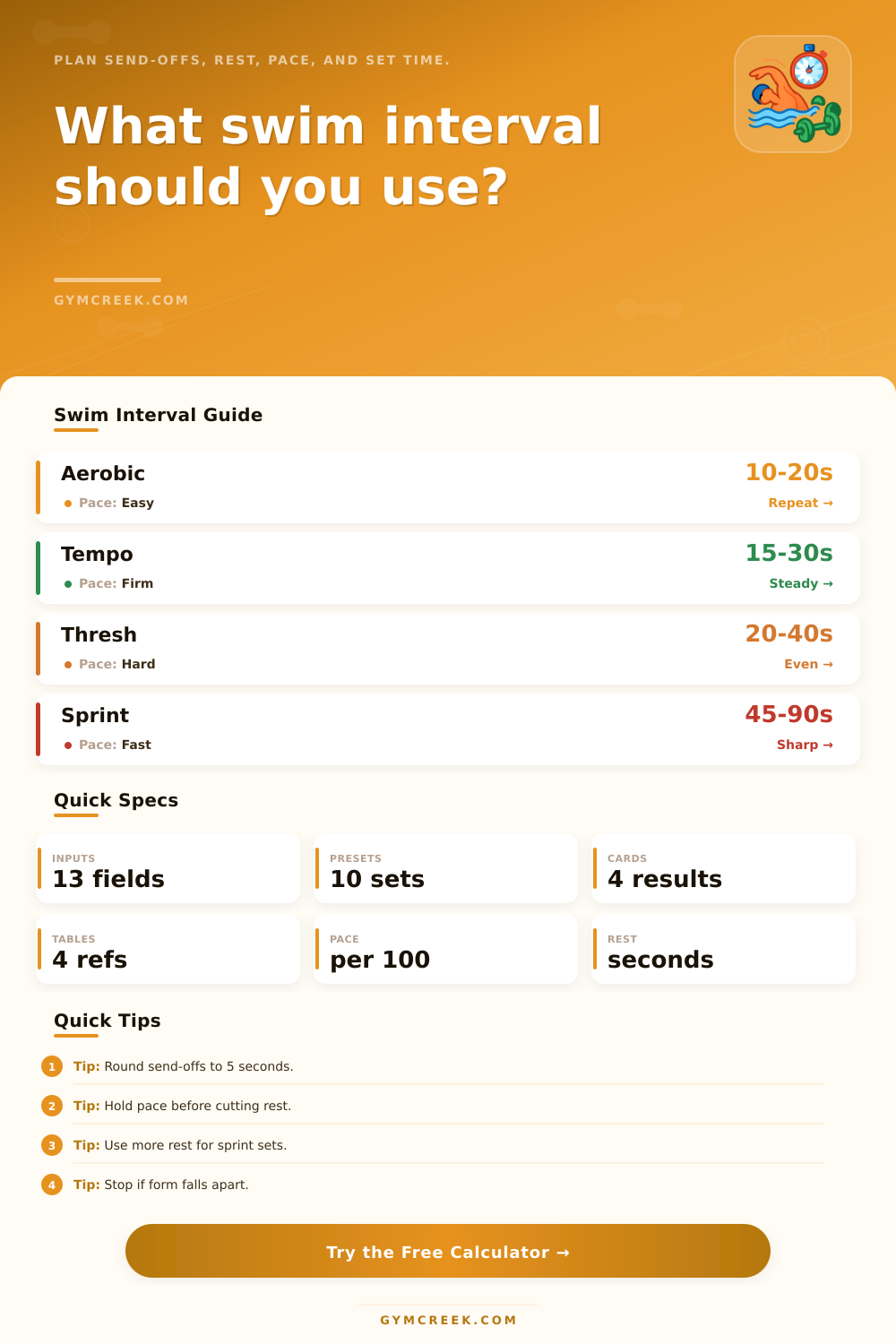
| Recovery technique | 15-45 sec | Loose and accurate | Form stays clean |
| Aerobic endurance | 10-25 sec | Repeatable breathing | Same split all set |
| Tempo pace | 15-35 sec | Firm but controlled | Last third holds |
| Threshold set | 20-45 sec | Hard and repeatable | Small fade only |
| Race pace or sprint | 45-120 sec | Quality over density | Speed stays sharp |
| Pattern | First Third | Middle Third | Final Third |
|---|---|---|---|
| Steady | --- | --- | --- |
| Mode | Rest Bias | Watch For | Interval Cue |
|---|---|---|---|
| Freestyle swim | Baseline | Breathing drift | Even 50s |
| Backstroke swim | Slightly more | Hip timing | Consistent count |
| Breaststroke or fly | More recovery | Power fade | Quality first |
| Kick set | More variable | Leg burn | Hold line |
| Pull set | Often tighter | Shoulder load | Smooth catch |
💡Swimming Interval Tips
The interval you select defines whether the set swims or not. If your interval is too loose, then the swim are easy and doesn’t push you. If your interval is too tight, you begin to miss. Your form deteriorate. You are just trying to survive rather than training. It’s the rhythm between rest and swim that tells a pile of repeat apart from movement that advances fitness.
Plug those figures into calculator up top and it does math for you. All you need to know is the number of reps, what pace you want them at, how long you want to rest, and how far apart you plan to stand from wall. Enter that info and the calculator asks for your current fatigue, intensity level, stroke, and length of pool.
How to Use the Swimming Calculator
Why? All those decisions affects how sustainable that set is going to feel and how much recovery you really require. Freestyle at an aerobic pace requires less recovery time then a butterfly set at race pace. Even if they has the same distances written down on paper. Your fatigue changes the equation as well. If you’re feeling fatigued, you’ll require either less repeats or a little bit more recovery time to maintain quality. If you don’t account for this, you’ll grind out a sloppy swim.
The rounding step have more impact than most realize on actual interval. To keep it practical on deck, we round to the next closest five or ten seconds. But this alters the actual rest you’re getting as well. When your calculated interval falls on some awkward second mark, it rounds up. This gives you a couple extra second of breathing room. And that little cushion might just make the difference between holding pace all the way through the last round or fading out early.
You’ll also notice a risk band and density score in the output. Those numbers will indicate if the set is leaning towards being maximal, demanding, steady, or easy. They’ll also indicate if the balance of volume, pace, and rest are likely to break down or stay steady. Then there are reference tables on the page that present which rest ranges generally go with which intensity, and how that pattern is supposed to feel in the water. Sprint work is more often within a narrower rest window compared to the typical set where the threshold sit has its usual place. Broken or negative split patterns move the pacing recommendation across thirds of the set. It’s all guidance on whether the numbers the calculator spits out match your actualy intended training goal.
That’s where real-world practice provides things the calculator can’t account for. How difficult was your last set? What’s the water temp? Are you swimming in the same lane? All of those thing make a set land different than before.
Bottom line: Run the math, but use first couple rounds as your test. Are you on pace? Does the rest feel appropriate? Great. Go at it. Feeling winded between reps? Not feeling good enough to keep the pace up? Adjust before entire set falls apart. So yes, that feedback loop makes the calculator less of a one-and-done planning device, and more something you should of return to during practice when conditions change.