Swimming Distance Per Stroke Calculator
Calculate swim distance per stroke from distance, stroke count, pool length, time, stroke type, count method, pace target, tempo target, and turn context.
📌Distance Per Stroke Presets
Presets load realistic stroke counts, split times, pool setup, stroke type, push-off distance, target DPS, and session goals for quick comparison.
⚙DPS Inputs
Swim DPS snapshot
Enter distance, time, strokes, pool length, and targets to calculate distance per stroke.
📊DPS Metrics Grid
📑Distance Per Stroke Reference Tables
| Measure | Raw Value | Per Length | Use |
|---|---|---|---|
| Distance per stroke | --- | --- | --- |
| Stroke | Controlled Set | Race Set | Watch Point |
|---|---|---|---|
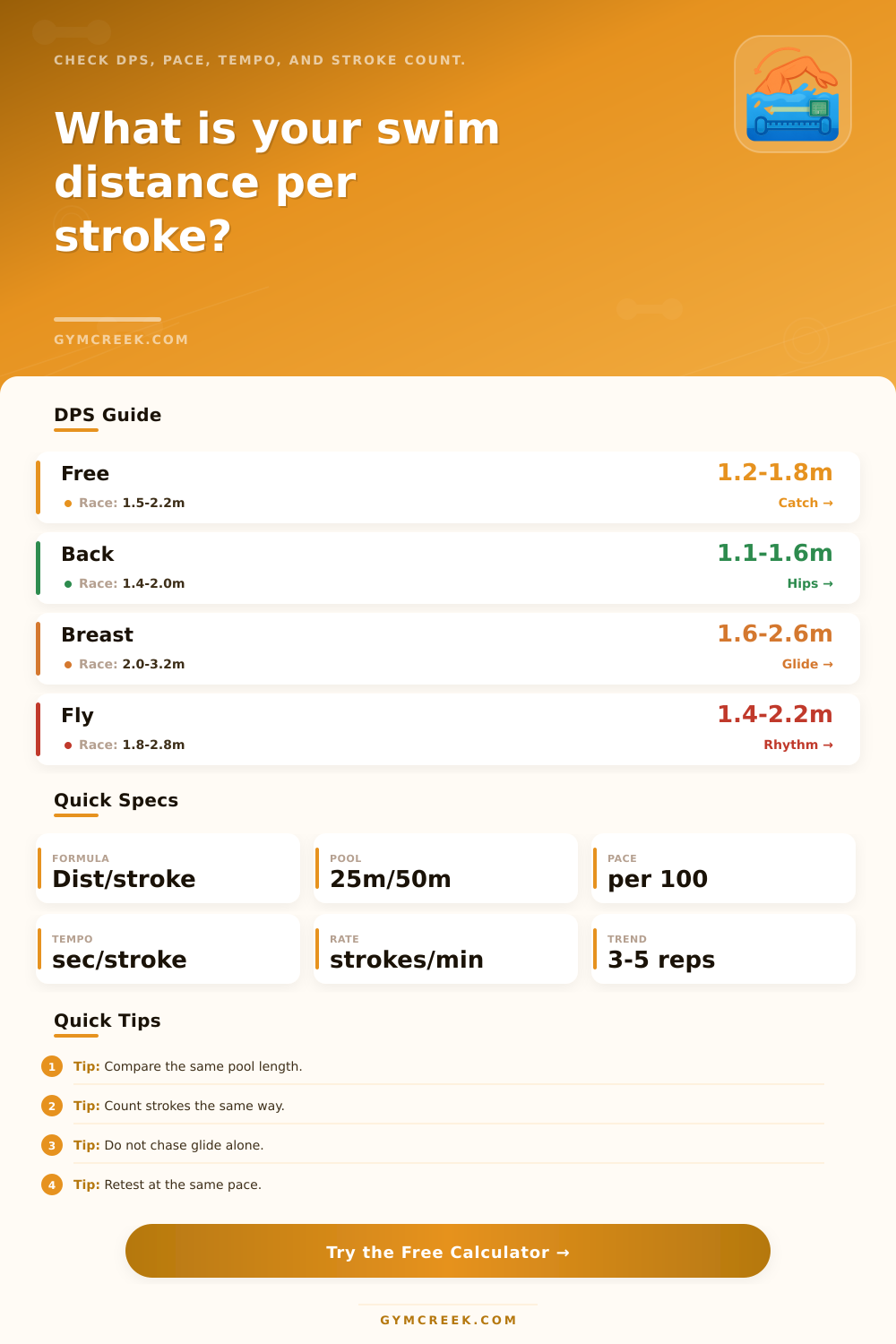
| Freestyle | 1.20-1.80 m or yd | 1.50-2.20 m or yd | Short catch if rate rises |
| Backstroke | 1.10-1.60 m or yd | 1.40-2.00 m or yd | Wide entry and low hips |
| Breaststroke | 1.60-2.60 m or yd | 2.00-3.20 m or yd | Glide that turns into a stall |
| Butterfly | 1.40-2.20 m or yd | 1.80-2.80 m or yd | Rhythm loss before power loss |
| Pattern | Likely Meaning | Useful Change | Retest Cue |
|---|---|---|---|
| High DPS | --- | --- | --- |
| Session Goal | DPS Bias | Tempo Bias | Best Check |
|---|---|---|---|
| Technique length | Higher than normal | Controlled | Same pace, fewer strokes |
| Aerobic efficiency | Stable | Repeatable | Average across repeats |
| Threshold pace | No collapse | Firm | Last repeat matches first |
| Sprint turnover | Enough water held | High | Speed rises without slipping |
| Race rehearsal | Race specific | Race specific | Pace under fatigue |
💡DPS Tips
Technical sounding but a number that matters: Swimming Distance Per Stroke refers to how far forward in the pool you move with every pull. When it go down, you are working harder for equal distance. When it rises or holds and your speed remains constant, you have found something valuable. Why? And what makes it rise? Knowing the answer is key to finding an effective adjustment for your style of swimming.
When swimming most people don’t really give a lot of thought to their stroke count. Freestyle and backstroke are typically done with one hand entry, while butterfly and breaststroke is easier to count by full cycle. Selecting which method you use will automatically convert for you on the calculator. It’s nice if you’re comparing swim sessions or switching strokes because it eliminates guessing. Keeping the count rule constant between tests is where it shows its real value.
What Is Distance Per Stroke?
How much pool length affects the result is greater then most realize. You get more wall per given distance in a 25 meter pool vs a 50 meter pool and every wall is another push off which extend your raw distance per stroke. Take out that wall-assisted distance and you’re left with a cleaner number that represent more accurately how your stroke is performing in open water. When you input the estimate of push off and pool length into calculator, it accounts for this so that you can make comparisons between different facilities using fair numbers.
Distance per stroke trades off with pace and tempo in ways that is hard to see in the course of a workout. Pushing the tempo up too far often leads to a shorter stroke but it feels like you’re working harder. Concentrating only on lengthening your stroke leads to pace slipping away as you have more time to “glide” which becomes dead time. The useful middle ground seems to be where both numbers go up together. Neither should of collapse while the other is getting better. A check of this balance after a repeat or two tell you if what you’ve done is real or simply a feel good adjustment.
The other variables are fatigue/effort as well. Even with good looking form on camera, that hard set late in practice will typically produce less distance per stroke. That’s not failure. That’s data. That’s telling you something about how your stroke perform when you’re fatigued. Often it’s that moment during a race that counts the most. Use the calculator to score your effort and fatigue, then see if your later repeats is getting harder for predictable reasons.
This means the context is provided by the reference ranges, but they are not meant to be hard targets. For example, the butterfly stroke isn’t the same as freestyle and both aren’t the same as breaststroke. None of those strokes is performed at an easy pace the same way they are at race effort. Each stroke has a unique propulsion pattern with a unique rhythm. The calculator uses the right band for you based off your session goal and stroke type, so the results stay accurate instead of forcing everyone toward the same number.
Best to think of tool as a comparison device, not a scoreboard, and use it repeatedly. Run the same amount at the same effort a few times, notice the conditions, and see if the numbers go in direction you hoped they would. Dramatic one-off spikes don’t compound as fast; small consistent gains do. And the calculator just takes out the arithmetic to keep comparison clear.