Swimming Distance Calculator
Total pool lengths, laps, yards, meters, open-water correction, stroke type, swim time, and pace into clear distance totals for lap swimming, triathlon practice, and mixed pool sessions.
📌Swim Presets
Presets load common lap-pool and open-water distance scenarios. Edit pool length, count mode, stroke, correction, or pace after loading.
⚙Calculator Inputs
Swimming distance snapshot
Enter pool length, count, stroke, pace, and time details to calculate your swim distance.
📊Swim Metrics Grid
📘Reference Tables
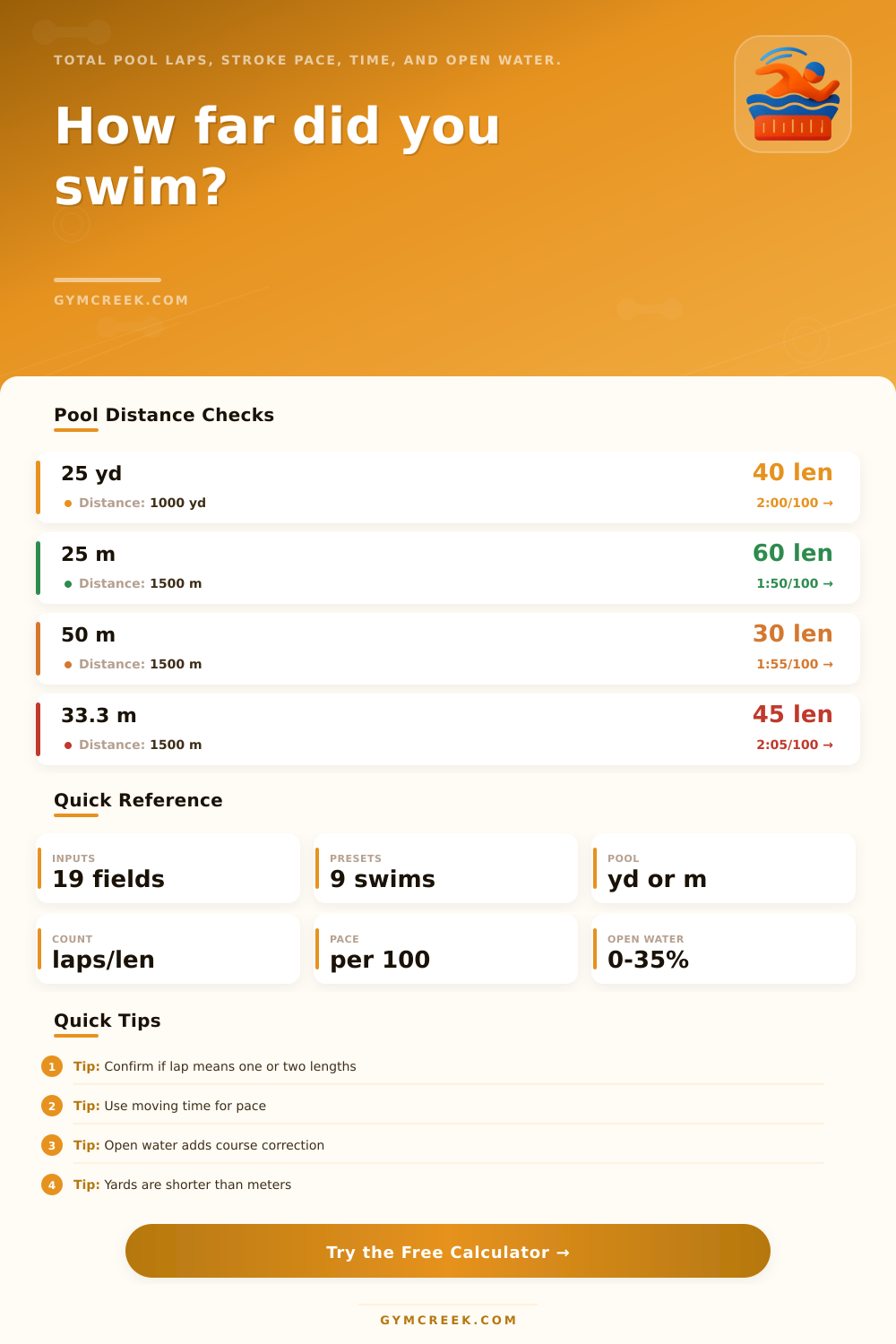
| Pool | 40 lengths | 60 lengths | 80 lengths |
|---|---|---|---|
| 25 yd | 1000 yd | 1500 yd | 2000 yd |
| 25 m | 1000 m | 1500 m | 2000 m |
| 33.3 m | 1332 m | 1998 m | 2664 m |
| 50 m | 2000 m | 3000 m | 4000 m |
| Distance | Meters | Yards | Use |
|---|---|---|---|
| Short set | 400 m | 437 yd | Warmup |
| Sprint tri | 750 m | 820 yd | Race check |
| Metric mile | 1500 m | 1640 yd | Pool goal |
| Iron swim | 3800 m | 4157 yd | Long event |
| Stroke | MET | Distance note | Pace read |
|---|---|---|---|
| Freestyle | 8.3 | Efficient | Fastest common |
| Backstroke | 7.0 | Steady | Technique driven |
| Breaststroke | 10.3 | High effort | Slower pace |
| Butterfly | 13.8 | Very high | Short repeats |
| Formula | Inputs | Output | Purpose |
|---|---|---|---|
| Pool distance | Length x count | Distance | Lap total |
| Pace distance | Time / pace | Distance | Missing count |
| Open water | Distance x % | Adjusted | Course drift |
| Calories | MET, kg, time | kcal | Fitness context |
💡Calculation Tips
Swimming distance are a variable measurement because there are two different measurements for pool length and swimming conditions. Forty length can be swam in a twenty-five yard pool, but forty lengths could also be swam in a fifty-meter pool. These two distance would not be the same.
Distance is important in that training plans depends upon the distance measurement. If the distance isnt accurately entered into the calculator, then the training plan will not be accurate, as will the decisions regarding recovery from that swimming session. Pool length is one of the primary variables in calculating distance.
What Affects Swimming Distance
The length of a length in a short-course yard pool will be less than the length of a length in a long-course meter pool. You must enter the length of the pool and the unit of measurement into the calculator to calculate the distance swam. Additionally, the distance could be defined as one direction of the pool or it could be defined as two direction (a lap).
If the distance is defined as one length, then it is half the distance of defining a lap as two lengths. The type of stroke chosen for swimming will impact the distance swam and the amount of energy used while swimming. Freestyle will move the swimmer a more greater distance than swimming breaststroke.
Additionally, breaststroke may use more energy than other stroke because it creates more resistance. The calculator will account for the stroke that is swam. The distance swam isnt the same as the energy used if different stroke are used.
Open water swimming presents different variables than swimming in a pool. Swimming in open water presents the variable of sighting and currents in the body of the swimmer. These two variables will impact the distance swam in a straight line in the water, so a percentage can be entered to adjust for these variable.
This percentage is an optional entry in the calculator so as to not change the exact distance logged for pool swims, but can be a helpful variable for swimmers who would like to compare their open water swims to there pool swims. Pace and time will be factors in calculating distance if the number of lengths swam is not known. If the swimmer enters the length swam and the time swam into the calculator, the calculator can calculate the distance.
For instance, if a swimmer swims for twenty minutes at a two-minute-per-hundred-yard pace, the distance can be calculated. Additionally, the pace determine the effort zone swam by the swimmer. This effort zone does not describe the swimmers performance, but it does make it possible to see the swimmers effort during the session.
Variables such as warm-up lengths and cool-down lengths adds to the total distance swam. Many swimmers dont consider that the lengths used to warm-up or cool-down could make up a percentage of the total distance swam. Thus, it is important to include warm-up and cool-down distances in the total distance swam.
Additionally, any number of intervals will add to the total distance by simply multiplying the lengths by the number of intervals completed. The energy estimate is different than the distance swam. The energy estimate is used to relate the swim to the swimmers daily needs for calories.
The energy calculation does not take into account the swimmers age, weight, or activity level needs. Thus, while the energy calculation may be helpful to understand how many calories is related to the swimming distance, it should of not been used to plan the swimmers diet. Common mistakes are made in calculating distance due to the use of different definitions for length and lap.
Some swimmers use different pools without adjusting for the differences in length between pools. Other swimmers use different strokes without accounting for the difference in energy used. While the calculator does not prevent these mistakes from happening, it does allow swimmers to see the consequence of making these mistakes.
Many competitive swimmers use different pools and strokes during the season. For example, triathletes may use short-course meters to perfect their strokes, but use open water to simulate the conditions of the race. Masters swimmers may use different strokes to avoid straining their shoulders.
The calculator accounts for these different swimming variables so that the swimmer can accurately track their distance, fatigue, and recovery during the season. The distance swam can change based off different factor. For instance, a distance goal of fifteen-hundred meters can be different in a pool and in open water.
Additionally, swimming breaststroke for a certain distance will fatigue the swimmer differently than swimming freestyle for the same distance. These factors should be considered so that the swimmer can adjust for their next swim. If they dont adjust for these variable in their next swim, their results will likely be the same as the variables introduced during the swim that is being considered.