Swimming Conversion Calculator
Convert a swim time between yards and meters, SCY, SCM, LCM, custom pool lengths, pace per 100, and adjusted target times using course, turns, stroke, start style, and training conditions.
📌Swimming Presets
Presets load full swimming scenarios with course, distance, time, pool length, stroke, turn quality, and adjustment settings. Edit any field after loading.
⚙Conversion Inputs
Converted swimming time
Enter source time, source course, target course, stroke, and pool conditions to estimate the converted result.
📊Conversion Metrics
🏊Pool Conversion Snapshot
📑Reference Tables
| Course | Pool length | Race unit | Conversion note |
|---|---|---|---|
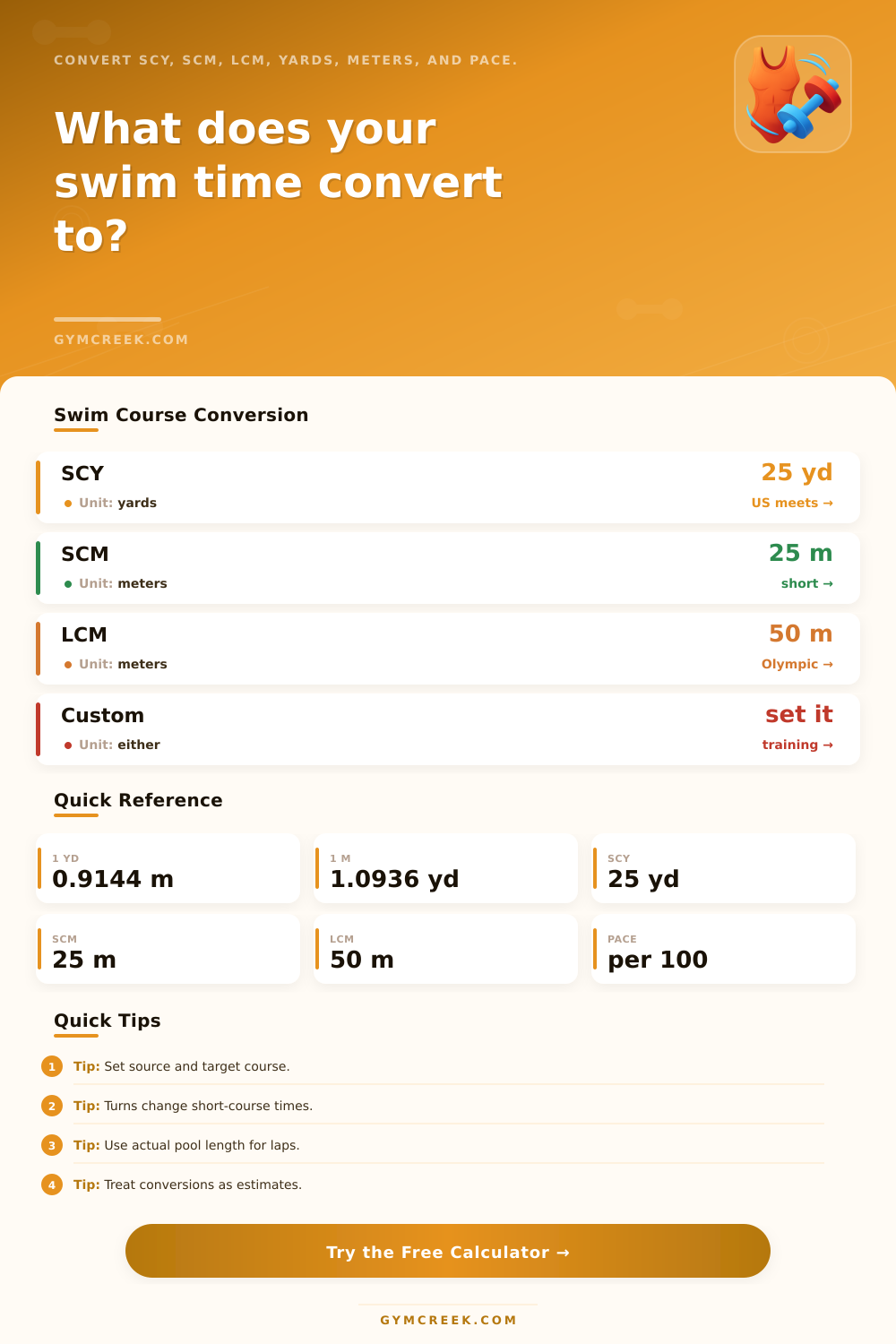
| SCY | 25 yards | yards | Short-course yards, common in U.S. school and college meets. |
| SCM | 25 meters | meters | Short-course meters; more turns than long-course meters. |
| LCM | 50 meters | meters | Long-course meters; fewer turns and longer uninterrupted swimming. |
| Custom | User set | either | Best for odd-length pools, lap planning, and practice logs. |
| Distance | Meters | Yards | Use |
|---|---|---|---|
| 25 yd | 22.86 m | 25 yd | SCY length |
| 50 m | 50 m | 54.68 yd | LCM length |
| 100 yd | 91.44 m | 100 yd | SCY sprint |
| 100 m | 100 m | 109.36 yd | meter sprint |
| Stroke | Base turn | Short-course effect | Caution |
|---|---|---|---|
| Freestyle | 0.85 sec | Strong | Flip turns and underwaters matter. |
| Backstroke | 0.82 sec | Strong | Back-to-breast turns vary in IM. |
| Breaststroke | 0.58 sec | Moderate | Pullout timing changes the effect. |
| Butterfly / IM | 0.70 sec | Moderate | Stroke rules and fatigue can dominate. |
| Setting | What changes | Typical size | Best use |
|---|---|---|---|
| Distance only | Length conversion | Exact math | Pure yards to meters pace work. |
| Course adjusted | Turns plus course | Small to medium | Race-time comparison. |
| Pool condition | Practice drag | 0 to 6% | Shared lanes or open water logs. |
| Start style | Block or push | 0.4 to 1.2 sec | Practice-to-race correction. |
💡Swimming Conversion Tips
Swimming conversions is necessary in situations where an individual wants to compare the times of individuals who swam in different pool. For instance, a swimmer may have raced a 100-yard freestyle in a short course pool, but may want to compare there time to a 50-meter pool. In these situations, the swimming conversion calculator account for the fact that there are different elements to the pools that may impact the time that a swimmer will record.
For instance, some pool have more walls than others, which provides swimmers with more opportunities for turns and push-offs. To use the calculator, an individual must input information about the source pool that the swimmer raced in, the target pool that they wish to compare the time to, the distance that was swam, and the time that the swimmer recorded for that distance. Each of these factors have an impact upon the time that the swimmer will be given as a result of the calculation.
How to Use a Swimming Time Conversion Calculator
For instance, short course yards pools provide more walls for a swimmer to push off of than long course meters pools, which can lead to slower times for pools with fewer opportunities to push off of the walls. The time difference between pools may be more pronounced for some strokes than others; freestyle and backstroke races will feature more use of the walls than breaststroke and butterfly races, as the rules for freestyle and backstroke allow for a swimmer to swim underwater after each wall. The calculator also features a field for the quality of the turns that a swimmer use in each pool.
Swimmers who use their walls more efficient will lose more time when moving from short course to long course pools than those who do not use their walls efficiently. However, the time difference between these two types of pools may appear small for a swimmer for a single race, but if that swimmer competed in a 200 or 400 yard event, those differences in time will become more prominent. The calculator allow individuals to account for this factor with the turn quality setting.
In addition to the quality of the turns that a swimmer sets when competing in a race, the condition of the pool may impact the time that a swimmer sets. For instance, a swimmer may race in a lane that is relatively clear of other swimmers, but in other pools the swimmer may encounter other swimmers in the same lane, creating drag upon the swimmer. The calculator accounts for the condition of the lane in which the swimmer raced.
Altitude may also impact a swimmer’s times. The thinner air at high altitudes affect the oxygen that the body receives and how quickly the body can recover. The swimming conversion calculator also accounts for altitude, though only if the distance and the altitude reach certain thresholds.
Additional fields in the calculator allow for an individual to input the body size of the swimmer. While these fields may be used to make estimates of the energy that a swimmer will consume during a session, those fields is not used as a means of determining times for those swimmers. For instance, taller individuals may travel the distance with fewer strokes than shorter individuals, but that impact upon performance is outside of the scope of the time calculation of the conversion calculator.
Finally, the activity level for the swimmer can be accounted for. A high school swimmer may feature different notes in the calculator than a masters athlete, for instance, because a time that may be competitive for one group of swimmers may not be competitive for another. Many individuals make the mistake of not accounting for the different ways that the body may utilize the walls of the pools in which they are racing.
Another mistake may be in the assumption that all strokes are the same in their responses to turns; breaststroke and butterfly races will feature different impacts of the loss of turns than will freestyle or backstroke races. These factors are accounted for in the calculator. The reference tables that are provided in the calculator include the lengths of the pools, as well as the assumption regarding the use of the turns in each of the pools.
These reference tables dont need to be memorized by the individual using the calculator, but are provided as a means of understanding the impact of the distance that is swam upon the times of the swims. For instance, the tables help to show why a 100 yard distance may have a different time conversion than a 200 yard distance. Additionally, the tables indicate the difference in time between a distance that includes turns and one that does not.
The factors that are listed in these reference tables are general; the meets that may publish factors that may differ from those listed in the calculator. While the calculator may provide a swimmer with a conversion factor for the times that they set in their own races, the calculator does not provide an official factor for swim meets. Thus, the calculator may be used to plan training sets, to compare one’s performances to others in swimming, and to determine how long it would take to swim in one pool compared to another.
However, if an individual is competing in a race that requires a specific time to qualify for entry into the event, that individual should of refer to the actual packet that is published for the race to determine the time requirement for entry. Thus, one of the main values of this conversion calculator is the removal of guesswork in swimming performances; by removing guesswork from swimming, an individual can focus upon their training and racing in the pool.