Calories Burned Swimming Calculator
Estimate swim calories from body weight, stroke, pool distance, pace, intensity, rest intervals, and open-water conditions.
📌Swim Presets
Presets load realistic combinations of body weight, stroke, pool setup, duration, pace, rest interval, water conditions, and weekly frequency.
⚙Calculator
Swimming calorie snapshot
Enter your swim details and calculate burn, distance, pace, and efficiency.
📊Swim Metrics
📑Reference Tables
| Stroke | Easy | Moderate | Hard |
|---|---|---|---|
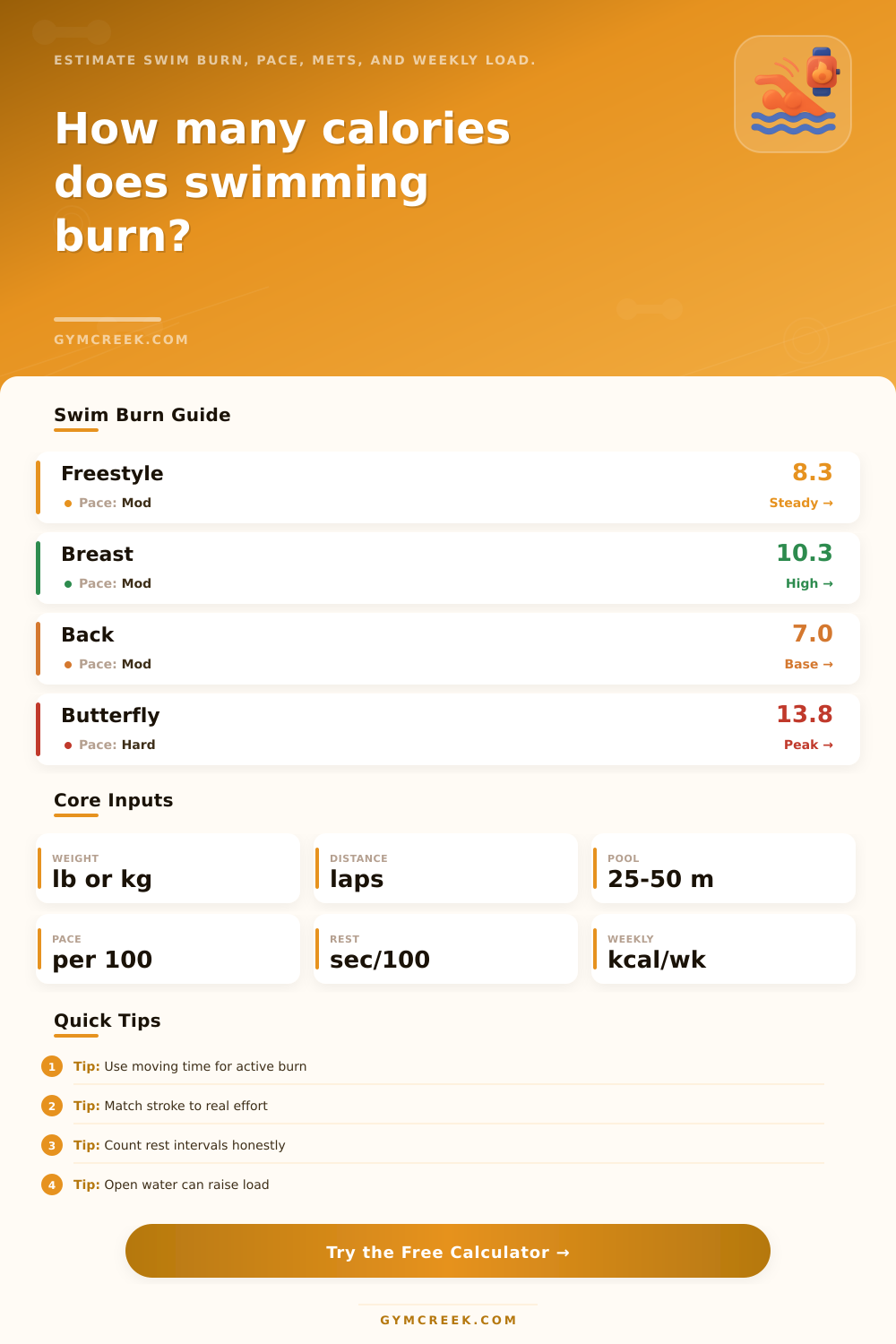
| Freestyle | 6.0 | 8.3 | 9.8 |
| Breaststroke | 8.3 | 10.3 | 12.0 |
| Backstroke | 4.8 | 7.0 | 8.5 |
| Butterfly | 11.0 | 13.8 | 15.0 |
| Pool | 40 lengths | 60 lengths | 80 lengths |
|---|---|---|---|
| 25 yd | 1000 yd | 1500 yd | 2000 yd |
| 25 m | 1000 m | 1500 m | 2000 m |
| 50 m | 2000 m | 3000 m | 4000 m |
| 33.3 m | 1333 m | 1998 m | 2664 m |
| Pace per 100 | Feel | Typical use | Rest cue |
|---|---|---|---|
| 3:00+ | Easy | Technique | Short rest |
| 2:00-3:00 | Moderate | Fitness laps | 10-20 sec |
| 1:25-2:00 | Hard | Intervals | 15-40 sec |
| Under 1:25 | Race | Sprint set | Full quality |
| Condition | Factor | Why it changes | Use for |
|---|---|---|---|
| Drafting | 0.96 | Less drag | Group pool |
| Wetsuit assist | 0.97 | Buoyancy | Open water |
| Calm open | 1.05 | Sighting | Lake swim |
| Current or chop | 1.12+ | Extra drag | Rough water |
💡Tips
Swimming is an exercise that involve a person moving through waters. Swimming is also an exercise that involves the use of resistances from the water against the swimmer. Because water is a dense medium, it both assist in the movement of the swimmer, but also require the swimmer to utilize energy in order to move through the water.
The amount of energy that is used during a swim session is not a fixed number; rather, the amount of energy that is used during a swim session changes based off several different factor. One factor that change the amount of energy that is used during a swim session is the weight of the person who is swimming. A person who have a higher body weight will have to move more mass through the water than a person who has a lower body weight.
What Changes How Much Energy You Use When You Swim
Moving a large mass through the water require more energy than moving a small mass through the same medium. Another factor that changes the amount of energy that is used during a swim session is the stroke that the person uses when swimming. For instance, freestyle is a stroke that requires a moderate amount of energy to be utilized by the swimmer.
However, the butterfly stroke require nearly twice the amount of energy that is required to use freestyle; butterfly strokes require the swimmer to constantly move their limbs and the rest of their body. Similarly, the breaststroke also requires a moderate amount of energy to be utilized by the person who is swimming; however, more energy is often require for breaststrokes than the average person may expect from the breaststrokes appearance and movement. Thirdly, the structure of the swim session will change the amount of energy that the swimmer uses during that session.
For instance, a continuous period of swimming without any rest periods will burn calories differently than a swim that includes rest periods. During periods of rest, a persons metabolism drop; lower metabolic rates mean that less total energy is burned during the session. Thus, a person must differentiate between the total amount of time that they are in the swimming pool versus the total amount of time that the person is actively swimming.
Fourthly, open water swimming sessions will change the amount of energy that a person uses during that session. Open water swimming requires different movements from swimming in a swimming pool. Movements like sighting and course correction require the swimmer to perform energy.
Additionally, the swimmer may be using a wetsuit that provides buoyancy to the swimmer; buoyancy can reduce the amount of energy that the swimmer has to use. However, the same water conditions that provide buoyancy may also include waves or currents that increase the amount of energy that the swimmer must use. Thus, open water swimming can be different than swimming in a swimming pool.
Fifthly, the pace at which an individual swims and the intensity of their swimming sessions will impact the amount of energy that is used during those sessions. Swimming at a slow pace will burn fewer calories than high intensity sprint of swimming. Thus, a swimmer can increase the intensity of their swims to increase the amount of energy that they will use during those sessions.
Additionally, using a calculator can help to track energy use during swimming sessions. A calculator can help a person to avoid having to estimate the energy levels that the person themselves uses during swimming. The planning of the swimming routine each week also requires precision.
For instance, swimming three sessions of moderate intensity will produce different results than five swimming sessions of shorter duration that include more rest by the swimmer. Thus, a person should track the distance that is swam and the amount of energy that is used during the swimming sessions to determine if additional swimming sessions should be added to the persons weekly plan. A swimmer may also utilize an efficiency score to determine if the swimming sessions that the swimmer performs are providing the expected value for the energy and effort that the swimmer invested into these sessions.
A low efficiency score for the swimmer may indicate that the swimmer rests too much during swimming sessions, or that the swimmer swims at too slow of a pace for the amount of energy that is expected to be used. To increase an efficiency score for swimming, the swimmer may decrease the number of rest periods that are taken during swimming sessions, or may change swimming strokes to those that require the swimmer to use more energy. Small adjustments to swimming routines are important to make over the long term training cycle of a swimmer.
A person who swims at the same sustainable rate each week will experience improvements in their body composition and aerobic capacity; however, a person who only swims at high intensities from time to time will not see the same improvement. Thus, a swimmer should of utilized a calculator to make these adjustments visible to themselves, as the calculator enables a person to become aware of the pattern that they should form as part of their swimming routine without the need to utilize manual conversion tables. The same logic that can be applied to energy use while swimming can also be applied to weight management plans for individuals.
Seeing the impact that changes to a swimmers rest, stroke, and water conditions can have upon their total weekly energy use provides insight into the energy that is being used by the body while swimming. Thus, this visibility into energy use during swimming allows a person to transform their intention to swim into a plan of action to swim regularly.