Sweet Potato Carb Calculator
Estimate sweet potato total carbs, fiber, net carbs, cooked yield, raw equivalent, portion size, and target fit from weight, form, peel, variety, and cooking method.
📌Sweet Potato Presets
Presets estimate edible sweet potato weight. Raw-basis entries use moisture yield, while cooked-basis entries use cooked carb density for the selected method.
⚙Calculator Inputs
Sweet potato carb snapshot
Enter weight, cooking method, peel status, variety, and targets to estimate your serving.
📊Sweet Potato Metrics
📑Reference Tables
| Portion | Weight Basis | Total Carbs | Fiber |
|---|---|---|---|
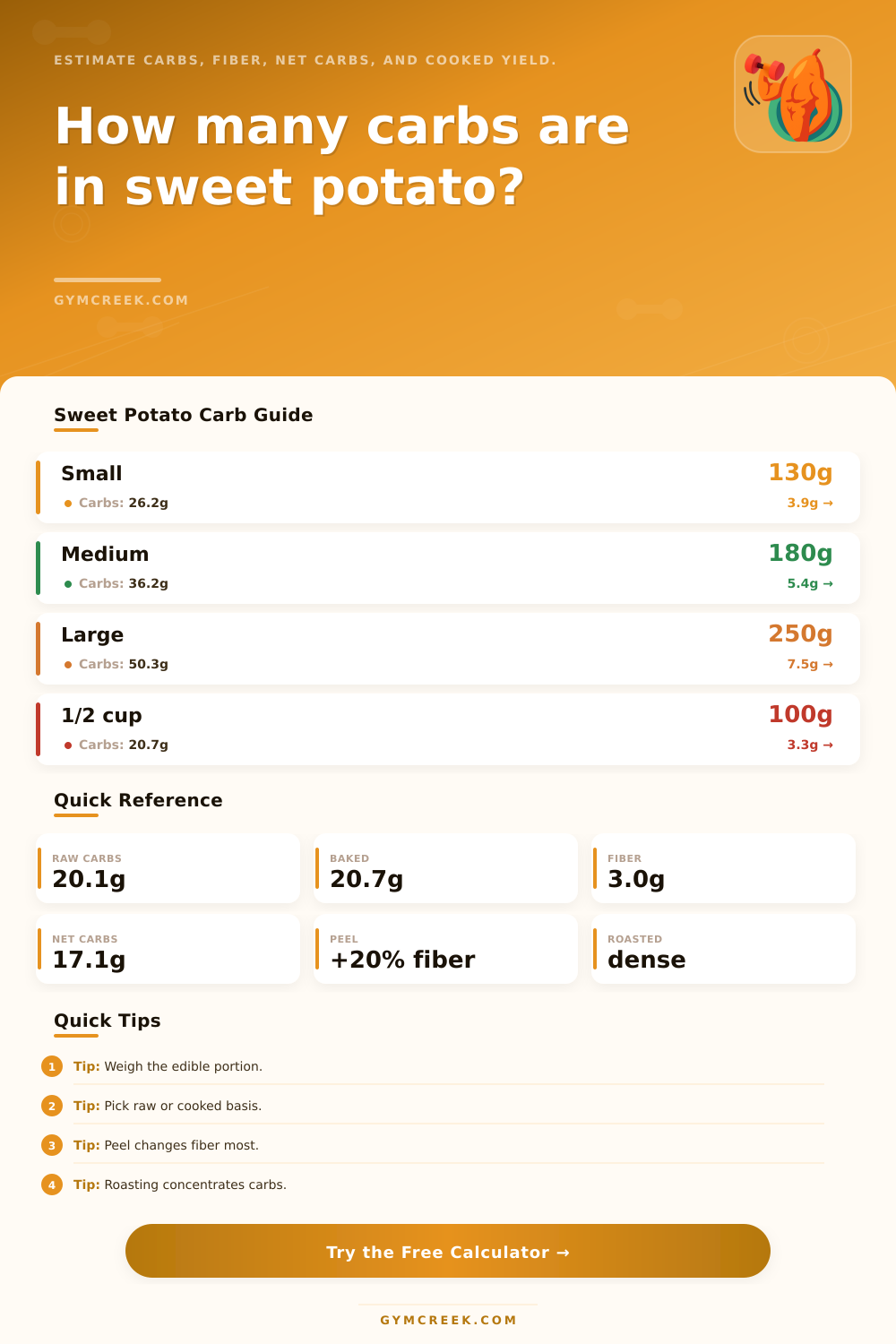
| Small whole potato | 130 g raw | 26.2 g | 3.9 g |
| Medium whole potato | 180 g raw | 36.2 g | 5.4 g |
| Large whole potato | 250 g raw | 50.3 g | 7.5 g |
| 1/2 cup mashed | 100 g cooked | 20.7 g | 3.3 g |
| 1 cup cooked cubes | 150 g cooked | 30.8 g | 4.8 g |
| Cooking Method | Yield From Raw | Carb Density | Use Note |
|---|---|---|---|
| Raw reference | 1.00 | 20.1 g/100 g | Food scale baseline |
| Baked whole | 0.78 | 20.7 g/100 g | Moisture loss |
| Roasted cubes | 0.70 | 24.0 g/100 g | Most concentrated |
| Boiled pieces | 1.02 | 17.7 g/100 g | Water gain |
| Steamed pieces | 0.94 | 19.6 g/100 g | Moderate change |
| Mashed plain | 0.90 | 20.7 g/100 g | Use cooked weight |
| Type | Carb Shift | Fiber Shift | Best Entry |
|---|---|---|---|
| Orange flesh | Baseline | Baseline | Whole or cubed |
| Purple flesh | Slightly lower | Slightly higher | Steamed weight |
| Japanese type | Higher starch | Average | Baked weight |
| Garnet or jewel | Slightly higher | Average | Baked whole |
| Canned drained | Lower density | Lower fiber | Drained grams |
| Peel Status | Fiber Effect | Net Carb Effect | Accuracy Note |
|---|---|---|---|
| With peel | Full fiber | Lower net | Best for baked whole |
| Mixed batch | Moderate fiber | Small change | Average the batch |
| Mostly peeled | Reduced fiber | Net carbs rise | Common for mashed |
| Fully peeled | Lowest fiber | Highest net | Use edible grams |
💡Tips
There it is, sitting there in your pantry, staring up at you: A medium orange sweet potato. It appears harmless, but you know better. You know its nutrition is far more complex than what can be captured by its humble cylindrical form, because baking it versus boiling it makes a dramatic difference to nutrition. Mash it with some butter? Ditto. Its fiber content (carbs) is not written in stone; it varies based on the variety of flesh, peel retention, and even its own water content. If you’re watching energy for an afternoon run or net carbs for a low glycemic diet, getting this right matters.
The disconnect occurs when most folks just select a random number they found on the internet without considering how the dang potato was cooked. Boiling water and absorbing it dilutes amount of carbs per gram of that sweet potato. Roasting moisture out of it, however, concentrates that same amount of carbs into a more dense bundle. So if you input the database value for “sweet potato” assuming it’s still raw, but then eat it after roasting, your estimates will be way off.
How Cooking and Skin Change Sweet Potato Nutrition
Once you enter your own peeling-and-cooking status (see image above), the calculator does the math for you; saving you from having to guess about whether you’re losing or gaining water, which would mess up your numbers.
How about the skin? Dieters will often remove it because they think it contains too many calories for its size. Wrong again. Skin contain an unusually large amount of dietary fiber for its weight. Fiber help slow down digestion and blunt the rise in blood sugar. That’s why we subtract it out when calculating net carbs (it’s not “actual” carbohydrate). By removing all of the skin, you’re raising your net carbs (not so good), while simultaneously decreasing a primary source of satisfaction (very bad). You feel as if you’ve eaten less, but in terms of metabolic effect it has an even greater and swifter impact. Keeping the skin intact slows the blood sugar spike, which is precisely why nutritionists who want sustained release of energy recommend whole potatoes.
There is also some subtle variation at play here. Orange-fleshed varieties are generally higher in beta-carotene. Purple varieties can have various other types of antioxidants and may also differ slightly in their starch structure. And Japanese sweet potatoes often contain more resistant starch, which acts similarly to fiber in the gut by resisting immediate digestion. All these differences aren’t going to drastically change the overall number of carbs per hundred grams, but they will affect the way your body absorbs that fuel over time. So if you’re particularly sensitive to blood sugar swings, sticking to a starchier, drier variety could help keep things steadier from meal to meal.
One potato is a snack or a meal, depending on the context. Sometimes we need fast digesting carbohydrates after workouts in order to quickly top off our depleted glycogen stores. On days like those, a mashed (and peeled) sweet potato does its job well and effectiveley. Maybe post workout you’re looking for something similar to fill out what you just burnt away. But, when it comes to maintaining weight over time, or when you’re attempting to maintain relatively low insulin during the day, you’d prefer the minimally processed, whole, fibrous form of potato.
This little switch moves through those contexts so you can see not only the nutrient data of that particular spud, but also the role it plays within the rest of your day’s goals.
We can easily reduce food logging to an exercise in arithmetic: every gram matters, down to the last digit, measured with military precision. But our metabolisms aren’t spreadsheets. They don’t respond to decimal places on labels; they’re influenced by preparation techniques, overall load, and patterns. The calculator comes with reference tables that outline average densities and yields, providing a sanity check against what’s showing up on your scale. Calibrate your expectations using those as benchmarks, not as absolutes.
All this comes down to a consistent approach to meal prep and measurement. Raw weight of what goes into the pot is going to give you most reliable starting point. This is because it changes a lot depending on how long things cook and at what temperature. That’s why using only raw weights in your log will ensure that your readings remain apples-to-apples from month-to-month and week-to-week. Using cooked weight measurements adds too many variables. Unless each one is done exactly the same way every time, there is no way to make sense of them. After you develop a routine then they can be used as meaningful feedback instead of white noise.
When you know exactly which fuel source you are planning for, a simple root vegetable is no longer just a vague carbohydrate. It becomes something you have power over. You get to decide whether or not it impacts your day. Guesswork becomes management; meal preparation shifts from a chore to a strategy. And each bite does exactly what you want it to do.