Surfing Calorie Calculator
Estimate surfing calories from paddling time, wave attempts, waves caught, ride length, duck dives, board choice, wetsuit load, and ocean conditions.
📌Presets
Each preset loads a named surfing scenario and recalculates the session estimate.
⚙Calculator
Surfing calorie snapshot
Enter your water time, paddling, waves, and conditions to estimate surfing calories.
📊Surf Metrics
🧮Formula Cards
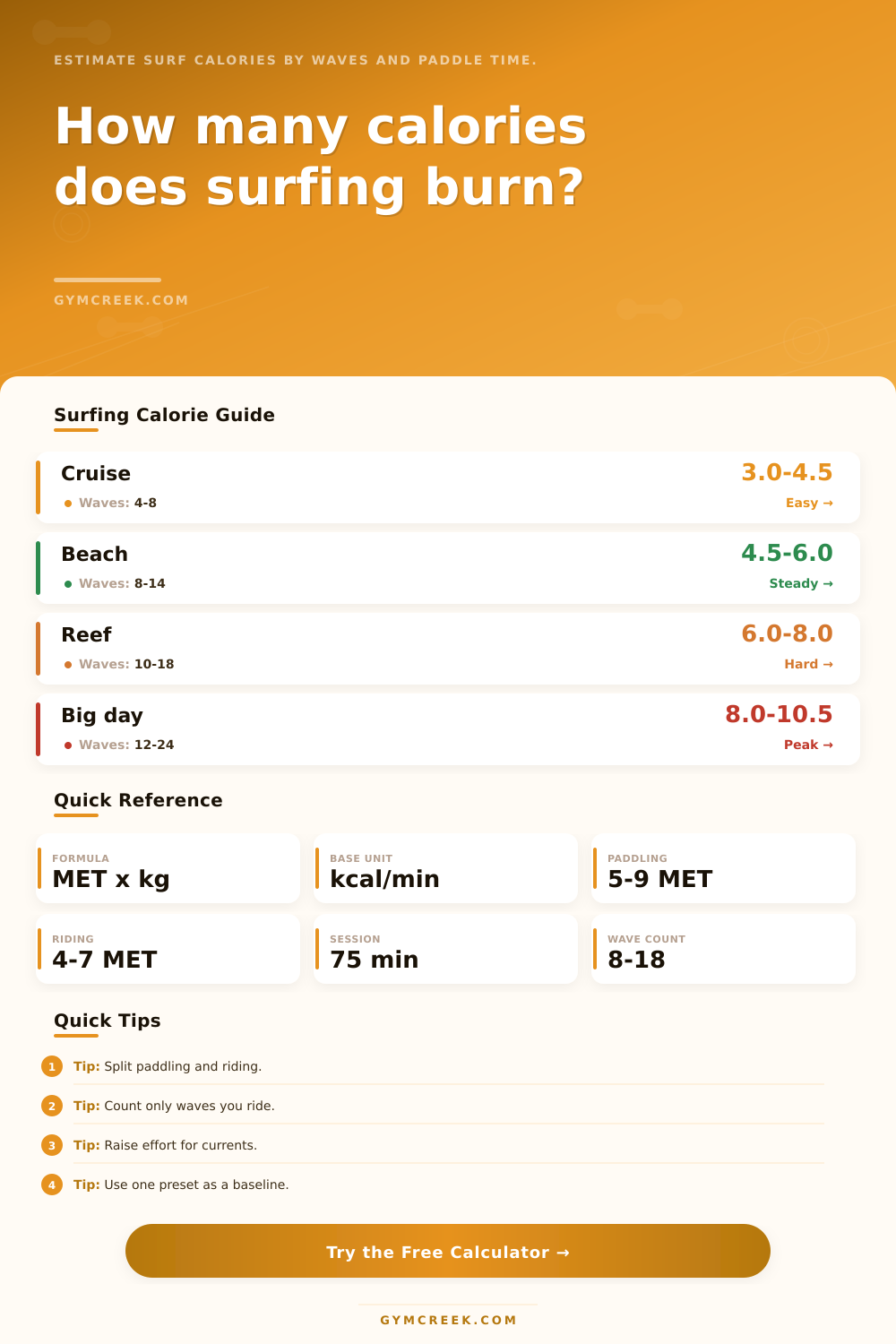
Calories per minute = MET x 3.5 x body weight in kg / 200. The calculator applies this separately to each surf segment.
Total water time is divided into paddle-out, wave-paddle, ride, duck-dive, and lower-intensity waiting minutes.
Wave size, current, wind, break type, wetsuit drag, and board choice adjust the paddling and total session load.
Mifflin-St Jeor estimates baseline calories, then activity level estimates TDEE so the surf session can be compared.
📑Reference Tables
| Surf Segment | Easy | Steady | Hard |
|---|---|---|---|
| Waiting and sitting | 1.5 MET | 1.8 MET | 2.2 MET |
| Paddle-out | 4.8 MET | 6.3 MET | 8.0 MET |
| Wave chase paddle | 5.5 MET | 7.2 MET | 9.0 MET |
| Riding the wave | 3.8 MET | 5.0 MET | 6.6 MET |
| Duck dive cluster | 6.5 MET | 8.2 MET | 10.0 MET |
| Surf Profile | Water Time | Waves | Typical Load |
|---|---|---|---|
| Beginner lesson | 45-60 min | 4-8 | Low to steady |
| Longboard cruise | 60-90 min | 8-16 | Steady |
| Shortboard beach day | 75-120 min | 10-20 | Moderate hard |
| Winter paddle | 60-120 min | 6-14 | Hard |
| Competition heat | 20-35 min | 3-8 | Peak bursts |
| Condition | Modifier | Where It Hits | Meaning |
|---|---|---|---|
| Clean and easy | 0.96x | Paddling | Less drag |
| Normal movement | 1.00x | All segments | Baseline |
| Choppy side-current | 1.10x | Paddling | More corrections |
| Strong sweep | 1.20x | Paddling | Hard position work |
| Crowded rotation | 0.94x | Riding | More waiting |
| Formula | Variables | Output | When Used |
|---|---|---|---|
| MET kcal | MET, kg, min | Calories | Main estimate |
| Catch rate | Caught, tries | Percent | Wave skill |
| Weighted MET | kcal, kg, min | Session MET | Intensity check |
| Mifflin BMR | kg, cm, age | Baseline | Daily context |
💡Tips
There you sit on your board looking at a row of waves. They appear enticing, but so far away. After paddling out, your arms burn and your legs feel heavy in your wetsuit. Do I realy want to be out here? Is it all worth it?
This is what many folks think about when balancing fun and exercise. Many do not realize that surfing isn’t just floating along on the surface; its a complete body work out pretending to be play. While most think they’re merely surfing, they soon forget that most of their time in water is spent battling current, wind, and gravity. That battle occurs prior to the ride itself. You can’t separate riding from paddling; that’s why it’s important to know what your body do during each.
Why You Should Know How Much Energy You Burn While Surfing
Once you enter your session details, the calculator above will do the work for you. No more guesswork with conversions and coefficients. By breaking down your time into specific components (active wave chasing, actual ride, the first paddle out, time spent repositioning between sets, etc.), the tool assigns an ME (metabolic equivalent) value for every action.
For example, sitting around and waiting is leisurely calorie-burning, like light walking. Hard paddles for a takeoff spike it. Think vigorous rowing. Depending on how long each segment lasts, the tool calculates it accordingly and provides you with a reasonable total instead of some kind of vague average.
There’s a big piece of that puzzle called body weight. Moving more mass through force of water resistance burns more calories. It is simple physics. A surfer who weigh 200 pounds will work harder pushing into current compared to a surfer weighing 150 pounds. The calculator takes that into account.
Environmental resistance is another variable. On a glassy day, water puts up little resistance, making it feel like a cakewalk. Throw in a strong outgoing current, side wind or a bit of chop and you’re constantly adjusting your position. That requires more physical and mental effort which results in increased energy use. In the heat of the battle trying to stay ahead of the set, you may not even realize what’s happening. But the energy cost add up fast.
Then there’s the wetsuit factor. Surfers know this one is surprising. Most people think of their wetsuits as thick neoprene suits for winter months. They’re cumbersome and bulky. They create drag on your paddle stroke. They make every action just a little bit more difficult. When you’re surfing in cold water, you’ve probably got more clothing on. Your body work harder just to stay warm and mobile. That’s what the multipliers for conditions account for. Surfing in the cold Pacific Northwest differs from cruising around in warmer waters off of California. One is a battle with the elements. The other is more of a glide. Both require different amounts of fuel. And neither is wrong.
Why does this matter? Because it informs how you’ll feed yourself and recover. You might think you’ve only ridden six waves, so your core and shoulders will be fine. But when you add up all the water time, and consider the intensity of paddling, the story are different. Now you see the full picture: Your upper body took a serious beating. This knowledge tells you how you should of refuel. No longer do you treat a high-output surf session as though it were a light yoga class.
It affects your training, too. Want to paddle out to a farther break? Knowing the energy cost lets you build a dry-land workout to match. You begin to target the muscles that manage the paddle-out drag.
Finally, having all this information has a positive psychological effect as well. Being able to see how many calories you burn can actualy motivate you. It confirms your work. You realize that waiting for waves is not downtime; it is active endurance training. It’s active endurance exercise.
Surfing isn’t an easy sport. It requires constant attention. Each little adjustment of body position contributes to the overall load. Each duck dive under a breaking wave contribute to the overall load. When you think about it like that, surfing becomes less of a hobby and more of a measurable athletic effort. And you’ll have data to support your aching muscles.
At the end of the day, though, those numbers are just a look at one moment. They don’t represent the thrill of nailing a flawless bottom turn. It also represents the disappointment of missing that takeoff. What they do represent is a starting point for measuring what your body does when put through the paces.
Accept the estimates as the starting point. Then tweak them based on what you discover about yourself and your bodys rhythms. Before long, you’ll have a feel for how each condition and break impact your energy level. You’ll see a difference whether it’s a tough workout or when it feels like just swimming laps.
That’s the way you make the ocean less of a riddle, more of a well understood training ground. You know instead of guessing. And where water will reward those who understand it, whether for preservation or performance. Remember that balance the next time you head out for another set.