Supination Strength Calculator
Estimate forearm supination torque from dumbbell or hammer load, lever arm length, wrist angle, reps, timed holds, side comparison, body weight, RPE, and pain score.
📌Presets
Each preset fills a realistic forearm rotation setup and recalculates torque, work quality, side balance, and safety flags.
⚙Calculator
Supination strength snapshot
Enter load, lever length, wrist angle, reps, and comparison data to estimate forearm torque.
📊Metrics Grid
🧮Formula Cards
1. External force
Load is converted to kilograms, then multiplied by 9.80665 to estimate downward force in newtons.
2. Torque in Nm
Torque equals force x lever arm x sin(wrist angle), then tool distribution adjusts the result.
3. Capacity work
Capacity score uses torque x active seconds, then discounts high RPE and pain flags.
4. Side comparison
Difference compares torque-capacity scores from both sides using the same lever and angle.
📑Reference Tables
| Training Use | Typical Load | Reps / Hold | Stop Rule |
|---|---|---|---|
| Early rehab | 1-5 lb / 0.5-2 kg | 10-15 reps | Pain 0-2 |
| Tendon capacity | 5-12 lb / 2-5 kg | 8-15 reps | Pain 3 max |
| Strength accessory | 10-25 lb / 5-11 kg | 5-10 reps | RPE 8 max |
| Max test | Heavy lever | 3-6 reps | No sharp pain |
| Wrist Angle | Sine Factor | Torque Demand | Use Case |
|---|---|---|---|
| 30 degrees | 0.50 | Low | Warm-up |
| 45 degrees | 0.71 | Moderate | Rehab |
| 60 degrees | 0.87 | High | Control work |
| 90 degrees | 1.00 | Peak | Testing |
| Side Difference | Meaning | Action | Progression |
|---|---|---|---|
| 0-5% | Even | Train normal | Small jumps |
| 6-10% | Mild gap | Match weak side | Hold volume |
| 11-15% | Notable gap | Add easy work | Slow jumps |
| 16%+ | Large gap | Reduce load | Re-test later |
| Formula | Variables | Output | Why It Matters |
|---|---|---|---|
| Force | kg x 9.80665 | Newtons | Load input |
| Torque | F x m x sin | Nm | Joint demand |
| Work time | reps x sec + hold | Seconds | Capacity |
| Balance | weak / strong | Percent | Side gap |
💡Tips
Turn your wrist, lift a weight. You feel a twinge in forearm, it’s a familiar burn. But what you’re doing isn’t just hoisting a load. You’re also controlling torque. You’re managing rotation. You’re protecting the health of the tendon.
Most folks monitor how strong their back or biceps is. They neglect small muscles that stabilize their elbow. That’s why we get tennis elbow, golfer’s elbow, or, all at once, see our deadlifts and pull-up numbers tank.
How to Keep Your Forearms Healthy
Upper body mechanics include supination strength, and learning to manage it involves more than staring at the dumbbell dial. Plug your lever length and load into this calculator (above) and the calculator does all the math for you, no conversion or coefficient guessing.
Remember, force times distance = torque. For example: Gripping 2 inches higher up on the handle has a greater impact on forearm strain different than increasing weight at the end of the handle by 5lbs. Most folks believe they’re going easy on themselves when gripping high on the handle. In reality, they’ve created a longer lever arm which increase the rotational demands placed on their joint.
The key is understanding what numbers represent. And then there’s pain. Pain is best measure you have. That’s what the tool is designed to flag: When does it hurt enough that you need to slow down? Because a tiny niggle now will mean a big injury later. Don’t ignore it.
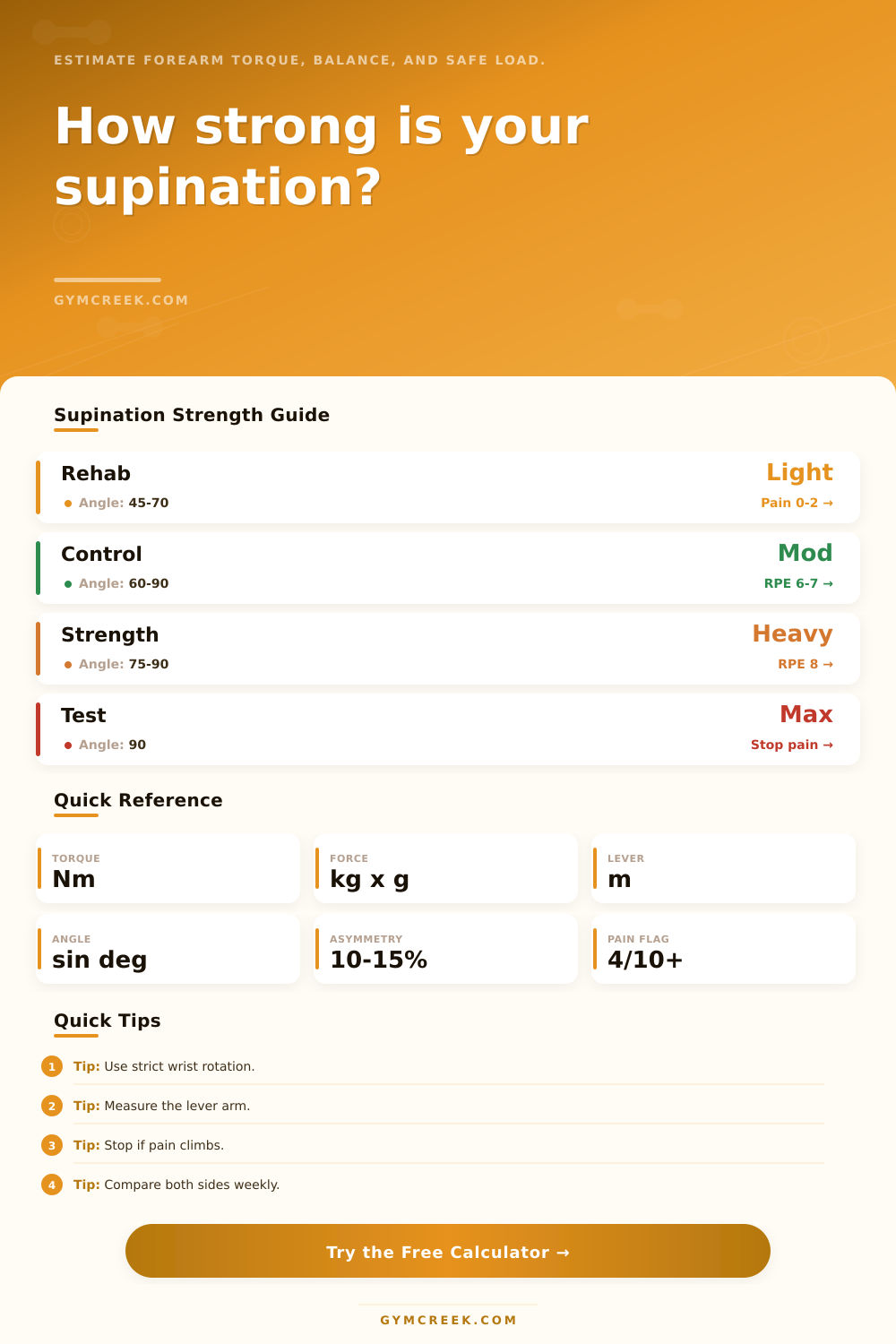
The page has a chart that spells out when it’s time to stop. Remember: Rehab shouldn’t feel like a huge struggle; it should be an easy session. Don’t worry about the number if you feel numbness or sharp pain. Stop. Reduce the load if your pain scale is at four or above. And yes, even if you can get more reps in.
Everyone messes up here. They think they’ll suffer there way to the finish line. Suffering is not progress.
You can’t feel the imbalance between your two sides, but you will if you compare them. Your arms may appear equally strong… Until you start rotating. Then one has less control. That’s a sign of a hidden weakness, waiting to surface when loaded down. A 10 percent side-to-side gap is normal. A 20 percent side-to-side gap means trouble ahead.
To estimate the imbalance, the calculator compares each limb’s torque capacity. The same angle and lever are used so there isn’t any unfair advantage. When your strong side proves to be much stronger, that doesn’t mean you train it harder. You add low-intensity, controlled work on the weak side until the gap closes. Brute force isn’t as important than balance.
This is where the wrist’s angle comes in. The angle of your wrist changes how hard the movement is for your muscles. Torque requirements is highest when you have your hand at ninety degrees. Much lower when at thirty degrees. So start the warm-up with your wrist near neutral. As tissue loosens up, you’ll gradually crank up the angle.
If you try to jump right into a fully extended throw with a heavy dumbbell in-hand… you’re gonna hurt yourself. That is why the sine factor adjusts the torque estimate based off that information. This ensures your score represents the true mechanical stress put on your body. It is a small detail, but it makes a big difference.
Forearm health is about consistency, not intensity. Tendons are slow to respond to stress. It takes time to strengthen and to adapt. Working at high RPE scores feels good, but often shows your form is breaking down. Pain + high effort = score penalty from the calculator. The calculator recommends lightening up in subsequent sessions. This is a conservative approach that avoids the injury/rest cycle. Your goal is to build forearm capacity, not break it apart.
If you don’t know where to begin, use one of the presets. They provide a safe place to start when doing strength tests, control work or rehabilitation. Depending on your current level of ability, choose what fits best. Follow up weekly instead of daily. Your forearms get tight and fatigued. A lower score on a bad day doesn’t equal that you’re weakening. You’re just tired.
Follow up long enough to see trends across a month. Is it gradually increasing your torque capacity? Are its pain scores decreasing? Is the side difference diminishing? Those are signs of true improvement.
The numbers in this tool aren’t absolute truth; they’re estimates, meant as a guide to help in your decision making regarding your training load. Supination strength is about longevity. It is the difference between months of elbow issue keeping you out or years of consistent training.
Respect the small muscles. Measure the lever arm. Listen to the pain. The math tells you where you stand, but discipline keeps you there. Stay in the game. You twist the wrist, you hold the hammer, you stay in the game.