Strongman Medley Time Calculator
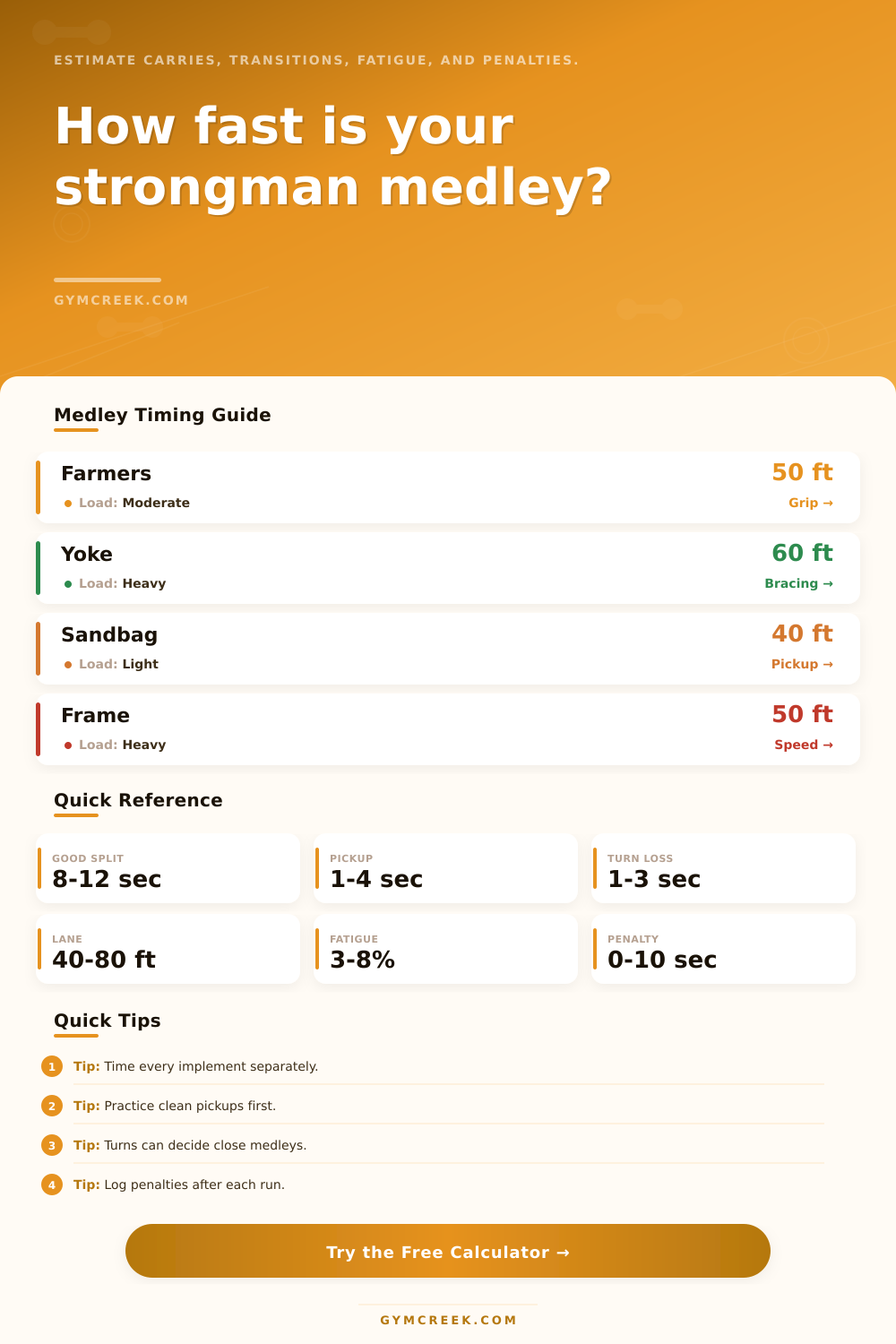
Estimate total medley time from implement count, lane distance, load ratio, pickups, drops, transitions, turns, surface drag, fatigue, and penalties.
📌Presets
Presets load realistic medley profiles and recalculate the full event time including transitions, fatigue, turns, surface drag, and penalties.
⚙Calculator
Medley timing estimate
Enter your event details to estimate the full run.
📊Fitness Metrics Comparison
📑Reference Tables
| Load Ratio | Strongman Meaning | Expected Speed | Planning Cue |
|---|---|---|---|
| Under 0.75x | Speed biased | Fast carry | Push transition pace |
| 0.75-1.10x | Contest moderate | Controlled fast | Clean pickups matter |
| 1.10-1.50x | Heavy event | Braced carry | Protect footwork |
| Over 1.50x | Limit medley | Slow grind | Plan drops and restarts |
| Medley Type | Common Distance | Typical Split | Main Bottleneck |
|---|---|---|---|
| Farmers carry | 40-80 ft | 7-14 sec | Grip and turns |
| Yoke carry | 40-60 ft | 8-18 sec | Pick and balance |
| Sandbag load | 20-50 ft | 10-22 sec | Lap and load |
| Frame carry | 40-80 ft | 8-16 sec | Start speed |
| Surface | Time Effect | Who Feels It Most | Adjustment |
|---|---|---|---|
| Turf or rubber | Baseline | All athletes | Use normal speed |
| Smooth asphalt | About 5% slower | Foot-speed athletes | Shorter steps |
| Uneven grass | About 10% slower | Yoke carriers | Brace before turns |
| Soft field | About 16% slower | Heavy medleys | Expect pickup drift |
| Formula | Variables | Result | Use |
|---|---|---|---|
| Load ratio | Load / body weight | Relative load | Speed penalty |
| Carry time | Distance / speed | Moving seconds | Main event time |
| Fatigue curve | Rate x station | Late split cost | Medley pacing |
| Non-carry time | Pickup, drop, turn | Handling cost | Technique focus |
💡Tips
The whistle sounds, and within one lane are three different monsters. Raw horsepower, physics, and footwork is all put to the test in a strongman medley. Heavy loads has to be moved over various distances against the clock. For most athletes, it’s all about lifting more weight. What they often fail to realize is that pickups and transitions equal speed. Understanding those variables will make a difference between a good run and a great one.
The calculator do the math for you. First thing to consider is load ratio: the implement’s weight over your body mass. Take for example a two hundred pound yoke. A beginner might have trouble with this, their frame doesn’t support it effectively. Compare that to an elite athlete who weighs three hundred pounds. They handle the same load in different ways. They’re more stable than others. Their center of gravity are lower. How heavy you are compared to what you haul determines the speed at which the tool expects you to work. Everyone slows down when hauling a heavy load, but smaller athletes slow down disproportionatley.
How to Improve Your Strongman Time
Sure, you can train grip strength all day. If you’re going over your load ratio of 1.5 times your body weight, you will lose balance. It’s all about transitions. You put down the yoke and have to run as fast as possible to get to next station (farmers walk). It’s only a few feet but it seems like nothing until you realize those steps happens multiple times. That half-second pause for dropping the yoke and that slow jog to the next station add up. Enter in the exact distance of your transitions and how long it takes to get from each one. That will make you see the hidden cost of awkwardness.
Sandbags move around if you move them. You can’t just grab one and off you go, you have to hold on, re-position yourself, and so on. Every second wasted fumbling is a second you’ll never get back.
The other factor is surface conditions. While rubber tracks offer explosive acceleration, they soak up that energy on soft grass or an uneven dirt surface. As the reference table on the page shows, it add almost twenty percent to your moving time on a soft surface. It’s often the difference between first and fourth place and not a small detail. Most of us train on clean gym floors, while competition typically finds us in some rough parking lot or a muddy field. Your times will look great in theory if all you practice on is a smooth surface, but will fall apart when faced with real pressure of contest.
As the day goes on you get tired. Your muscles are fresh for the first carry, your grip weakens and your lactic acid burns by the last implement. To reflect that reality, the calculator will penalize you with an increasing fatigue penalty at the latter stations. If you choose a really lightweight load, you can still go full bore the whole time. But if not, smart competitors conserve their energy for late in the event when their legs are heavy. The ones who forget about fatigue finish slowly and rank poorly overall.
When you push your limits, penalties follow. You may wobble that load into dangerous territory, or you might catch it with your foot. These mistakes can cost you time. Judges frequently increases times for those errors. Instead of finding yourself surprised by extra time added onto your effort, plan ahead and expect some padding for error. Establishing reasonable expectations include adding a cushion for mistakes.
Practice your picks when tired. If you can still pick up your yoke fast after a hard workout, you’ll crush the competition who drops weight because they’re too weak. Consistency in the face of chaos is the name of the game when it comes to winning a medley.
Move quickly, don’t do anything reckless. And this thing helps you visualize what each variable does then how much time you spend doing it. When you realize almost half of your time is spent on pickups and transitions, you’ll begin practicing differently. Train clean. Work on quick turns while maintaining speed. Respect the surface beneath your feet. Then, grab something realy heavy and get after it in a hurry.