Strength to Bodyweight Ratio Calculator
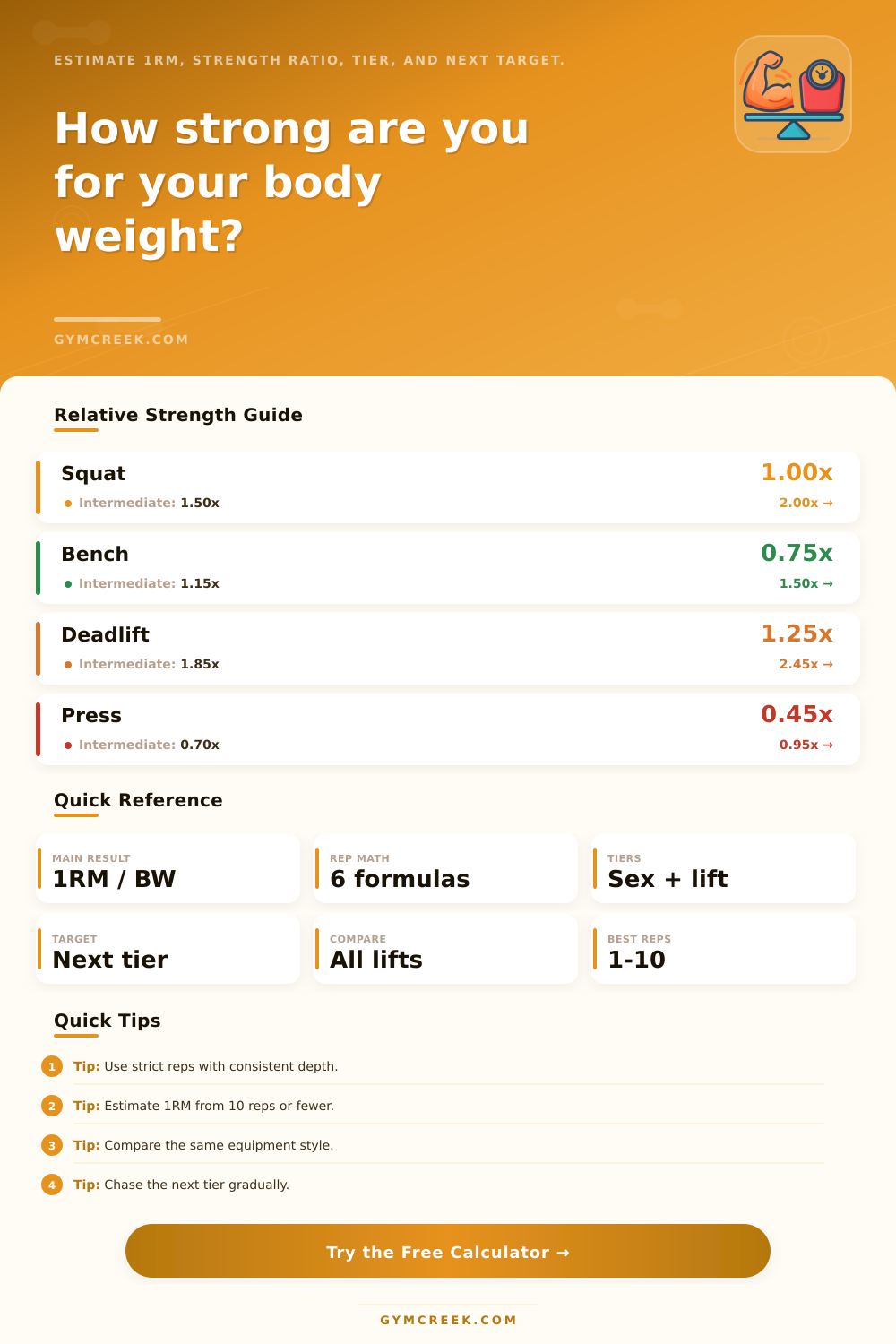
Estimate your 1RM, calculate strength/bodyweight ratio, place the lift in a relative strength tier, and compare the result across major lifts.
📌Strength Presets
Each preset loads body weight, lift type, lift weight, reps, sex, experience, equipment, and 1RM formula choice.
⚙Calculator Inputs
Strength/bodyweight snapshot
Enter a lift, body weight, reps, and formula to estimate your ratio.
📊Metrics Grid
📑Standards Tables
| Lift | Beginner | Novice | Intermediate | Advanced | Elite |
|---|---|---|---|---|---|
| Squat | 0.75x | 1.00x | 1.50x | 2.00x | 2.50x |
| Bench press | 0.50x | 0.75x | 1.15x | 1.50x | 1.85x |
| Deadlift | 1.00x | 1.25x | 1.85x | 2.45x | 3.00x |
| Overhead press | 0.35x | 0.45x | 0.70x | 0.95x | 1.20x |
| Lift | Beginner | Novice | Intermediate | Advanced | Elite |
|---|---|---|---|---|---|
| Squat | 0.45x | 0.70x | 1.05x | 1.45x | 1.85x |
| Bench press | 0.25x | 0.40x | 0.65x | 0.90x | 1.15x |
| Deadlift | 0.70x | 0.95x | 1.40x | 1.90x | 2.35x |
| Overhead press | 0.18x | 0.30x | 0.45x | 0.62x | 0.82x |
| Formula | Equation | Best range | Note |
|---|---|---|---|
| Epley | Weight x (1 + reps / 30) | 1-10 reps | Common strength estimate |
| Brzycki | Weight x 36 / (37 - reps) | 1-10 reps | Conservative near 10 reps |
| Lombardi | Weight x reps ^ 0.10 | 3-15 reps | Smoother at higher reps |
| Average | Mean of valid formulas | 2-12 reps | Reduces formula bias |
| Equipment | Adjustment | Use for | Compare carefully |
|---|---|---|---|
| Barbell | 1.00 | Main standards | Competition-style lifts |
| Dumbbell pair | 1.06 | Stability demand | Total both dumbbells entered |
| Smith machine | 0.95 | Guided bar path | Machine angles vary |
| Machine | 0.90 | Gym machine stacks | Pulleys change load |
💡Tips
Strength to bodyweight ratio calculates the strength of an individual in relation to a weight of that individual. This is a different measurement than the total amount of weight lift by an individual because the strength to bodyweight ratio also accounts for the size of that individual. For instance, a 300 pound deadlift performed by an individual that weighs 150 pound will have a different strength to bodyweight ratio than an individual that weighs 220 pounds that performs the same lift.
Therefore, this strength to bodyweight ratio is useful in comparing the strength of individuals of different size, or in monitoring the strength gains of an individual relative to their training age. The strength to bodyweight ratio calculator will calculate the ratio after inputting information about the body weight of the individual, the type of lift performed, the load that was lifted, and the number of repetitions of that lift performed. The calculator will use estimation equations to calculate the one repetition max (1RM) of that individual for that lift, and will divide that 1RM by the body weight of that individual to calculate there strength to bodyweight ratio.
What Is the Strength to Bodyweight Ratio?
Standards for each individual based on their sex are compared to these ratios, because men and women typically have different distributions of strength in their bodies. Each of these standards differ for different types of lift, as each type of lift requires different muscle groups to be strong. In addition to these ratios, the calculator will also provide a tier label for the calculated ratio, a target weight for that individual to aim for, and a comparison of that individual’s strength to bodyweight ratio for other types of lifts.
The tier labels for each strength to bodyweight ratio are not an indication of the absolute strength of that individual, but rather a point of comparison for individuals with similar strength and body weight. To reach the next tier in their strength to bodyweight ratio, an individual will have to increase their strength or maintaining their body weight. For instance, if an individual gains 10 pounds of muscle, their absolute strength will have increased, but their body weight will have increased as well.
As a result, their ratio may remain the same. However, because their strength to bodyweight ratio may change due to changes in body weight, the calculator can indicate the target body weight that an individual should aim for to reach the next available tier in their strength to bodyweight ratio. The number of repetitions that an individual performs will affect the accuracy of the strength to bodyweight ratio that the calculator calculates.
The estimation formulas work best for individuals performing sets near failure that contain less than 10 repetitions. The calculator will provide an indication of the quality of those repetitions. Additionally, equipment can impact the calculated strength to bodyweight ratio.
For instance, a dumbbell bench press will require more stability than a barbell bench press. As a result, the calculator will adjust the load that is calculated for an individual if they use a dumbbell as opposed to a barbell. An individual may make the mistake of performing different types of lifts on different days without accounting for changes in their body weight.
The strength to bodyweight ratio can only be calculated if the same conditions is met each time that the strength to bodyweight ratio is calculated, such as their range of motion, tempo of the lifts, and whether they use a paused or touch-and-go movement for those lifts. The calculator will remind an individual to keep these variables the same. Additionally, another factor that will impact an individual’s strength to bodyweight ratio is their training age.
An individual that has been lifting weights for 2 years may be able to aim for standards for intermediate lifters, while an individual that has only been lifting for 1 year may experience gains in strength but not in there strength to bodyweight ratio. Therefore, the calculator will account for the training age of the individual that is entering the calculator. The concept of relative strength can also be applied to each of these lifts and the requirements of certain type of athletes.
For instance, powerlifters may want to have more body weight than athletes who must move their bodies while performing lifts, such as climbers or gymnasts. Thus, the strength to bodyweight ratio does not suggest that one body weight is better then another, but indicates the body weight of an individual and their relative strength to that body weight. Thus, the strength to bodyweight ratio can be used to determine if an individual should increase the weight that they lift, or if they should manage their body weight.
One of the most useful concepts of the strength to bodyweight ratio is that an individual can pick one type of lift, and calculate their strength to bodyweight ratio each six to eight weeks. If their strength to bodyweight ratio increases, they may be gaining strength well. If the ratio stagnates, their target weight will provide them a goal to aim for.
If the ratio decreases, the breakdown of their ratio can indicate whether their body weight is too high for their strength, or whether their quality of their lifts has decreased. Thus, the strength to bodyweight ratio act as a means of measuring whether an individual is developing strength with their training program, and the relevance of that ratio itself.