Stiff Leg Deadlift Calculator
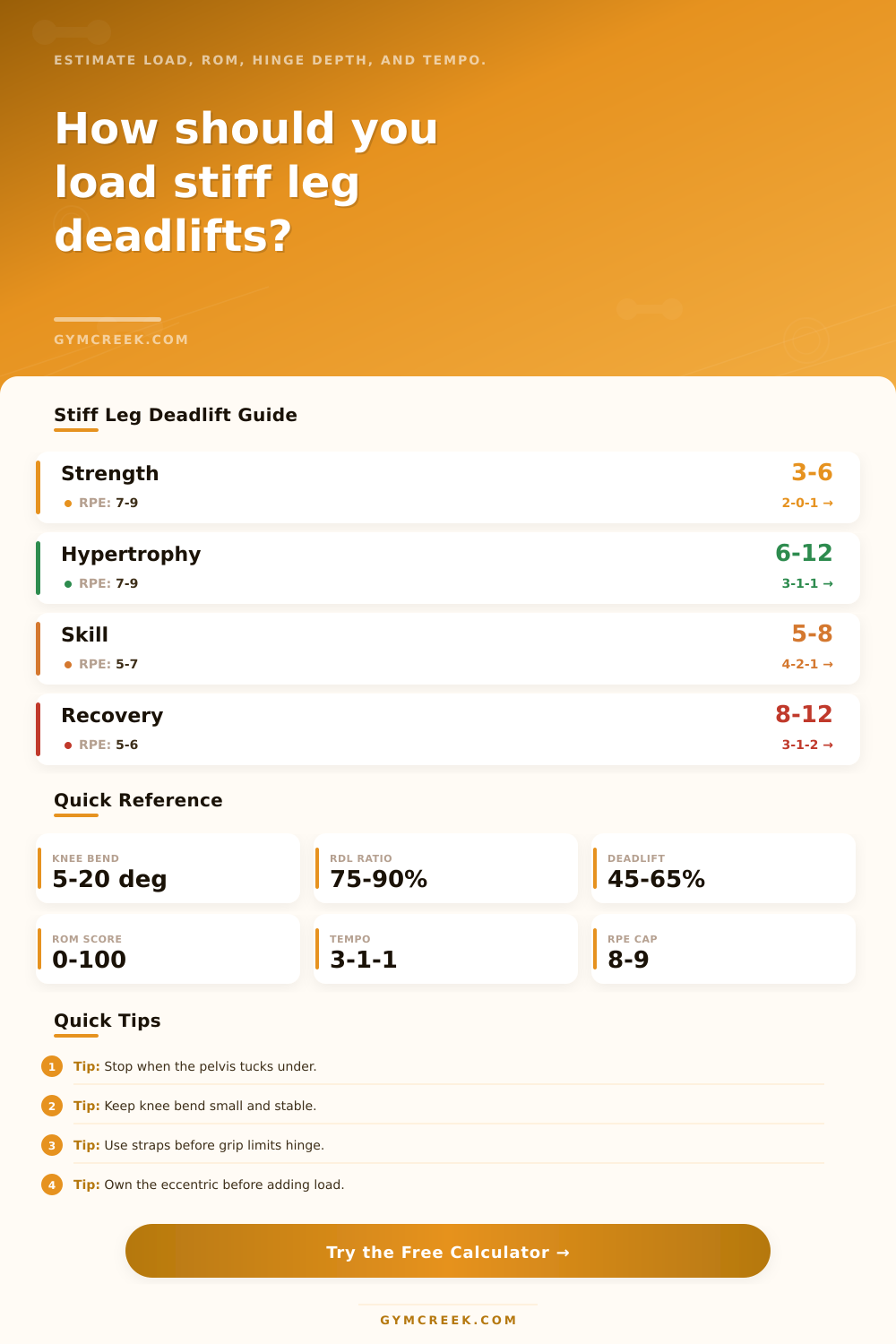
Estimate stiff leg deadlift load, hamstring range, knee bend, hinge depth, tempo, RPE, and how the lift compares with your deadlift and RDL.
📌Presets
Presets load realistic hinge setups and immediately recalculate the suggested stiff leg deadlift range.
⚙Calculator
Stiff leg deadlift snapshot
Enter your pull numbers, hinge depth, and tempo to calculate the session target.
📊Metrics Grid
📑Reference Tables
| Hinge Marker | Green Range | Caution Range | What It Means |
|---|---|---|---|
| Knee bend | 5-20 degrees | 25+ degrees | More bend shifts toward RDL or deadlift mechanics. |
| Hinge depth | 70-90% | Below 60% | Depth should come from hips without lumbar rounding. |
| Stretch rating | 6-8 of 10 | 9-10 of 10 | Strong stretch is useful, pain is not the target. |
| Tempo | 3-1-1 | Fast drop | A controlled eccentric keeps hamstrings loaded. |
| Lift | Common Load | Knee Bend | Main Limiter |
|---|---|---|---|
| Deadlift | 100% pull | More bend | Total body strength |
| Romanian deadlift | 60-80% pull | Soft bend | Hip control |
| Stiff leg deadlift | 45-65% pull | Small bend | Hamstring length |
| Good morning | 25-45% pull | Small bend | Torso position |
| Goal | Reps | RPE | Loading Note |
|---|---|---|---|
| Strength accessory | 3-6 | 7-9 | Keep reps crisp and braced. |
| Hypertrophy | 6-12 | 7-9 | Use a deep controlled eccentric. |
| Hinge skill | 5-8 | 5-7 | Pause in the clean bottom range. |
| Recovery technique | 8-12 | 5-6 | Stay light and leave speed in reserve. |
| Tempo | Best Use | Tension | Adjustment |
|---|---|---|---|
| 2-0-1 | Strength sets | Moderate | Use when load is already heavy. |
| 3-1-1 | Most work | High | Best default for hamstring focus. |
| 4-2-1 | Skill work | Very high | Reduce load before adding reps. |
| 3-1-2 | Recovery | Moderate | Stand tall without snapping the hips. |
💡Tips
Most lifters treats the stiff leg deadlift as a punishment exercise. Bar gets loaded until form cracks, and a burn they can’t control chases them. Left with a bruised ego and a rounded back, the lifter does not understand why the movement is so different than a normal deadlift, other than having straighter legs.
It moves the limiting factor from total systemic strength to hip hinge precision and hamstring flexibility. To get it right you have to look beyond weight on the bar. You must learn the mechanics of the hinge itselfs.
How to Do Stiff Leg Deadlifts Correctly
It’ll do all the math for you (above), but understanding what those inputs mean is where the real value lie. For starters, plug in your Romanian deadlift rep strength and your conventional deadlift max. From there, it use that reference point to estimate your potential on the stiffer variation. I’m guessing it won’t be as much as you might think, at least initially.
In fact, that’s kinda the whole point: Stiff legs aren’t a strength contest. They’re an endurance and controlled-tissue-length test for the posterior chain. To that end, the tool show whether or not you’re using a load that falls within a resilience-building range versus one that invite injury.
The most frequent breakdown when doing this move is knee bend. Ideally you want to keep it small, five to twenty degrees at most. Any larger and you’re simply performing another type of Romanian deadlift. Nothing wrong with that, but it’s not the unique purpose of this variation. As the table on the page show, a slight rise in knee flexion transfers mechanical stress off the hamstrings. The stress now return toward the lower back and glutes.
When you become tired, if you notice your knees begin folding forward, then it’s time to put down the bar and hold onto the hinge. Chasing reps with poor mechanics is not a good plan.
The load is also important but so too is tempo. When your hamstrings are long they needs to absorbs the tension during the eccentric phase (the slow part) and this is when you gain strength and muscle growth. When you rush the eccentric phase the movement becomes a momentum game. The most difficult portion of the exercise get skipped. Strive for a three second lowering phase with a short pause in the bottom. This maintains constant tension on muscles. It also ensures that the stretch reflex doesn’t do all the work. If it feels like you’re bouncing back up out of the bottom then slow down. Speed isn’t the currency here, control is.
Many people mistake another variable: hinge depth. Go down as far as you can while feeling a solid hamstring stretch and no more. Don’t go so low that your lower back starts to round or your pelvis tucks under. When this happens, you’ve gone too deep for right now. Rounding is a sign that you’ve exceeded your range of motion, not that you need to push harder. Stop at the point where it feels safe yet uncomfortabley to continue. The quality of your range always outweigh the quantity of weight you’re moving through. Move with a clean, controlled arc rather than a deep, rounded one.
Consider this lift to be a hinge checkpoint. It trains your body to produce power through your hips without overextending your spine. Use it as a tool to establish a starting point. From there, make adjustments based off the feeling in your body. Pain means lightening the load. Easy = upping the tempo control and adding more weight.
The objective is a strong, flexible posterior chain. This protect your back and helps your other lifts. When you master the hinge, the weight will take care of itself. That’s how you go from a feared movement to a powerful asset.