Stationary Recumbent Bike Calorie Calculator
Estimate calories burned on a supported-seat exercise bike from ride time, body weight, cadence, resistance, optional watts, heart-rate effort, and interval share.
📌Presets
Presets load realistic recumbent bike sessions, including supported posture, resistance, cadence, heart-rate context, and optional watt readings.
⚙Recumbent Bike Inputs
Recumbent bike calorie estimate
Enter your bike settings to estimate calories, METs, effort zone, and fuel mix.
📊Fitness Metrics Grid
📑Reference Tables
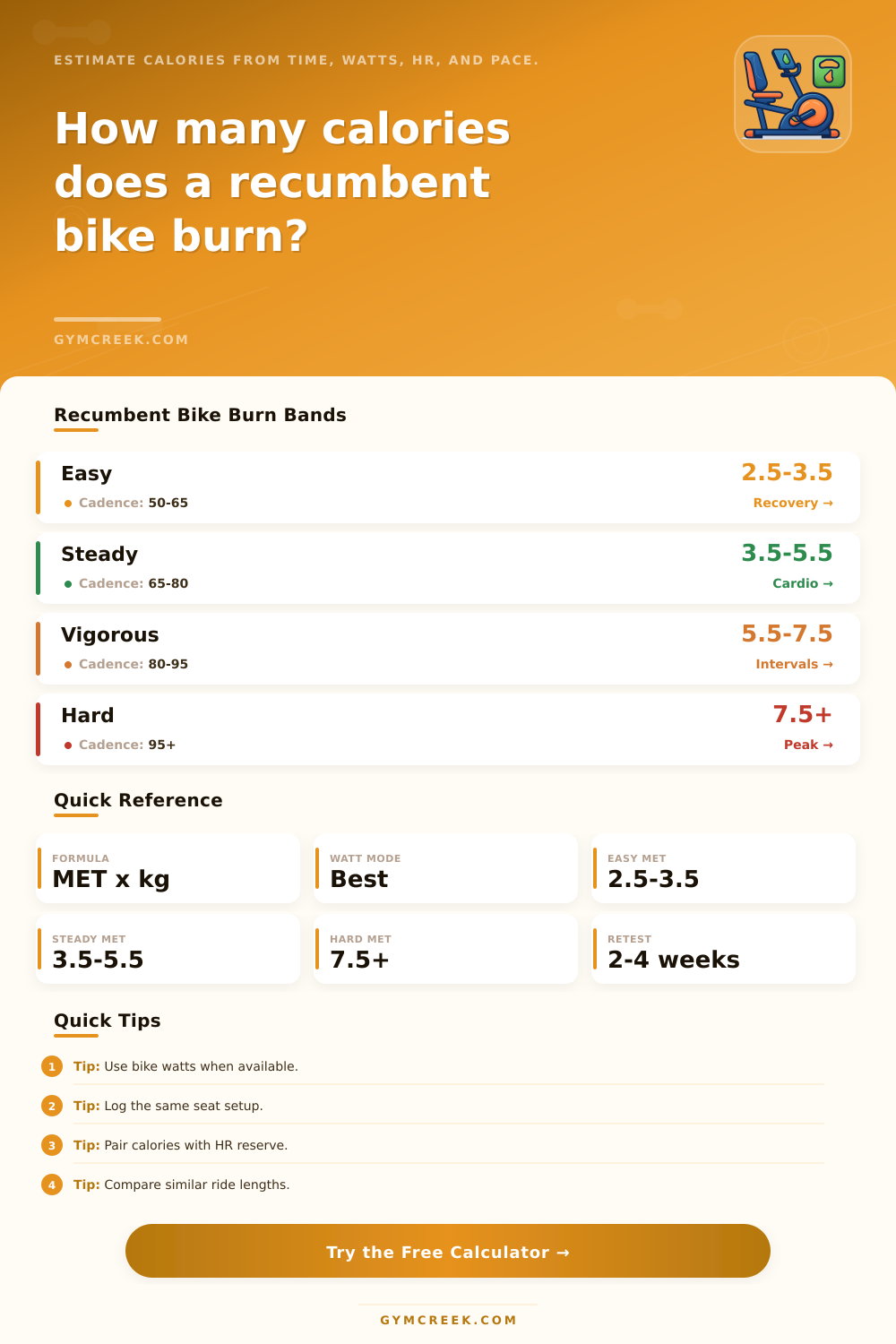
| Ride effort | Typical MET | Cadence cue | Session use |
|---|---|---|---|
| Very easy recumbent spin | 2.5-3.2 | 50-65 rpm | Recovery or mobility |
| Light supported cardio | 3.2-4.2 | 60-75 rpm | Beginner base work |
| Moderate steady ride | 4.2-5.8 | 70-85 rpm | General calorie burn |
| Vigorous interval ride | 5.8-8.5 | 80-105 rpm | Conditioning intervals |
| Resistance range | Bike feel | Cadence target | Watch point |
|---|---|---|---|
| 1-5 | Light spin | 55-80 rpm | May understate effort |
| 6-10 | Steady pressure | 65-90 rpm | Good calorie baseline |
| 11-15 | Heavy cardio | 60-85 rpm | Monitor knee comfort |
| 16-20 | Hard grind | 50-75 rpm | Use short blocks only |
| Duration | Best use | Data quality | Retest cue |
|---|---|---|---|
| 10-20 min | Warm-up or HIIT | HR may lag | Compare watts first |
| 20-40 min | Daily cardio | Good average | Compare same length |
| 40-60 min | Endurance base | Strong calorie estimate | Track drift |
| 60+ min | Long support ride | Fuel and fatigue matter | Watch comfort |
| Formula piece | How it works | Best input | Limit |
|---|---|---|---|
| MET calories | MET x 3.5 x kg / 200 | Body weight and MET | Needs good intensity |
| Power calories | Watts to metabolic kcal | Bike watt reading | Depends on calibration |
| HR reserve | Average HR versus reserve | Reliable HR sensor | HR can lag intervals |
| Recumbent posture | Small support adjustment | Same seat position | Not a medical measure |
💡Tips
Recumbent bikes often provide estimates of the number of calories that will be burned during the workout as inaccurate measurements. The built-in consoles of the bikes make these inaccurate estimate and use generic average to calculate the number of calories. These generic averages do not take into account the physical characteristic of the individual using the recumbent bike.
The bikes use a generic average for both a lightweight athlete and an individual that is beginning to ride bikes. Due to the fact that the bikes treat each individual as if they is the same, regardless of there physical characteristics, the estimation of calories to be burned is likely to be incorrect. In order to understand how much calories are actualy burned by an individual on a recumbent bike, it is necessary to consider the physics and biology of the body during the ride.
Why calorie numbers on recumbent bikes are often wrong
Physics can be used to estimate the calories burned by an individual on a recumbent bike by measuring the work that the individual is performing while on the bike. The most accurate measurement of work is in the units of watts. Watts are a measurement of the power that the individual is generating while on the bike.
Watts do not vary based off the characteristics of the individual. Watts are a calculation of the amount of force that is applied to the pedals multiplied by the rate at which the pedals are turning. If the bike provides a reading of the watts that the individual is generating, those watts can be used to calculate the calories that are being burned by that individual.
Using watts as a measurement allows for the calories to be calculated without the use of the resistance levels that may differ from bike to bike. For individuals who have access to only the bikes resistance levels and the cadence at which the individual is ridden on the bike, the resistance and cadence can be used to calculate the calories. The resistance levels of the bikes can be thought of as a measure of the load that is placed upon the individual while biking.
The cadence is the rate at which the load is being ridden. Additionally, the number of calories that are burned can be thought of as the biological cost of biking and that cost is calculated in part by the body weight of the individual. A more heavily weighted individual will have to expend more energy to move there legs than an individual of a smaller weight.
The other factor in the calculation of calories is the heart rate of the individual. The heart rate is a measure of the bodys effort during the biking session. For instance, an professional cyclist may be generating the same wattage as an individual that is a beginning biker, yet the heart rate of the cyclist will be low compared to the beginning biker.
The heart rate of the individual can be factored into the calculation of calories by calculating the individuals heart rate reserve. This value will provide another measurement of the individuals effort while biking on the recumbent bike. In addition to the factors described above, the posture at which an individual must ride on a recumbent bike may impact the number of calories that are burned.
Because the bike supports the individual’s back and has a wide seat, the individual does not have to use their core muscle to maintain their balance on the bike. Additionally, because the individual does not have to fight for their balance on the bike, an individual may burn fewer calories on a recumbent bike than upon an upright bike. While this difference in calorie burn is likely small, the posture of the bike does impact the number of calories that can be burned.
Because the body adapts to the same type of exercise that is performed on a recumbent bike, each individual should not use the same settings on the bike each day. If the same resistance levels and cadence are used each day for many months, the individual’s heart rate while biking will drop. This is due to the bodys increase in efficiency.
Although the amount of work that is being performed is the same, less energy is being used by the body due to its increased efficiency. To combat this decrease in the rate at which calories are burned, intervals can be incorporated into the biking routine. Performing intervals will cause the heart and lungs of the individual to work harder.
As a result, the number of calories that the individual burns will increase even if the individual spends the same amount of time on the recumbent bike. Intervals can be of different intensities depending upon the goals of the individual rider. For example, a recovery spin that is performed after a strenuous biking session may be of a lower intensity and is not performed with the goal of burning a large number of calories.
Additionally, an individual can perform a tempo ride to increase the cardiovascular conditioning of the individual. This type of biking is of an intense nature. Additionally, depending upon the intensity of the biking, the body utilizes either fat or carbohydrate stores for energy.
At lower intensities, the body utilizes fat as its fuel source. At higher intensities, the body utilizes carbohydrates. The measurements of calories can be tracked over a period of several weeks.
For example, if the individual increases the watts that are generated while biking but their heart rate is the same, the individual has become stronger and more powerful. By tracking each of these factors, it is possible to understand the real picture of the effort that each individual puts into biking on there recumbent bike.