Stationary Bike Weight Loss Calculator
Project stationary bike calories, weekly deficit, expected weight change, and sustainable loss range from rider stats, power, resistance, ride duration, frequency, food deficit, and plan length.
📌Bike Weight-Loss Presets
Presets combine rider profile, stationary bike workload, ride schedule, dietary deficit, appetite compensation, and plan duration so the output stays specific to indoor cycling.
⚙Calculator
Stationary bike weight-loss snapshot
Enter rider stats, bike workload, ride frequency, deficit, and plan length to estimate sustainable progress.
📊Plan Metrics
📑Reference Tables
| Formula | Inputs | Output | Use in calculator |
|---|---|---|---|
| Mechanical kJ | Average watts and ride seconds | Work done on the bike | Watts x seconds / 1000 |
| Ride calories | Mechanical kJ and efficiency | Gross exercise calories | kJ divided by cycling efficiency |
| Net ride calories | Ride calories and compensation | Deficit kept from exercise | Ride calories x rides x retained percent |
| Weight loss | Weekly deficit and weeks | Projected bodyweight change | 3500 kcal/lb or 7700 kcal/kg |
| Zone | FTP percent | Weight-loss role | Planning note |
|---|---|---|---|
| Recovery | Under 55% | Low burn, easy repeatability | Useful on extra days |
| Endurance | 56 to 75% | Best volume builder | Often sustainable for fat loss |
| Tempo | 76 to 90% | Higher calories per minute | Watch recovery and hunger |
| Threshold plus | 91% plus | High burn but costly | Use sparingly in weight-loss blocks |
| Weekly loss rate | Example at 180 lb | Deficit signal | How to read it |
|---|---|---|---|
| 0.25% bodyweight | 0.45 lb/week | Small deficit | Gentle and easy to recover from |
| 0.50% bodyweight | 0.90 lb/week | Moderate deficit | Common sustainable target |
| 0.75% bodyweight | 1.35 lb/week | Firm deficit | Needs good recovery habits |
| 1.00% bodyweight | 1.80 lb/week | Upper target | Often too aggressive for long blocks |
| Scenario | Ride schedule | Deficit source | Expected pattern |
|---|---|---|---|
| Beginner consistency | 3 x 30 min steady | Mostly bike calories | Small but repeatable weekly loss |
| Zone two block | 4 to 5 x 45 min | Bike plus small food deficit | Strong sustainable progress |
| Spin class plan | 3 hard classes | Higher calorie rides | Good burn with more hunger risk |
| Aggressive cut | 5 rides plus food deficit | Both exercise and diet | May exceed the sustainable range |
💡Practical Notes
A stationary bike can assist in achieve weight loss because this type of exercise does not rely on a traffic and weather outside of your home. You can use a stationary bike at various times throughout the day, making it convenient for those who has busy schedules. However, there are some detail to consider with using a stationary bike that will determine whether or not an individual can achieve weight loss with this exercise routine.
The calculator will ask for several different pieces of information to calculate the energy that you will burn during your stationary bike ride. The calculator will require your age, sex, weight, and height as inputs. These features determine your baseline metabolism, which indicates how many calorie your body burns during periods other than stationary bike rides.
Lose Weight with a Stationary Bike
Individuals who are more active during the day will burn more calories than those who is inactive. How long you ride the stationary bike, how often you ride the bike, and how much power you produce while cycling will define the stationary bike ride. If you use a measured watt output on the stationary bike, the calculator will be accurate in measuring the number of calories you will burn.
However, if you use the resistance settings for the stationary bike, you will have to ensure that you use the same stationary bike and the same resistance setting every time you use the bike to calculate your calories. The settings for the stationary bike will change the calculator’s calculations for the number of calories that you will burn. If you use the measured watt settings, the calculator will calculate the calories that you burn as a result of the physical work that you perform.
If you select the estimated watt settings, the calculator will make assumptions about the resistance that is created in the bike as a result of the power that you apply to the stationary bike. The calculator can convert these watts to calories to indicate how many calories your body burned during your exercise. In addition to this setting, the calculator will ask for your compensation level for the calories that you burn using the stationary bike.
Individuals will likely eat more food if they burn calories on the stationary bike to maintain their energy level, so the compensation settings will account for this. Without this setting, the calculator may display the number of calories that you will burn with the stationary bike, but it will not account for food intake. The most important number that the calculator will display is the weekly weight deficit.
This number will account for both the number of calories that you burn on the stationary bike and the number of calories that you will consume less of from your diet. The sustainability check will display whether or not your target weekly weight deficit is manageable. If the weekly weight deficit is small, you will find it easy to maintain your routine.
However, if you would like to lose weight at a faster rate, you will need to account for your fatigue levels. The reference tables will provide further information regarding the numbers that is displayed for your weight loss with the stationary bike. The first table will display information regarding the number of calories that are burned as a result of the power output of the stationary bike.
Additionally, it will explain how the compensation setting reduces the number of net calories. The second table will display different zones of power output for the stationary bike and the number of calories that are burned within each zone. This will allow you to determine whether your rides will last for long periods without causing you fatigue.
The third and final table will display the various ranges of weight loss as percentages of your body weight. This will provide a more accurate number of calories that you will burn because your body weight percentage can be applied to your body size. Even if you follow the plan that is created with the stationary bike calculator, there are a few variable in the body and diet that can impact the weight that you display on the scale.
If you consume more food that contains sodium, you may retain more water, which will make your weight higher on the scale. If you consume more carbohydrates, your body will store more glycogen, which will add to your weight. These factors will not impact your fat loss but will add to your weight on the scale.
To account for this, you can weigh yourself at the same time every day and calculate your average weight each week. Your appetite may change after riding the stationary bike. If you ride the bike harder, you may eat more food to provide your body with the energy that it burns during the cycle.
This will reduce the food deficit that you calculated for the week. As a result, your weight loss will slow down. To combat this, you can adjust the compensation settings on the calculator.
You can change your schedule to increase the number of minutes that you exercise on the stationary bike. You can add a shorter stationary bike ride on an additional day to your current schedule or make one of your current rides longer. Both of these options will increase the total number of minutes that you exercise on the stationary bike.
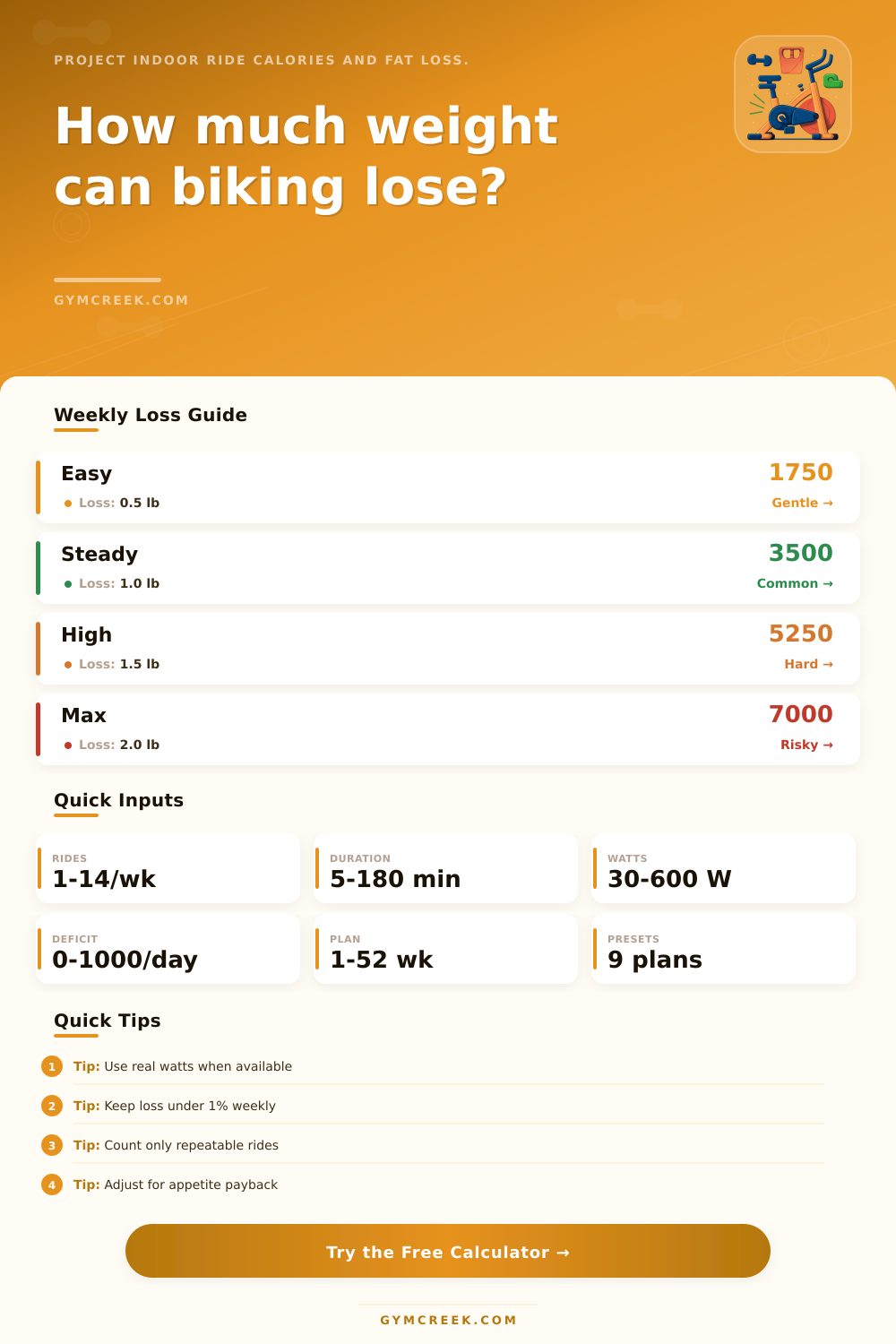
The calculator will allow you to change your schedule as many time as you would like to view which schedule will work best for your lifestyle. The goal pace setting will allow you to set the expectations for the rate at which you want to lose weight. A gentle pace will result in a small amount of weight loss that is easily recovered after periods of exercise.
A steady pace allows you to lose a medium amount of weight that is sustainable over many months. An aggressive pace will result in a higher weekly deficit in relation to your goal weight. This setting will display a sustainability flag for individuals who choose this setting.
A maintenance mode will display the amount of weight that you will lose if you use the stationary bike to maintain your current weight. The numbers that this calculator projects are a baseline that indicates the potential for weight loss. To calculate your true numbers, you must use the settings that you will follow with your exercise routine and your diet.
You should use the stationary bike for as many weeks as possible with your selected settings. After this time, you can compare your actual weight to the projected weight. If your actual and projected weights is different, you can adjust your settings or your compensation for the calories that you burn on the stationary bike.
By using these numbers from the calculator, you can eliminate the guesswork in relation to your weight loss and determine if your efforts with the stationary bike truly match your weight loss goals.