Stationary Bike Distance Calculator
Estimate virtual miles or kilometers from ride time, cadence, resistance, bike style, and a console calibration factor.
📌Presets
Each preset loads a realistic stationary bike scenario and recalculates the distance estimate.
⚙Calculator
Stationary bike ride snapshot
Enter ride details to estimate virtual distance.
📊Ride Metrics
📑Reference Tables
| Bike style | Base factor | Best use | Distance cue |
|---|---|---|---|
| Upright | 1.00 | General rides | Neutral |
| Spin | 1.08 | Class cadence | Higher |
| Recumbent | 0.92 | Comfort rides | Lower |
| Air bike | 0.86 | Full-body work | Lower |
| Bike erg | 1.03 | Power pacing | Steady |
| Cadence | Band | Ride feel | Use |
|---|---|---|---|
| 50-65 rpm | Climb | Heavy | Strength |
| 66-80 rpm | Steady | Controlled | Base work |
| 81-95 rpm | Tempo | Smooth | Aerobic |
| 96+ rpm | Fast spin | Quick | Intervals |
| Effort | METs | Talk test | Distance cue |
|---|---|---|---|
| Light | 3.5 | Easy talk | Shorter |
| Moderate | 6.8 | Sentences | Baseline |
| Vigorous | 8.8 | Few words | Faster |
| Hard | 10.3 | Brief words | Fast |
| Very hard | 12.0 | Minimal | Variable |
| Formula step | Variable | Role | Output |
|---|---|---|---|
| Revolutions | rpm x min | Total turns | Pedal revs |
| Rollout | m/rev | Bike scale | Meters |
| Adjust | style/res | Load effect | Distance |
| Calories | MET x kg | Energy est. | kcal |
💡Tips
Distance on a stationary bike is a calculated number. The distance that is recorded on a stationary bike isnt the same as distance that is traveled on a road. For people who use stationary bikes at home or at the gym, the numbers that is displayed on the bikes have meaning only if they understand the variable that determine those distances.
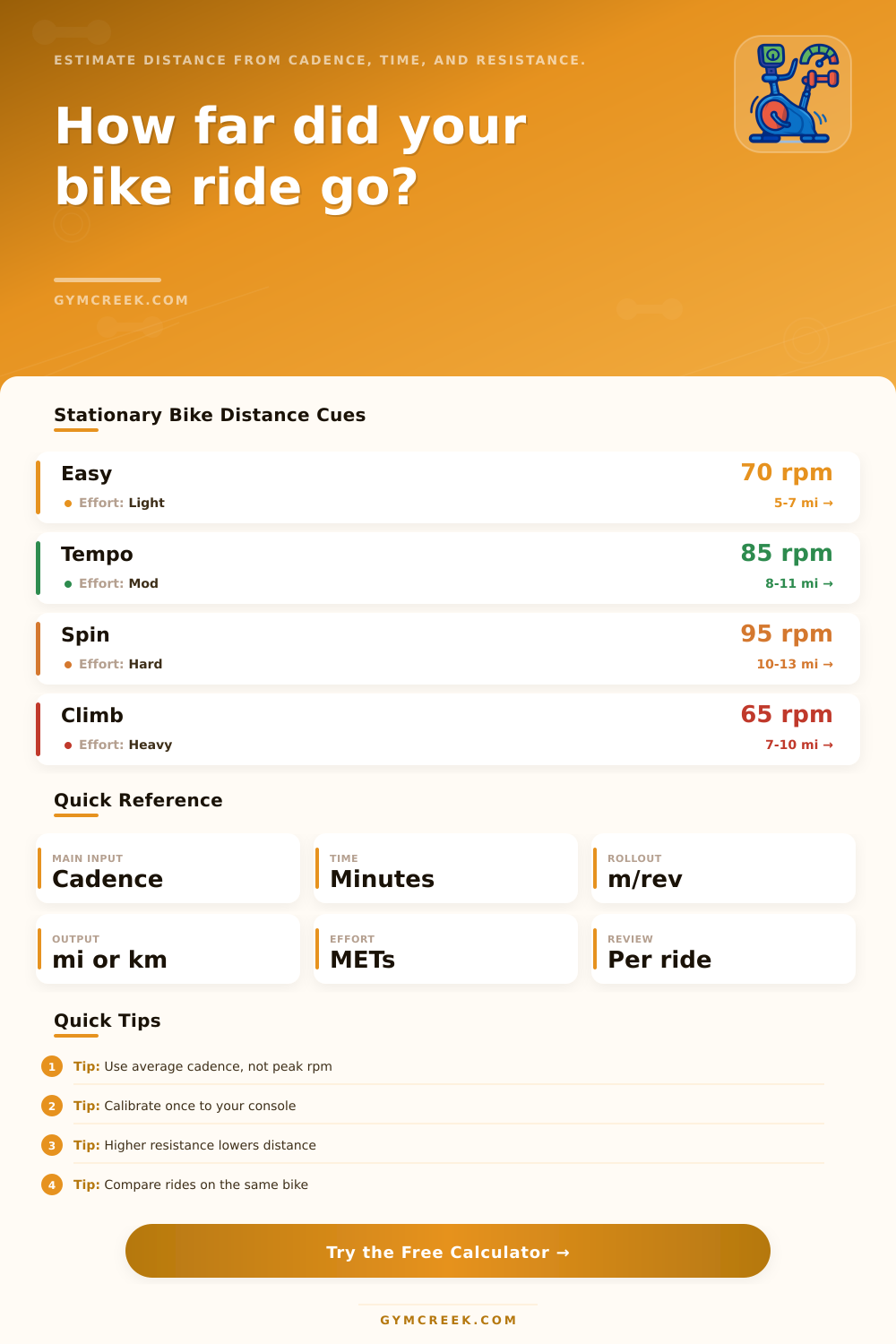
Distance on a stationary bike is created by the variables of cadence, time, resistance, and rollout value. The rollout value is the specific measurement of the distance that one pedal revolution will represent on a given stationary bike. Each of these variable has the potential to change the distance number that is calculated for each stationary bike ride.
How Distance on a Stationary Bike Is Calculated
Thus, individuals must understand the effect of each of these variables on the distance that is created on the stationary bike. Cadence is one of the main variables in the equation for calculating distance on a stationary bike. Cadence is a measurement of the number of times that the pedals of a stationary bike turn within a certain period of time.
Time is another of the variables that must be understood for individuals to calculate their distance on a stationary bike. Time is used to multiply the number of revolutions that the pedals make. The level of resistance that individuals utilize while riding the stationary bike is yet another variable.
The higher the level of resistance for stationary bikes, the less distance that will be counted for those individuals using the bikes. The style of stationary bike that is utilized will also have an effect upon the distance that can be calculated. For instance, the distance that is calculated for an upright stationary bike will be different than a spin stationary bike, recumbent stationary bike, and air stationary bike.
A calculator allows individuals to process these variables for them. By utilizing the calculator to calculate the distance for each stationary bike ride, individuals will no longer have to perform the calculations themselfs. Many individuals believe that the higher the cadence for stationary bikes, the more distance that will be traveled.
For instance, individuals who have a cadence of 95 revolutions per minute with light resistance for thirty minutes will travel more distance than individuals with a cadence of 70 revolutions per minute with heavy resistance levels. However, the individuals with the heavy resistance may be burning more calorie during those thirty minutes on the stationary bike. These calculations can help individuals to distinguish between strength and endurance training for the bodys lower extremities.
Additionally, if stationary bike riders do not track those variables, then the distance traveled will vary for those individuals due to changes in their habits regarding the resistance levels that they use, or the type of stationary bike upon which they ride. In order to accurately calculate distance on stationary bikes, the bikes must be calibrated appropriately. Each stationary bike console will have a different calibration factor.
That calibration factor will determine the amount of distance that is represented by one revolution of the pedals on those bikes. If the distance that is indicated on the stationary bike console does not match with the distance that is experienced by an individual, then that calibration factor should be adjusted. By setting that calibration factor to a given stationary bike, individuals will be able to accurately compare the distance of the stationary bike rides that they perform.
Without appropriately setting that calibration factor, individuals will not be able to compare their distance calculations of their different rides. Effort is one of the variables that will impact the distance that an individual travels on a stationary bike. Effort and resistance are linked; the higher the level of resistance that is utilized on a stationary bike, the higher the level of effort that the individual must utilize.
Thus, the level of effort for an individual impacts the distance that they can travel on the stationary bike. If individuals are to track distance and resistance on stationary bikes, then these variables should be tracked. If they are not tracked, then individuals may not understand whether or not they are providing a challenging workout for their body.
Body weight and age are other variables that impact the distance calculations on stationary bikes. While body weight and age will not impact the distance that an individual can travel, they will help to indicate whether or not an individual was challenging their body during their ride on the stationary bike. Should an individual ignore their body weight and age variables, they may not be aware of whether or not they were challenging their body during their ride.
Many individuals may make mistake when calculating their distance on stationary bikes. For example, if individuals use the peak cadence for their calculation instead of their average cadence, their distance will be calculated as greater than it should of. If they use time from when they first clipped into the stationary bike instead of when they first began to pedal, they may add extra minutes to their time calculation.
Additionally, if they use different types of stationary bikes, their distance will not be accurately calculated due to the differences in rollout values between these types of bikes. The calculator will help to tell individuals these mistakes so that they can develop correct habits for themselfs when using stationary bikes. The variables of stationary bike rides include factors beyond what an individual or calculator can calculate.
For example, factors like the temperature of the room, the hydration of the individuals, the amount of sleep that they got the previous night, and the music that played while they were riding the bikes will affect an individual’s distance calculations for that particular ride. An individual who rode their bikes when they were tired may have traveled more distance than an individual who felt better that same day. These variables should be considered in addition to the distance calculations to provide individuals with an understanding of their true progress on their stationary bike rides.
Calculating distance on stationary bikes has a value for the individuals who use them. For instance, if an individual decreases their resistance levels while maintaining their cadence, they will find that their distance traveled on the stationary bike decreases. Additionally, if the individual performs a recovery spin on the stationary bike at low cadences, they will find that their distance traveled on the bikes will increase if the length of their ride is long enough.
These types of calculations will help individuals to ensure that they are targeting their target heart rate zone when they are using their stationary bikes. One of the most useful variables to set up for stationary bike riders is to select one stationary bike and set the calibration factor for that bike. By setting these variables for each ride, the individual will be able to accurately track their distance.
Other variables can be changed, but the calibration factor should remain the same to ensure that each individual’s distance calculations are accurate. By establishing this habit for stationary bike riders, individuals will be able to track their distance over time. After many months of training on stationary bikes, the individual will be able to recognize their bodys progress.
Thus, the distance that can be calculated for stationary bike rides is a method of tracking the effort and consistency of the individual’s workouts. The calculator helps to ensure that each individual’s data is consistent from one workout to the next.