Standing Broad Jump Calculator
Estimate broad jump distance quality, body-height ratio, takeoff speed, jump power, and age-sex benchmark context from one best standing long jump attempt.
📌Presets
Presets load realistic test profiles and recalculate instantly so you can compare athlete types, ages, body sizes, and training contexts.
⚙Calculator
Broad jump estimate
Enter a valid best jump to see distance, power, and benchmark context.
📊Jump Metrics
📑Reference Tables
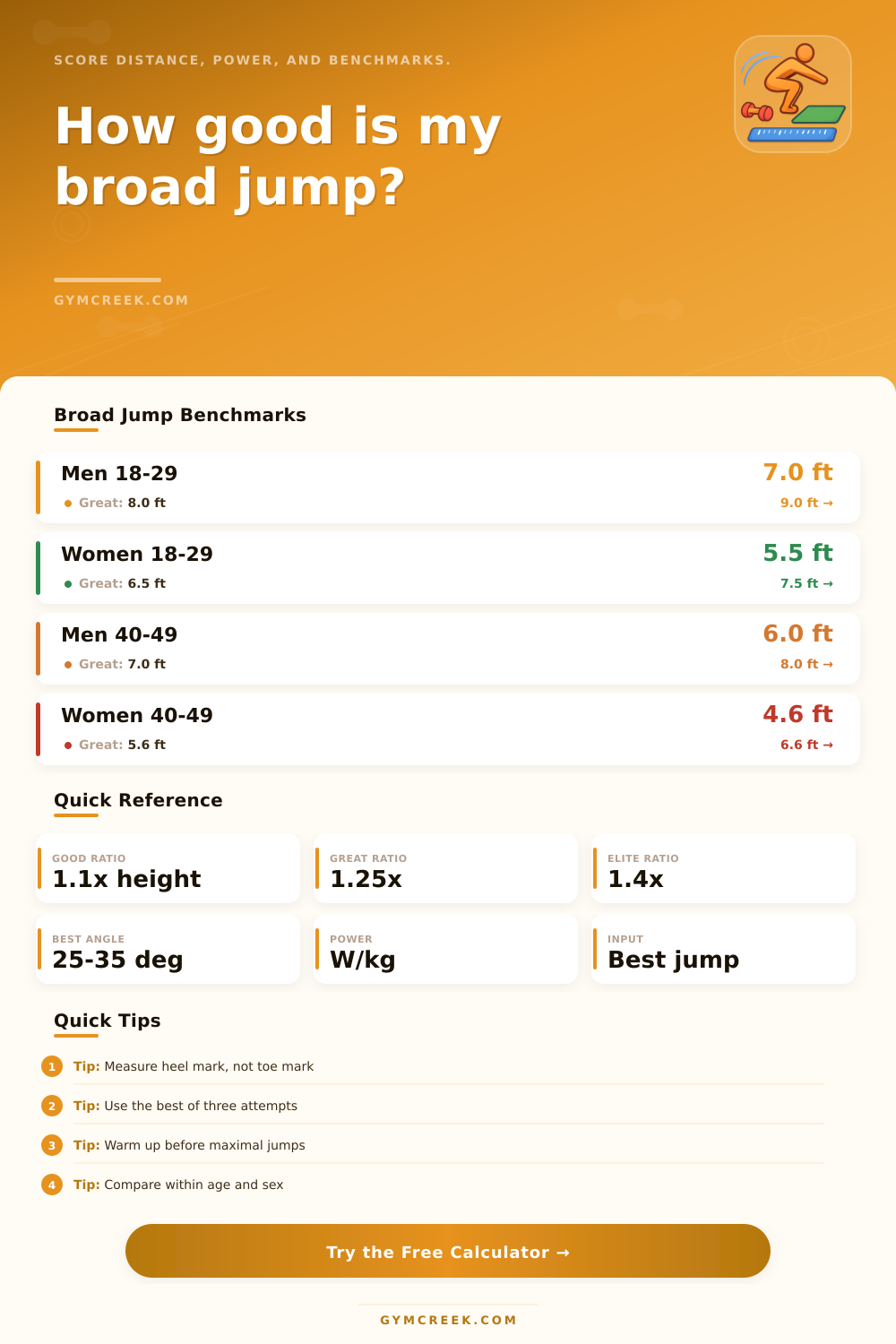
Age and Sex Benchmarks
| Group | Fair | Good | Elite |
|---|---|---|---|
| Male 18-29 | 6.0 ft | 7.0 ft | 9.0 ft |
| Female 18-29 | 4.7 ft | 5.5 ft | 7.5 ft |
| Male 40-49 | 5.1 ft | 6.0 ft | 8.0 ft |
| Female 40-49 | 3.9 ft | 4.6 ft | 6.6 ft |
Jump Index Ranges
| Ratio | Label | Meaning | Use |
|---|---|---|---|
| Under 0.90x | Base | Build capacity | General fitness |
| 0.90-1.10x | Fair | Developing power | Retest tracking |
| 1.10-1.30x | Good | Athletic output | Field sports |
| Over 1.30x | High | Strong power | Power sports |
Physics Reference
| Metric | Formula | Input | Note |
|---|---|---|---|
| Takeoff speed | sqrt(Rg/sin2a) | Distance, angle | Projectile model |
| Air time | 2v sin(a)/g | Speed, angle | Flight estimate |
| Power | KE / time | Mass, speed | Average push |
| Force factor | a/g + 1 | Speed, time | Body-weight units |
Testing Quality Checks
| Item | Best practice | Why it matters | Fix |
|---|---|---|---|
| Measure | Nearest heel | Prevents overcount | Mark tape line |
| Attempts | Best of three | Reduces noise | Rest 2-3 min |
| Surface | Same surface | Improves retest | Log conditions |
| Landing | Stick landing | Valid distance | Repeat if fall |
💡Tips
Many athletes think that jumping as far as possible has something to do with raw leg strength. “I’m going to go squat really heavy, and I’ll be able to jump farther.” That’s not the case. Standing Broad Jump isn’t necessarily a measure of pure strength. It’s actualy more of a test of how quickly you can apply force to the ground before your feet lose contact with it. Often times, what separates someone from jumping like an average human versus someone who jumps like an elite athlete is not necessarily how much weight you’re lifting but how many millisecond more you push off into the air for.
After plugging in your best jump distance, height and body weight into the calculator above, it’ll do all of the physics work for you. You don’t have to wonder what those values translate into. But here’s the meat: Understanding how those inputs play out. If you plug in an estimate of your takeoff angle, you’re recognizing that power alone isn’t everything; your trajectory plays a role too.
How to Measure and Improve Your Standing Broad Jump
Lots of folks try for 45 degrees since that’s the best for projectile motion in a vacuum. In practice, you can’t land on that steep of an angle with good balance. Twenty-five to thirty-five degree takeoffs provides you enough forward momentum to keep you upright and allow you to stick the landing without tripping backwards or falling over. That’s what most people mess up about their initial self-testing.
How does body height play into it? In a way, it evens out the playing field: A five-foot soccer striker can be compared to a six-foot basketball player through a jump-to-height ratio. The longer your legs, the longer the lever arm, so the farther you go (with equal force). It wouldn’t make sense otherwise. Your raw distance might appear lower if you’re shorter, but maybe your ratio shows you move relative to your size with greater power-to-weight efficiency. That’s one reason why, even though some athletes don’t jump far in raw feet, they still dominate their sport.
There’s another variable we didn’t consider before, the surface itself. Running a test on even grass will be different than on uneven ground, and even more different when comparing soft rubber track flooring to a stiff gym mat. Although ever-so-slightly, the surface take in some of the energy from your jump and adds (or subtracts) from the final distance. So when you record your test conditions into the tool, it’s not just honest about the environment; it provides a baseline against which you can compare all future tests. And that means being consistent with retests too. Don’t jump on turf one day and hardwood the next month. It’ll make for a useless comparison. You may think you’re stronger, but the data will be messy. If you really want to track longitudinal progress, i.e. You can see true improvement rather than random changes if you stick with one surface type.
Finally, let’s look at landing technique. Always measure from the toe line to your next closest heel marker on your back foot. No credit is given for reaching back with your hands or falling backwards. It subtracts credibility from the score. Sticking the landing is one reason coaches make such a big deal about it, it means you controlled yourself all the way through that whole movement chain. When you fall into a crouch off of the landing, your body give out before you came to rest. This means you didn’t produce as much acceleration as you thought, or you did a poor job slowing down. To make its physics calculations work, the calculator assumes a clean stick. Your takeoff speed and power estimate will be inflated if you’re doing any type of hopping/falling.
For novices, your current strength isn’t as important as your training age. Your muscles will adapt quicker, but the nervous system needs plyometrics to learn to activate them at a faster rate. Adding 20 pounds to your squat can happen within a few weeks, whereas a ten millisecond improvement in ground contact time may require six months of regular jump training. This is what caused the question regarding your jump training experience. If this is your first time using explosive movements, don’t be surprised if your early results reflect poor coordination, not weak muscles. Through repeated bounding and depth jumping drills, your body will understand how to better transfer force. The increase in distance comes from using less energy to fight your own inertia while transitioning from earth to air.
To put your results into context, there’s a section on the page with reference tables to benchmark yourself against other men (and women) of similar age and gender. The data comes from extensive testing on athletes. Being in the top band doesn’t make you good enough to compete professionally. But it indicates that you’re in the top ten percent of people in your demography when it comes to raw power output. Think of these bands as targets, not limits. No matter what category you fall into, you can improve how fast you apply force.
In conclusion, the standing broad jump is like a snapshot of your ability to explode. It reveals your body’s ability to convert potential energy into a horizontal distance. Keep your test conditions tight, track it over time and be sure to pay attention to the quality of your landing just as much as the quantity of your flight. The numbers will reveal where you’re at. Your technique will show you where you’ll go next.