Stair Climbing Weight Loss Calculator
Estimate calories, vertical gain, weekly fat loss, target timeline, and climbing power from body weight, stairs or flights, step height, workout duration, cadence, weekly sessions, calorie deficit, and handrail use.
📌Stair Weight Loss Presets
Use a preset to start, then replace the inputs with your actual stair count or flights, step height, session time, cadence, weekly schedule, food deficit, and handrail support.
⚙Calculator Inputs
Stair climbing weight loss snapshot
Enter your stair workout to estimate calories, vertical gain, weekly fat loss, target timeline, and average climbing power.
📊Metrics Grid
📘Reference Tables
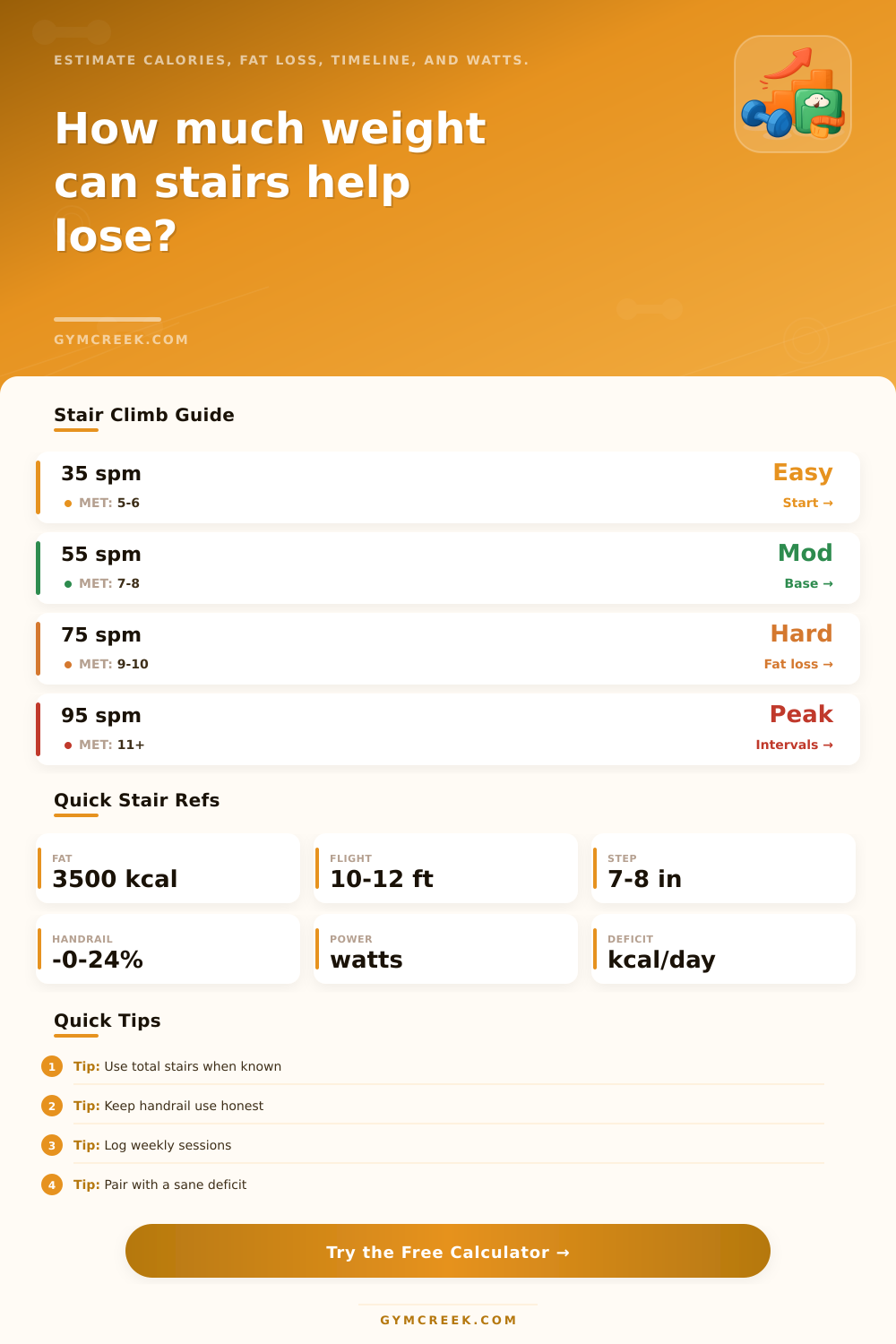
| Cadence | Typical feel | MET range | Best use |
|---|---|---|---|
| 30-45 steps/min | Easy to moderate | 5-6.5 MET | Beginner sessions, warmups, recovery days |
| 45-65 steps/min | Moderate steady | 6.5-8.5 MET | Repeatable calorie work with good posture |
| 65-85 steps/min | Hard sustained | 8.5-10.5 MET | Short fat-loss blocks or conditioned climbers |
| 85+ steps/min | Very hard | 10.5+ MET | Intervals, tests, brief finishes |
| Handrail use | Work factor | Calorie effect | Tracking note |
|---|---|---|---|
| No support | 1.00 | No reduction | Best for consistent body-weight estimates |
| Light touch | 0.94 | About 6% lower | Reasonable for balance without leaning |
| Moderate support | 0.86 | About 14% lower | Use when hands share noticeable load |
| Heavy leaning | 0.76 | About 24% lower | Calories can be overstated if ignored |
| Weekly plan | Exercise kcal | Food deficit | Fat loss estimate |
|---|---|---|---|
| 3 x 20 min easy climbs | 450-750 kcal | 0 kcal/day | 0.13-0.21 lb/week |
| 4 x 30 min steady climbs | 1,000-1,800 kcal | 250 kcal/day | 0.79-1.01 lb/week |
| 5 x 35 min hard climbs | 1,800-2,900 kcal | 300 kcal/day | 1.11-1.43 lb/week |
| 6 x mixed interval climbs | 2,000-3,400 kcal | 500 kcal/day | 1.57-1.97 lb/week |
| Output | Formula | Variables | Use |
|---|---|---|---|
| Calories | MET x 3.5 x kg / 200 x min | Weight, pace, time | Session energy estimate |
| Vertical gain | Stairs x step height | Steps and rise | Actual climbing volume |
| Fat loss | Weekly deficit / 3500 | Exercise plus diet | Planning estimate for body fat |
| Power | kg x 9.80665 x meters / sec | Mass, height, time | Mechanical climbing output |
💡Tips
If you know the total stair count, it gives a cleaner vertical gain estimate than flights because buildings vary in stairs per flight.
A higher weekly fat-loss estimate depends on recovery, food intake, sleep, and consistency. Avoid forcing the math beyond what your body can repeat.
Leaning on rails can make the same staircase feel easier because your arms are carrying part of the body-weight work.
For progress checks, repeat the same staircase or machine, step height, cadence method, and support level before judging calorie changes.
Stair climbing are an activity that many peoples perform every day. Additionally, stair climbing can be utilized as a forms of exercise. After two weeks of performing stair climbing, many people will notice how there leg feel different.
However, people must understand how stair climbing can aid in fat loss. Fat loss is create when the energy consumed is less then the energy expended. There is a calculator that you can utilize to calculate the energy expended by stair climbing by entering specific input into the calculator.
How Stair Climbing Helps You Lose Weight
These specific input include the stair count, the flight count, the step height, the duration of stair climbing, the cadence of stair climbing, the number of session performed each week, and the daily deficit burned during stair climbing. Each of these inputs can significantly impact the number of calories that can be burned during stair climbing. For instance, the body weight of the individual will impact the number of calories burned because a heavier individual will burn more calories than an individual of less body weight.
Additionally, the step height and the total number of stairs will determine the vertical distance that must be covered during stair climbing. Similarly, the cadence and the duration of stair climbing will determine the rate at which an individual can cover the vertical distance. Other factor to consider include the use of the stairwell handrail.
Many individual incorporate the handrail to maintain their balance while performing stair climbing. However, if an individual lean on the handrail, their legs wont have to perform as much work as if they did not utilize the handrail. As a result, the calculator will decrease the number of calories that are counted for stair climbing if individuals lean on the stairwell handrail.
The number of sessions performed per week and the number of calories burned each day will have an impact on the total amount of fat lost by an individual. Finally, the timeline that is provide with the stair climbing calculator will allow individuals to determine the number of day that it will take for them to reach their target body weight with the number of stair climbing session that they can perform each week. Cadence is a measurement of the rate at which an individual perform stair climbing that can be used as a measurement of the intensity of stair climbing.
For instance, if an individual slowly climb stairs that are tall, they will reach the top at a slower rate. However, if an individual rapidly climb stairs that are short, they will increase their cardiovascular exertion during stair climbing. The reference table for stair climbing incorporates different cadence rates for stair climbing and the amount of MET value that are created with those rates.
These MET values can help an individual to understand how intense their stair climbing is. Additionally, staircases is not created equally throughout the world. Many older staircases may have different height for their steps than moddern buildings.
Additionally, many stairwells have landing that may make stair climbing at different sections of the flight not equal to one another. In this case, the total number of stairs should be used rather than the number of flights to ensure that the individual accurately calculate their stair climbing session. Additionally, stair climbing calculators ask for the number of flights or the number of stairs that are to be climb, as the calculator can calculate one value from the other to provide an accurate measurement of the vertical distance that is covered during stair climbing.
The stair climbing calculator calculate the amount of mechanical power output during stair climbing. Mechanical power output is not the same as the number of calories that are burned during stair climbing. The mechanical power output of stair climbing increase if the body weight of the individual increase or if the vertical distance covered during stair climbing increase.
However, the mechanical power output of stair climbing decrease if the individual utilize the stairwell handrail while climbing the stairs. This measurement can help individuals compare their stair climbing performance at one building to another or on different stair climbing machines. It is common for individuals to assume that stair climbing at any rate or with any level of handrail use is the same as any other stair climbing session.
However, stair climbing slow with the use of the handrail is not the same as rapidly climb the stairs without utilizing the stairwell handrail. However, stair climbing calculators allow individuals to see these difference. Additionally, stair climbing is a relatively easy form of exercise to incorporate into an individual’s routine.
All that is required to stair climb is a set of stairs and a willingness to count the number of stairs that are climbed during the exercise. However, the vertical distance covered by stair climbing will lead to measurable result over time.