Stair Climber to Miles Calculator
Convert stair climber steps, floors, time, vertical gain, and calorie effort into practical mile equivalents for your workout log.
📌Presets
Each preset fills a realistic stair session. Use machine-reported steps when available, or estimate from time, pace, and steps per floor.
⚙Calculator
Stair climb snapshot
Enter your stair climber session to estimate miles and vertical work.
📊Session Metrics
📑Reference Tables
| Conversion | Formula | Best Use | Notes |
|---|---|---|---|
| Vertical miles | gain / 5,280 ft | Pure climb | Strict upward distance |
| Step miles | steps / flat steps | Step logs | Compares to walking count |
| Effort miles | kcal / kcal-mile | Cardio logs | Energy equivalent only |
| Floors | steps / steps-floor | Gym machines | Estimate varies by unit |
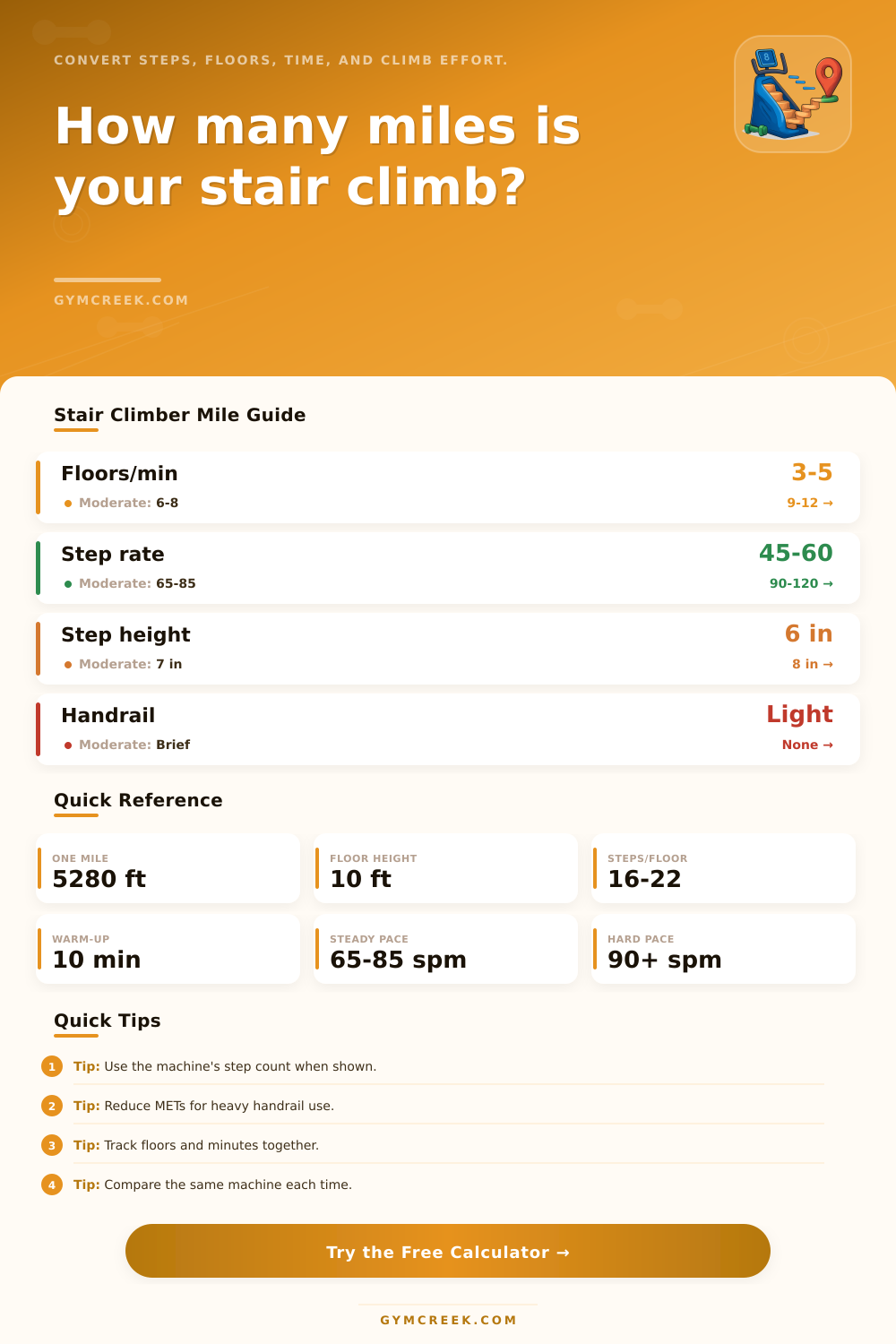
| Intensity | Step Rate | MET Range | Typical Feel |
|---|---|---|---|
| Easy | 45-60 spm | 5.5-6.5 | Warm-up pace |
| Moderate | 65-85 spm | 7.0-8.5 | Steady breathing |
| Vigorous | 90-110 spm | 9.0-11.0 | Hard but controlled |
| Weighted | 50-80 spm | 10.0-13.0 | Strength endurance |
| Session | Minutes | Floors | Expected Output |
|---|---|---|---|
| Warm-up | 8-12 | 25-55 | Light sweat |
| Cardio block | 20-35 | 80-170 | Steady effort |
| HIIT finisher | 8-16 | 50-110 | High power |
| Endurance climb | 45-60 | 180-320 | Sustained pace |
| Input | Why It Matters | Default | Adjust When |
|---|---|---|---|
| Step height | Sets vertical gain | 7.5 in | Machine rise differs |
| Steps/floor | Maps steps to floors | 19 | Using a building stairwell |
| Flat steps/mile | Compares step count | 2,200 | You know stride length |
| Handrail factor | Changes effort | Light | Leaning heavily |
💡Tips
A stair climber to miles calculator can take data from the stair climber to miles. A stair climber often displays various measurement of the user of the stair climber, such as the steps taken, the amount of floor climbed, and the amount of calories that were burned during that interval on the stair climber. However, none of these measurements indicate the distance that the individual stair climber to the next floor in the building traveled.
Thus, a stair climber to miles calculator allow for the user to compare the distance traveled by the stair climber to the distance that would be traveled by an individual that is jogging or walking. Furthermore, it can help to provide the user with an indication of whether or not the user’s climbing session was an easy or difficult session for the individual. Several different variables affect the calculation of the miles that the user traveled during the climbing interval.
Convert Stair Climber Steps to Miles
One of the variables is the weight of the individual user; the more weight that the individual moves, the more calories that the user will burn during the session. Another of the variables is the height of the steps; the higher the steps, the more miles that the user will travel. Additionally, if the user lean on the handrails during the climb, that will reduce the miles traveled by the user’s legs.
Each of these variables a stair climber to miles calculator accounts for. One of the most common measurements of the performance of the stair climber is the total steps that the user took. However, this variable isnt necessarily indicative of the difficulty of the climbing session.
For instance, an individual could take the same total steps on two separate days, but one day they may have been performing the steps at a faster rate and without using the handrails, while another session may have been slower and with the use of the handrails. Thus, a stair climber to miles calculator calculates both the vertical miles and the effort miles that the user traveled. The vertical miles will measure the distance by which the user ascended the stair climber, while the effort miles will calculate the distance that the user would have traveled on flat ground in relation to the calories that the user burned.
The number of steps that occur per floor is another variable of the calculator. Most stair climbers indicate that there are sixteen to twenty-two steps performed per floor; however, the steps per floor can vary from stair climber to stair climber. If an individual is attempting to climb stairs in the real world, those stairs will vary from the stair climber; thus, the user must adjust the steps per floor.
Furthermore, if the individual change stair climbers, the steps per floor may need to be adjusted to account for the differences between the stair climber machines in each gym. Consistency with the use of the stair climber can help to develop the aerobic capacity of the individual’s body, as well as to build the strength of the individual’s legs. For instance, an individual may perform the same interval of thirty minutes four times per week.
An individual can develop more leg strength with these intervals of thirty minutes per session four times per week than they would with one session of thirty minutes of intense climbing. Thus, the stair climber to miles calculator can help that individual to compare the distances covered in sessions of different lengths or intensities. For instance, if each session of forty minutes produce the same number of effort miles as shorter intervals of time, then the individual can choose which session best fits there schedule.
Pacing while descending the stairs can also change the calculations of the miles run by the stair climber. For instance, beginners may begin at a fast rate while they are descending, but beginners may slowly decrease their rate of descending over time. Experienced climbers may maintain a constant rate of stepping down the stairs.
The rate at which an individual descends a certain number of floors per minute is referred to as the floor rate; tracking the floor rate that an individual can maintain will help the individual to understand their improving fitness. The use of the handrails while descending the stairs may also impact the calculation. For instance, many individuals will rest their forearm on the handrails while descending the stairs; this will reduce the number of miles that are calculated for the legs of that individual.
The stair climber to miles calculator will account for the use of the handrails. If the individual indicates that they used the handrails to support their body, the calculator will reduce the number of calories and effort miles that are counted for that session. The resting of the forearm on the handrail for balance is different than resting the body weight on the handrail.
Other variables of stair climbing that a stair climber to miles calculator cannot measure include the evenness of the stairs, and the impact of the temperature and humidity in the location in which the stair climb occurs. Thus, while the calculator will help to provide an individual with a baseline measurement of the distance that they descended, the baseline does not account for each of these variables. For example, an individual may feel that they performed more effort when descending the stairs than the calculator suggests that they did; it is possible that these feelings are due to a change in the height of the steps on the stair climber or the level of fatigue that the individual felt during that session.
An individual should log the vertical miles, effort miles, and the floor rate. Each of these variables provide different information about the climbing session. For instance, vertical miles will show the total number of miles that were descended, effort miles will provide a comparison between stair climbing and other forms of cardiovascular exercise, and the floor rate will show at what rate an individual descended the stairs.
If these three variables are logged over time, an individual will be able to recognize any patterns in their fitness. These patterns will help to indicate whether increasing the duration of stair climbing sessions is more effective than increasing the intensity with which an individual performs those stair climbing sessions. A stair climber to miles calculator allows an individual to remove the guesswork in calculating the distance traveled by an individual while descending the stairs.
However, the calculator isnt a tool that will replace the observations of that individual. For instance, if an individual has climbed a large number of effort miles but feels fresh after descending the stairs with the stair climber, this suggests that the individual is well-recovered. However, if the individual has a high number of effort miles but also feels extremely exhausted, this indicates that the individual may be fatigued or dehydrated.