Stair Climber Distance Calculator
Estimate vertical distance, equivalent floors, horizontal mile estimate, calories burned, and power output from steps climbed, step height, machine floors, cadence, duration, body weight, resistance, and handrail use.
📌Stair Presets
Each preset fills a realistic stair climber session. Replace the values with your machine's step height, floor count, cadence, duration, body weight, resistance level, and handrail use.
⚙Calculator Inputs
Stair climber distance snapshot
Enter your stair climber workout to estimate vertical distance, floors, mile equivalent, calories, and watts.
📊Metrics Grid
📑Reference Tables
| Measure | Typical value | Formula | Use |
|---|---|---|---|
| One step | 7 to 8 in | steps x step height | Vertical distance |
| One floor | 10 ft | vertical ft / 10 | Building equivalent |
| One mile | 5,280 ft | vertical ft / 528 | Steep grade mile proxy |
| VAM | ft or m per hour | vertical / hours | Climbing rate |
| Cadence | Session feel | Common use | Watch item |
|---|---|---|---|
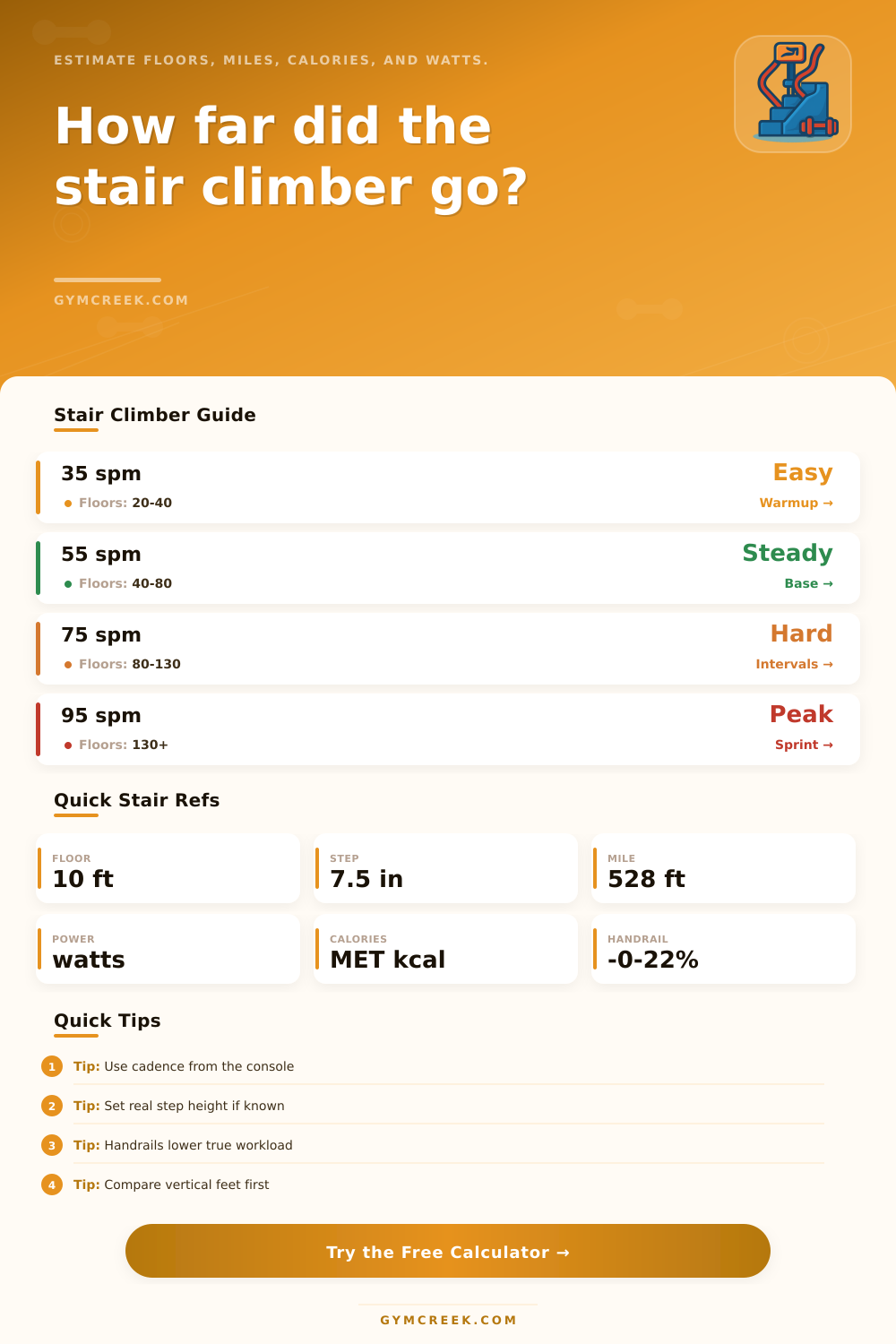
| 25-40 spm | Easy | Warmups, recovery | Smooth posture |
| 41-60 spm | Moderate | Base cardio | Breathing rhythm |
| 61-80 spm | Hard | Conditioning | Handrail reliance |
| 81+ spm | Very hard | Intervals | Step depth and control |
| Output | Calculation | Adjustment | Meaning |
|---|---|---|---|
| Calories | MET x 3.5 x kg / 200 x min | Resistance and support | Metabolic estimate |
| Work | kg x 9.80665 x meters | Support factor | Mechanical climb work |
| Watts | joules / seconds | Support factor | Average vertical power |
| Mile proxy | vertical ft / 528 | None | 10% grade equivalent |
| Input | Low value | High value | Effect |
|---|---|---|---|
| No handrail | 0% support | Full body load | Highest true work |
| Light touch | 6% support | Balance only | Small reduction |
| Moderate support | 14% support | Arms assisting | Lower calorie estimate |
| Heavy leaning | 22% support | Body weight unloaded | Largest correction |
💡Tips
A stair climber distance calculator allow people to convert these different input to measurements of the physical work that the individual performed. A stair climber distance calculator is useful in that it convert the raw data from the stair climber to data that can be used by the individual to compare there performance on different day with one another. To use a stair climber distance calculator, an individual must provide the calculator several piece of specific information.
The first of the pieces of information that the individual must provide to the stair climber distance calculator is the height of each step on the stair climber. The height of each step is typically between 7 and 8 inches, but the individual must use the actual height of the steps on its stair climber. If the individual dont provide the step height correctly to the calculator, the vertical distance that is calculate will be incorrect.
How to Use a Stair Climber Distance Calculator
Furthermore, it is also important to consider the use of the handrails when determining the distance that was covered. By leaning on the handrails while using the stair climber, the individual will be lifting less of their body weight than if they were using only their muscle to climb the stairs. Therefore, if stair climbing with the handrails isnt accounted for in the calculation, the individual may believe that they traveled a more greater distance with the stair climber then they did actualy travel.
The second of the pieces of information that the individual must provide to the stair climber distance calculator is the individual’s cadence and the length of time that they spent climbing the stairs… Both of which indicate whether or not the individual performed at a consistent effort during their stair climbing session. Cadence is the number of step that an individual takes per minute, while the duration is the length of time (in minutes) that they climbed the stair climber.
If an individual’s cadence changed throughout the session, their effort was not consistent throughout the session. Additionally, the final piece of information is the individual’s resistance level on the stair climber. The more resistance the individual provides, the more force that is exerted with each step that are taken on the stair climber.
Thus, the resistance level will affect the number of calories that the individual burns, as well as the amount of power that they exert with the stair climber. Furthermore, the resistance level will also allow for the calculation of the MET value of the session. The stair climber distance calculator will provide several different outputs after the calculation of the distance that is traveled.
The calculator provides the vertical distance that is covered (in units of feet); it will also provide the number of floors that are climbed during that period. Some stair climber distance calculators will even provide information about the distance that was climbed in relation to the length of a mile, the power (in units of watts) that the individual exerted during the session, and the number of calories that are burned per minute during that session. Each of these value can be used to compare the performance of an individual during one stair climbing session to that of another session.
In order to effectively use a stair climber distance calculator to provide meaningful comparisons between performance during different sessions, the individual should of use the same step height, use the same habits with the handrails, and climb for the same length of time during each session. Otherwise, it will be impossible to determine whether or not any changes in the outputs of the stair climber distance calculator resulted from changes in the individual’s physical effort to climb the stairs, or from the different variables that is introduced to the calculator. Thus, the use of the stair climber distance calculator can help an individual to understand the relationship between their physical effort, resistance level, and the distance that they traveled; it can help the individual to understand whether or not incorporating changes to variables like the resistance level or cadence increase their exertion of power or calories.