Squat to Deadlift Ratio Calculator
Compare estimated squat and deadlift 1RMs, bodyweight strength, stance/style context, training age, and imbalance flags.
📌Presets
Presets use realistic recent sets. They compare the ratio, not a separate squat level or deadlift level ranking.
⚙Calculator
Squat to deadlift snapshot
Enter recent squat and deadlift sets to compare estimated 1RMs.
📊Metrics Grid
📑Reference Tables
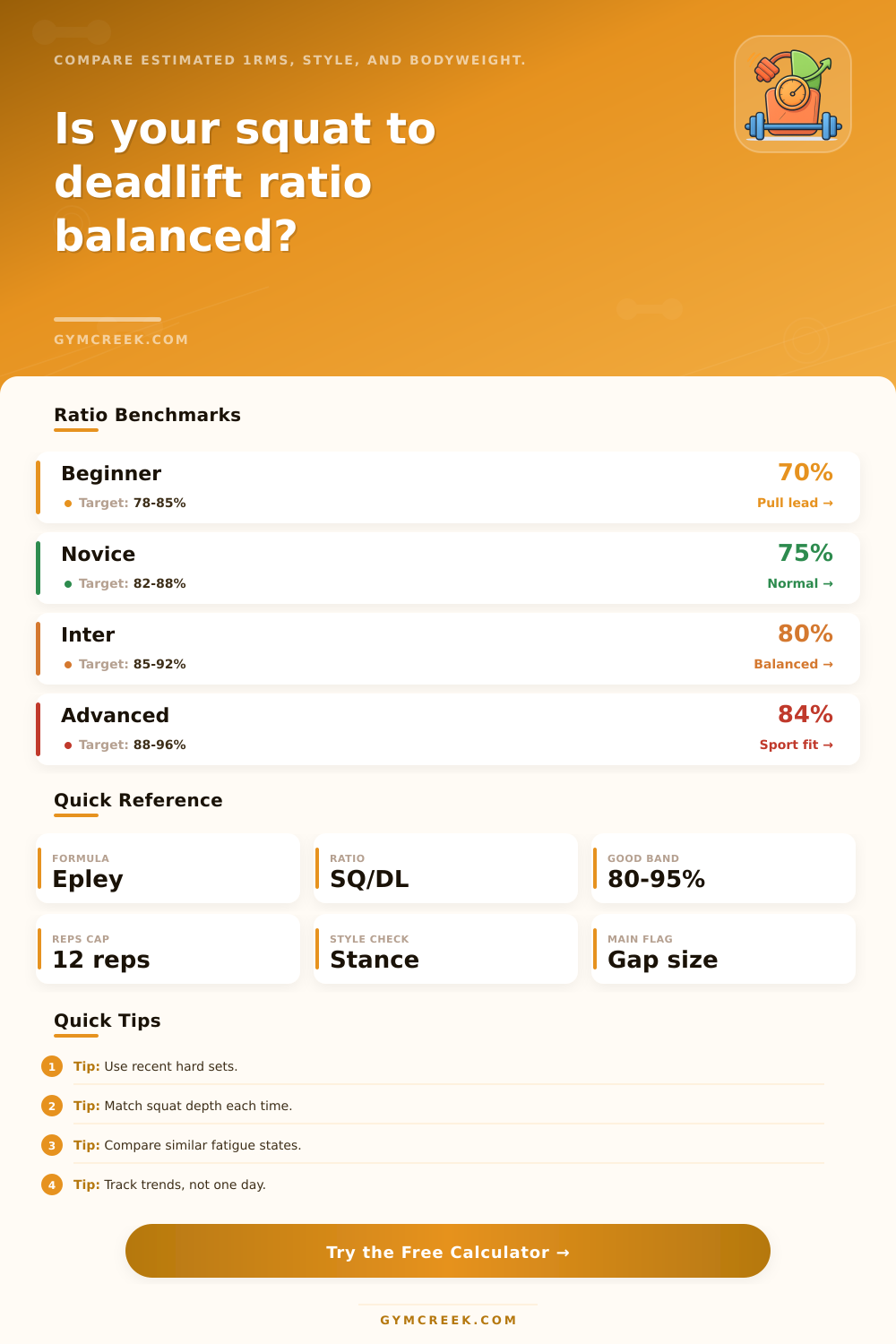
| Training Age | Typical SQ/DL | Common Pattern | Watch For |
|---|---|---|---|
| Beginner | 70-85% | Deadlift jumps first | Depth changes |
| Novice | 75-88% | Ratio stabilizes | Technique drift |
| Intermediate | 80-93% | More balanced | Weak variation |
| Advanced | 84-98% | Sport specific | Recovery cost |
| Style Factor | May Raise | May Lower | Ratio Note |
|---|---|---|---|
| Low-bar squat | Squat max | Depth margin | Higher ratio |
| High-bar squat | Quad demand | Absolute load | Moderate ratio |
| Sumo deadlift | Pull efficiency | ROM | Lower ratio |
| Trap-bar pull | Pull load | Comparison fit | Use caution |
| Scenario | Ratio Read | Likely Cause | Next Check |
|---|---|---|---|
| Under 75% | Pull dominant | Squat skill or depth | Video squat |
| 80-92% | Balanced | Normal spread | Trend monthly |
| 95-105% | Squat strong | Pull setup or grip | Check lockout |
| Over 105% | Deadlift lag | Hinge weakness | Retest pull |
| Formula | Calculation | Best Range | Use Here |
|---|---|---|---|
| Epley 1RM | Weight x (1 + reps/30) | 1-10 reps | Main estimate |
| SQ/DL ratio | Squat 1RM / Deadlift 1RM | Any maxes | Primary score |
| BW ratio | 1RM / bodyweight | Same unit | Context metric |
| Gap size | Deadlift 1RM - Squat 1RM | Same unit | Flag support |
💡Tips
The squat to deadlift ratio are a tool that demonstrates the relationship between your squat and your deadlift. The squat to deadlift ratio is a helpful tool because it demonstrates your training’s development over time. Because the squat and the deadlift is two different lifts, they develop different requirement from the human body.
If the two lifts’ numbers on a squat to deadlift ratio is similar to one another, that indicates that your squat and your deadlift are developing at a similar rate. However, if the two numbers are far from one another, that indicates that you may have an issue with your lifting style, your recovery, or your skill in either exercise. To calculate your squat to deadlift ratio, you will need to enter your most recent squat set and deadlift sets as well as your body weight.
How to calculate your squat to deadlift ratio
Additionally, you must enter the details of how you performs a squat (low-bar versus high-bar) and how you deadlift (conventional versus sumo). This is important because low-bar squats allow an individual to move more weight than high-bar squats, and sumo deadlift have a shorter range of motion than conventional deadlifts. The difference between the two lifts will affect the ratio that is calculate for the squat to deadlift ratio.
Many individuals will notice their squat to deadlift ratio early in their training because the deadlift will often increase more rapid than the squat. This is due to the fact that the deadlift is a more simplify exercise than the squat. The squat to deadlift ratio will remain fairly stable once the individual becomes an intermediate lifter and becomes even more stable as that individual develops into an advanced lifter with a potential point of specialization in one lift or the other.
An individual’s body weight will play a role in their squat to deadlift ratio. For instance, if an individual weighs 190 pound and can squat 315 pounds, they can squat 1.6 times their body weight. However, if that same individual can deadlift 385 pounds, they are able to deadlift 2 times their body weight.
These calculation will help you to understand whether your squat and deadlifts is developing in line with your strength. The calculator will provide these determinations for you so that you dont need to perform the calculation yourself. An individual’s level of fatigue can play a role in their calculated squat to deadlift ratio.
If you calculate the squat and the deadlift on the same day after a heavy training week, your squat will likely be lower than it should be due to the need for high level of technical precision when squatting while tired. However, performing the same squat and deadlift test when you are fresh will likely indicate that your deadlift will be stronger than it will be during a typical training day. The calculator will include a field to indicate your level of fatigue to calculate your squat to deadlift ratio.
An individual’s different lifting style can also impact the squat to deadlift ratio. Paused squats or deficit deadlifts allow for different ranges of motion and will impact the indicated strength for each lift. The reference table on this page will indicate the difference in squat to deadlift ratios according to these different lifting styles.
These tables can help you to recognize if your lifts’ differences are caused by your lifting style or if you are developing a strength imbalance in your squat or deadlift. An individual’s training age will also play a role in their squat to deadlift ratio. Beginners will have a gap between their squat and deadlift that is more significant than more experienced lifter due to the development in squat and deadlift skills.
As an individual gain more experience in these lifts, that gap will even out. At an intermediate level, an individual will have stabilized their squat to deadlift ratio. However, their body shape will still create some difference in the two lifts.
Advanced lifters may have a significant gap between their squat and deadlift in favor of one lift over the other due to a specialization in those lifts. The calculator will take into account the training age of the individual to ensure that the ratio does not incorrectly indicate an issue for those who have dedicated their strength training to one lift over the other. The absolute difference between a squat and a deadlift can indicate information regarding the strength of each lift.
The difference between a squat and deadlift of 50 pounds will be more significant for an individual who has a light body weight than it will be for an individual with a heavier body weight. This information will help you to indicate whether or not the gap between your squat and deadlift strength is significant. While small gap between these two lifts are normal, large gaps will indicate that you may need to adjust your technique in your squat or deadlift exercises.
When comparing your squat and deadlift sets, make sure that you are not making any mistake. Do not compare a set performed during a deload week with a set performed during a high-volume training week. Additionally, ensure that your squat or deadlift sets have similarity in the amount of effort required for each lift to be performed.
For example, inconsistent squat depth will result in an inaccurate squat to deadlift ratio. To accurately calculate your squat to deadlift ratio, use one squat and deadlift protocol and perform these test at regular intervals over several months. The calculator will allow you to rerun your test so that you can track your development over time.
Your squat to deadlift ratio indicate your strength at a specific moment. Your ratio will change with your training and with your recovery from intense training. While this ratio will not remain the same every training day, it will help you to recognize if you have an imbalance in your squat or deadlift strength.
By determining if your calculated squat to deadlift ratio matches your training age, lifting style, and workload, you can determine if you need to adjust your technique or your training program. This calculator will provide you with a starting point for evaluating your training program.