Squash Calorie Calculator
Estimate calories burned during squash matches, solo drills, conditioned games, and tournament play using MET logic, rally tempo, court movement, rest ratio, body weight, and session format.
📌Presets
Each preset fills a realistic squash profile and recalculates the estimate.
⚙Calculator
Squash calorie snapshot
Enter match format, rally tempo, drill minutes, rest ratio, and body size to estimate calories.
📊Fitness Metrics
🧮Formula Cards
Calories per minute = MET x 3.5 x body weight in kg / 200. The calculator applies this to active play, drill work, and rest separately.
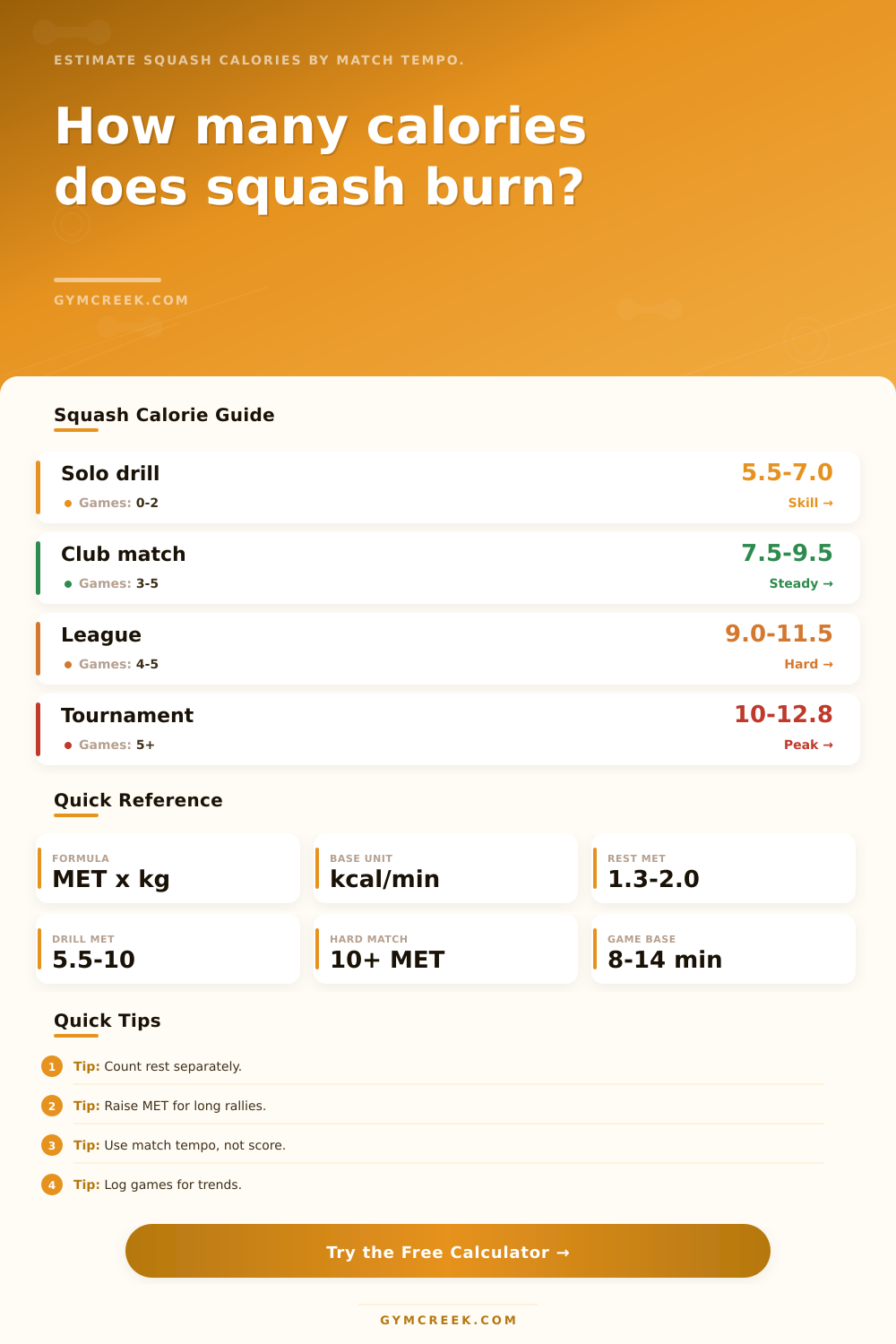
Base squash MET comes from match level, then rally tempo and shot volume adjust the estimate for short points, long rallies, or interval bursts.
Court movement changes match MET, while drill type sets a separate drill MET so ghosting, solo hitting, and conditioned games are not treated the same.
Mifflin-St Jeor estimates BMR from body size, age, and gender; activity multiplier turns it into TDEE so the session can be shown as a daily share.
📑Reference Tables
| Match Level | Base MET | Typical Games | Session Feel |
|---|---|---|---|
| Social hit | 6.2 MET | 2 to 4 | Skill pace |
| Club match | 8.0 MET | 3 to 5 | Steady hard |
| League match | 9.4 MET | 4 to 5 | Competitive |
| Advanced training | 10.2 MET | 4 to 6 | High load |
| Tournament pace | 11.2 MET | 5 or more | Peak effort |
| Rally Tempo | Modifier | Shot Rate | Best Input Cue |
|---|---|---|---|
| Short rallies | 0.92x | Under 22/min | Quick points |
| Steady rallies | 1.00x | 22 to 34/min | Normal club play |
| Long rallies | 1.08x | 35 to 44/min | Many resets |
| Pressure tempo | 1.15x | 45 to 54/min | Repeated attacks |
| Explosive intervals | 1.20x | 55+/min | Short surges |
| Drill Mix | Drill MET | Movement Bias | Example |
|---|---|---|---|
| Technique drills | 5.8 MET | Low | Feeds |
| Solo hitting | 6.4 MET | Medium | Length work |
| Ghosting | 8.4 MET | High | Six corners |
| Conditioned games | 9.4 MET | High | Boast drive |
| Doubles rotation | 6.8 MET | Shared | Court rotation |
| Formula | Variables | Output | When Used |
|---|---|---|---|
| Match kcal | MET, kg, min | Game burn | Games played |
| Drill kcal | Drill MET, kg | Drill burn | Extra blocks |
| Rest kcal | Rest ratio, kg | Break burn | Between games |
| Mifflin BMR | kg, cm, age | Baseline | Daily context |
💡Tips
Most people step onto the court thinking they are just there to hit a ball, but it’s actualy much more complicated and taxing than that. Get on the court, smack a ball around, and end up with burning lungs and head spinning. Go get yourself a big meal, that’s what I just did! It was not quite like that. When you’re competing at your best, there’s quite a bit of physical work going into it. A casual, fun game on the other hand, require much less effort.
If you’re trying to increase stamina or working on losing some weight, then it’s important to know that distinction. When you input your playing session data, the calculator figure out the rest. There’s no need to guess or understand conversions and coefficients. You get a realistic idea of how many calorie you burned.
How to Calculate Calories Burned in Squash
How you play is as important as duration. A casual two-hour session with frequent breaks might burn fewer calories then a focused forty-five-minute block of intense rally play. This is what people that focus on hours alone is overlooking. One of the biggest factors in input is rally tempo. How many times do you stop and start? A short point resets frequently, dropping the overall metabolic cost greatly from a long rally.
To compensate, the tool weigh the intensity of those exchanges. Stopping and starting isn’t as hard on you as sustaining high heart rate throughout. Guessing about your real life play style won’t cut it. Many new players miss more shots which mean shorter rallies. That’s OK. It is physics. The tool figure all this into account.
The weight matter too; specifically, bodyweight. Basic thermodynamics means it take more energy to move something heavy than light. That said, you don’t have to weigh yourself exactly on the scale to get a good idea. You just want to stay within five pounds or so to still benefit from estimate.
It’s about understanding how different activities compare in effort over time. A single drill session alone burns fewer calories than a full-on league match even though they might last same amount of time. There are decisions to make, and tactical movements that aren’t present during solo work. Low value burns: Drills are frequently criticized as low value burners. If you’re working hard and solo-hitting or ghosting a ball, it can be a high value Metabolic Equivalent.
That’s why the calculator differentiate between drill minutes and match play time. It knows that technique drills versus conditioning circuits has different values. So you can tell which aspect of your training contribute to the burn. Shadow drills for 20-minutes count too. Just not the same way as competitive play for 20-minutes.
Finally, there’s rest ratio. That’s a little-known but powerful consideration. Amateur players tend to have longer changeovers than pros do. You can account for that in the tool. Say you’re getting water and checking your phone for five minutes between games. Your average burn rate decrease as a result. Again, that’s not necessarily a bad thing; it just makes your session more sustainable.
Model what you actualy did. Don’t pretend you were playing continuously if you weren’t. Knowing what those inputs are enable you to make better nutrition and recovery choices. You’ll realize when your session is a real challenge, or when it’s just light cardio. That protects you from eating too much after an easy match, and not enough after a hard one.
The page has a set of reference tables that spell all that out. These describe how your match level relates to intensity and give you a benchmark for moderate versus hard effort. Hard effort. The game of squash is one of contrasts: deep lunges followed by rapid recovery, abrupt halts interrupted by bursts of energy. The same holds true for your calorie burn.
Don’t look for a single figure to represent all the details of your fitness experience. Instead, think of it as a trend indicator and use it as such. Over time if you are training hard and see the burn rise month after month, then that’s a sign of improved density and effort. It is a little thing. But it is important. Keep the emphasis on honesty in input and consistency. And let the numbers speak for themselves.