Sprint Triathlon Time Calculator
Predict a sprint-distance finish from 750 m swim pace, 20 km bike speed, 5 km run pace, T1, T2, course factors, and beginner versus racer scenarios.
📌Sprint Race Presets
Every preset stays inside the sprint format. Standard sprint distance is 750 m swim, 20 km bike, and 5 km run, but you can adjust for short-course events.
⚙Athlete Profile
📏Sprint Distance And Pace Inputs
Your sprint triathlon estimate
Enter swim, bike, run, and transition data to calculate a sprint-distance finish time.
📊Sprint Metrics
📘Sprint Triathlon References
| Band | Finish time | Typical profile | Main limiter |
|---|---|---|---|
| First finish | 1:45 to 2:15 | New triathlete | Swim comfort and T1 |
| Steady finisher | 1:25 to 1:45 | Regular endurance training | Bike pacing and run fade |
| Club racer | 1:12 to 1:25 | Experienced age-grouper | Bike speed and transitions |
| Local podium | 0:58 to 1:12 | Strong racer | Run durability after bike |
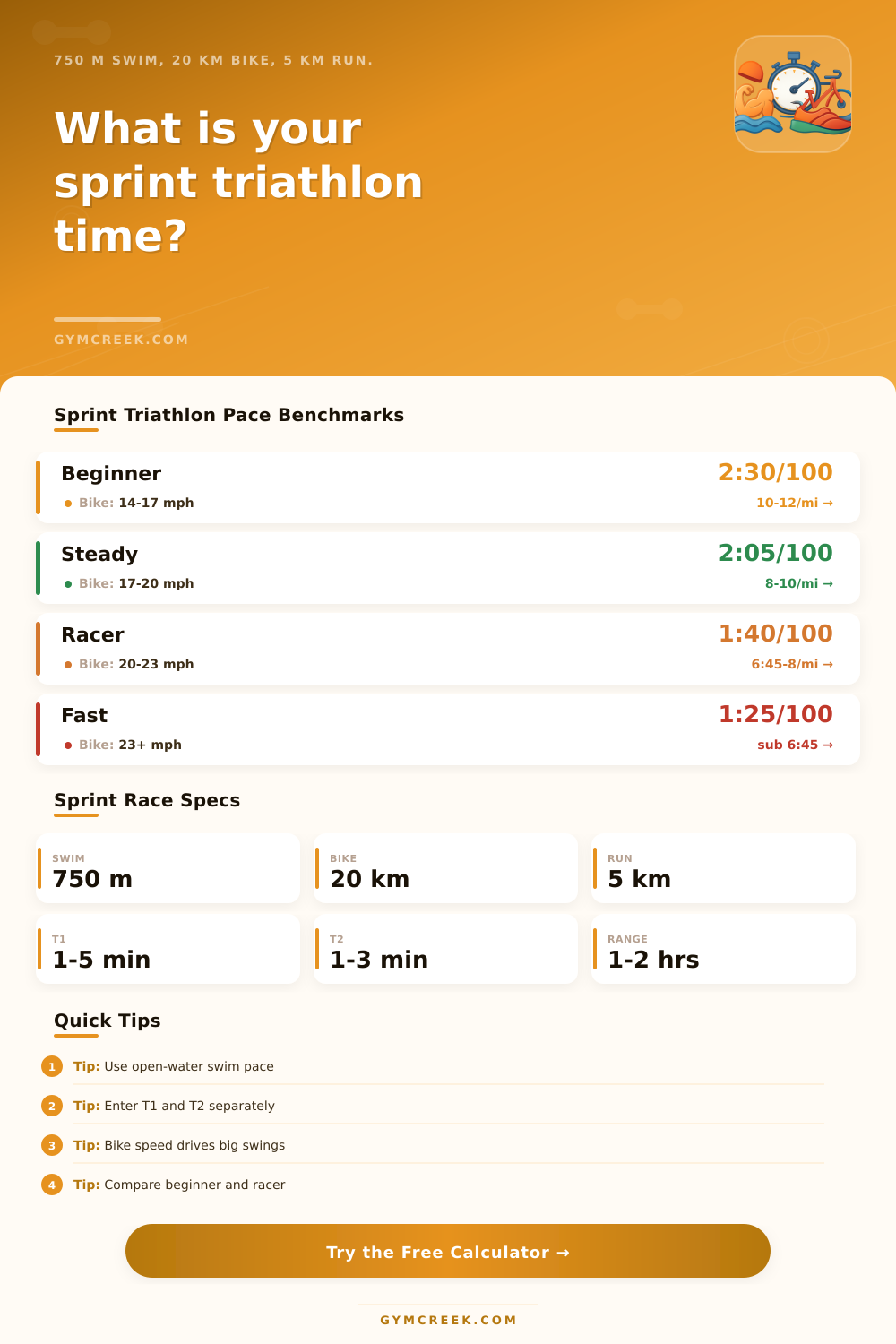
| Level | Swim pace | Bike speed | Run pace |
|---|---|---|---|
| Beginner | 2:20 to 2:50 per 100 m | 22 to 27 km/h | 6:15 to 7:45 per km |
| Steady | 1:55 to 2:20 per 100 m | 27 to 32 km/h | 5:10 to 6:15 per km |
| Racer | 1:35 to 1:55 per 100 m | 32 to 37 km/h | 4:10 to 5:10 per km |
| Fast | Under 1:35 per 100 m | 37+ km/h | Under 4:10 per km |
| Transition | Beginner | Trained racer | Fast target |
|---|---|---|---|
| T1 swim to bike | 3:00 to 6:00 | 1:30 to 3:00 | Under 1:30 |
| T2 bike to run | 2:00 to 4:00 | 0:50 to 2:00 | Under 0:50 |
| Total transition | 5:00 to 10:00 | 2:20 to 5:00 | Under 2:20 |
| Time impact | Large for sprint | Meaningful | Often decisive |
| Formula | Inputs | Output | Use |
|---|---|---|---|
| Swim time | Distance and pace | Minutes | 750 m split |
| Bike time | Distance / speed | Minutes | 20 km split |
| Run time | Distance x pace | Minutes | 5 km split |
| Finish time | Splits + T1 + T2 | Total time | Race prediction |
| Mifflin-St Jeor | Sex, age, size | BMR/TDEE | Context only |
💡Calculation Tips
A sprint triathlon are a race that includes a swim, a bike, and a run. To compete in a sprint triathlon, you must plan your race. The planning for a sprint triathlon will determine your training and how you race.
Although sprint triathlons is short races, the time you spend in each portion of the race will add up to your total time. You can use a calculator to estimate your total time for a sprint triathlon. This calculator will take your swim time, your bike speed, your running speed, and the time you spend in transitions to provide you with your total time for the sprint triathlon.
Estimate Your Sprint Triathlon Time
For this calculator to estimate your total time effective, you must use accurate input. For your swim time, you must use the pace that you use for open water races because swimming in an open water setting is different than swimming in a swimming pool. For your bike speed, you should use a speed that you can maintain on the course because the course features hill and other obstacles.
For your running speed, you should use a pace that you can maintain after cycling because cycling to the end of the race and thereafter running is more physically difficult than mere running on your own. Transitions are part of a sprint triathlon in which competitors change equipment. The first transition, T1, is when you shed your wetsuit and put on a helmet.
The second transition, T2, is when you remove your bike and put on your running shoes. These transitions takes time, so you should account for them in your total time estimate. Many first-time sprint triathletes dont account for the time it take to complete T1 and T2, so you should account for them in your total time estimate to provide a more realistic time for your sprint triathlon.
Course conditions will impact your total time for your sprint triathlon. A flat course allow for high bike speeds, while a hilly course will negatively impact your bike speed. High temperatures will impact your running speed, as will the wind impact on your bike speed.
The calculator should account for these variables to show the actual impact of the course on your total race time. Benchmarks can help you understand your predicted time for your sprint triathlon. First-time finishers may take between 105 and 135 minutes to complete a sprint triathlon.
Experienced age-group athlete usually complete sprint triathlons in a time range of 125 to 145 minutes. Club racers can complete sprint triathlons in under 125 minutes. These time ranges provides a means of comparing your predicted time to an average sprint triathlon time.
Avoiding common mistake will increase the accuracy of the calculator. One common mistake is using your pool race time instead of your open water race time. Your pool times are faster than open water time.
Another mistake is using your peak power on the bike instead of your average speed on the course. Another mistake is using a running pace that is too fast for you to maintain after cycling. Avoiding these mistakes will improve the accuracy of your time estimates.
Including an execution buffer will provide you with extra time in case of any delay. For example, your first transition may take longer than expected. Or you may get nervous starting the race or having a slow start in the water.
Finally, you may slow down on your bike for various reason. An execution buffer of three or five percent will provide more breathing room in case of delays. Including an execution buffer will ensure that your plan account for the difference between training and the actual race day.
The calculator is most useful when you use it well before the sprint triathlon. For example, if your estimated time for your transitions is long, you can use that to motivate you to practice your transitions. If your bike speed is slow, you may want to focus on training for better bike speed.
Thus, the sprint triathlon time calculator provide a map for your training plan that you can adjust along the way.