Sprint Stride Length Calculator
Estimate step length, two-step gait stride length, stride frequency, sprint speed, and goal gaps from a timed sprint split or video contact count.
Your Sprint Stride Results
Results appear after calculation.
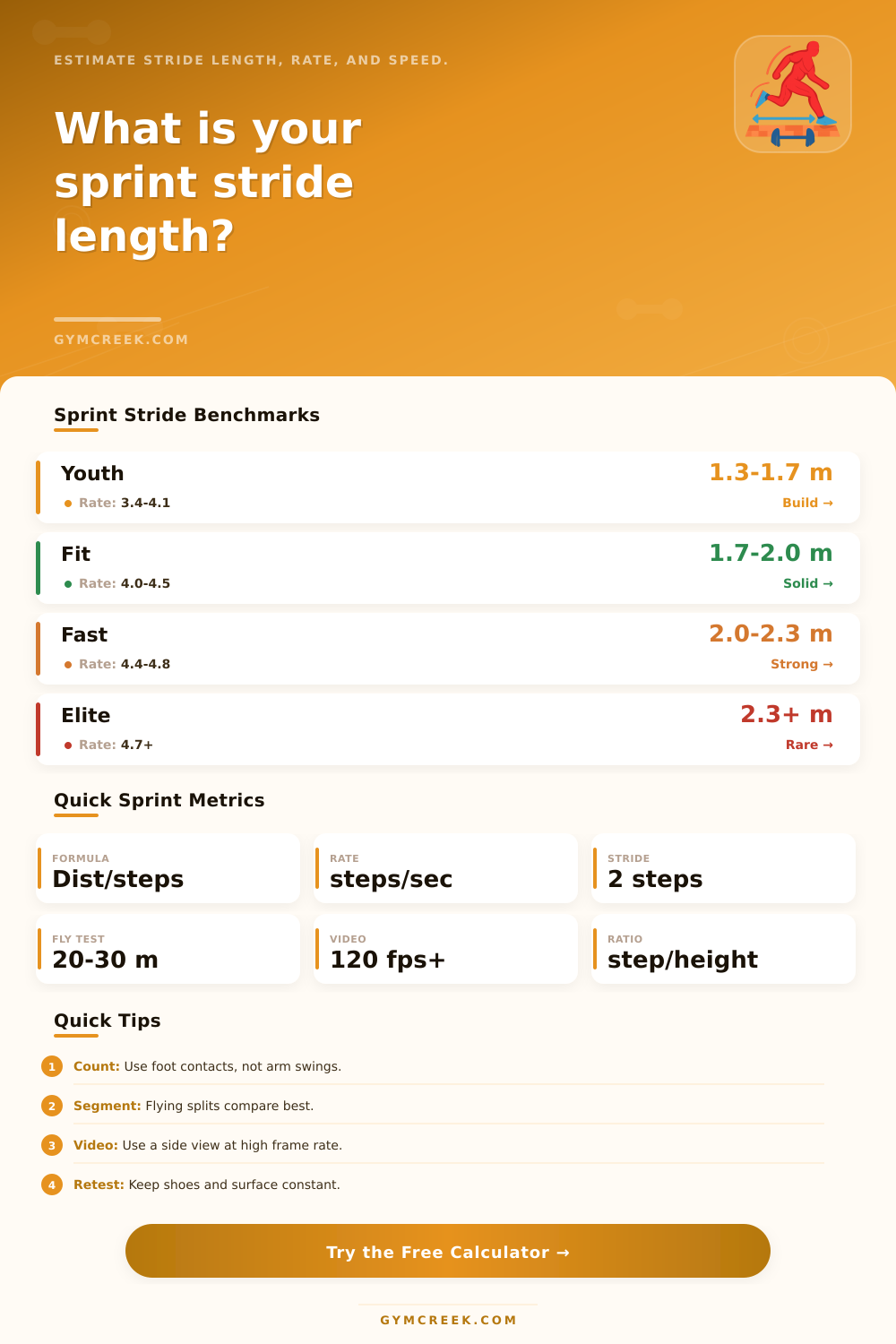
| Group | Typical step length | Typical step rate | Best use |
|---|---|---|---|
| Youth or beginner | 1.20 to 1.70 m | 3.4 to 4.1 steps/sec | Basic mechanics and timing practice |
| Fit team sport athlete | 1.70 to 2.05 m | 4.0 to 4.5 steps/sec | Acceleration and field sprint checks |
| Trained sprinter | 2.00 to 2.35 m | 4.4 to 4.9 steps/sec | Flying sprint and race modeling |
| Elite max velocity | 2.30 m or longer | 4.7 steps/sec or faster | High speed splits with video review |
| Test | What it shows | Counting note | Interpret carefully |
|---|---|---|---|
| 10 yd or 10 m split | Acceleration step pattern | Short contacts and rising posture | Step length should be shorter early |
| 30 m from standing | Acceleration plus transition | Count every foot contact in the zone | Average hides early and late steps |
| Flying 20 m | Max velocity rhythm | Start count after entry gate | Best setup for stride comparison |
| Full 100 m average | Race-level summary | Use video or reliable split data | Fatigue lowers late-race stride rate |
| Metric | Formula | Unit | Meaning |
|---|---|---|---|
| Step length | Distance divided by total steps | m or ft | Distance covered per foot contact |
| Gait stride length | Step length multiplied by 2 | m or ft | One complete left-right cycle |
| Step rate | Total steps divided by time | steps/sec | How quickly contacts occur |
| Sprint speed | Distance divided by time | m/s or mph | Segment average velocity |
Sprinting involve the consideration of the relationship between step length and step rate, as these two factor determine an individuals maximum sprinting velocity. Step length is the distance that an individual cover during a single step. Step rate is the numbers of steps that an individual take during a sprint.
If an individual focus solely upon increasing their step length, they may begin to overstride. Overstriding occurs when an individual’s foot land too far in front of there center of mass. This overstriding creates resistance for the sprinters, which slow them down.
How Step Length and Step Rate Affect Sprint Speed
Additionally, if an individual focus solely upon increasing their step rate, they may begin to develop an inefficient gait. An inefficient gait is created when an individual focus too much upon the quickening of the movement of their legs without covering sufficient distance. Thus, an individual must find a balance between their step length and step rate in order to maximize their sprints velocity.
An individual can calculate their step length and rate through the use of tools like video analysis or timing gates. Additionally, while it may seem possible to manually calculate an individual’s step length and rate, it isnt easy for the individual to calculate their distance during a sprint. The calculator provided here can calculate an individual’s step length by taking the total distance that they sprint and dividing it by the total number of steps that they take.
Individual must understand the difference between a step and a stride. A step is when an individual’s foot make contact with the ground. A stride is a distance covered in two steps.
Thus, a stride is twice the length of a step. An individual’s step length change during a sprint. During the drive phase of a sprint, an individual will take shorter steps because they are lifting their body into the air.
However, when an individual reach their maximum velocity, their step length will be longer due to the rise of an individual’s hips during maximum velocity sprints. Thus, when an individual calculates their step length, they must consider the phase of their sprint. For instance, an individual starting from a standing start will have different measurements of their step length and rate different than a sprint where they are already in motion.
Thus, the standing start average will be lower than the average for a sprint where they are flying start. A flying start will measure an individual while they are already sprinting at there maximum velocity; therefore their average will be higher than their standing start average. Additionally, it would not be appropriate for an individual to calculate their step length and rate from both a standing start and a flying sprint.
The two measurements will not provide an accurate average for that individual’s step length and sprint rate. An individual’s height will impact their step length. An individual that is taller will naturaly have a longer stride than an individual that is shorter.
However, longer strides dont necessarily mean that an individual is exhibiting the most efficient stride. Efficiency is determined by dividing an individual’s stride length by the individuals height. Thus, this calculator utilize an individual’s height and weight in order to determine the most efficient use of there physical leverage when sprinting.
An individual’s environment can impact their stride length and rate measurements. For instance, if there is a headwind, an individual’s stride length will decrease. Additionally, if the individual is sprinting on a relatively soft surface, the individual will use more energy than if sprinting on a firm surface.
Thus, the stride length and rate measurements must account for the environment in which the individual is sprinting. For instance, if an individual ignore the variable of the sprinting ground and focuses solely upon the power that an individual can generate, they may ignore the variable of stride length. For instance, an increase in power generated by plyometrics will increase an individual’s stride length; however, increasing stride length may decrease an individual’s stride rate.
Additionally, if an individual have high stride rate but low stride length, they may be lacking explosive power. Additionally, if an individual has high stride length but low stride rate, they may be lacking in there neuromuscular coordination. By determining an individual’s target velocity for sprints, it is possible to calculate the necessary stride length and stride rate for that target velocity.
Additionally, knowing these requirement will allow for the creation of a training plan for that individual to improve their stride length and rate to reach there goal velocity. Thus, by tracking their stride length and rate, an individual can transition from using intuition to developing a more scientific understanding of their running velocity.