Sprint Pace Calculator
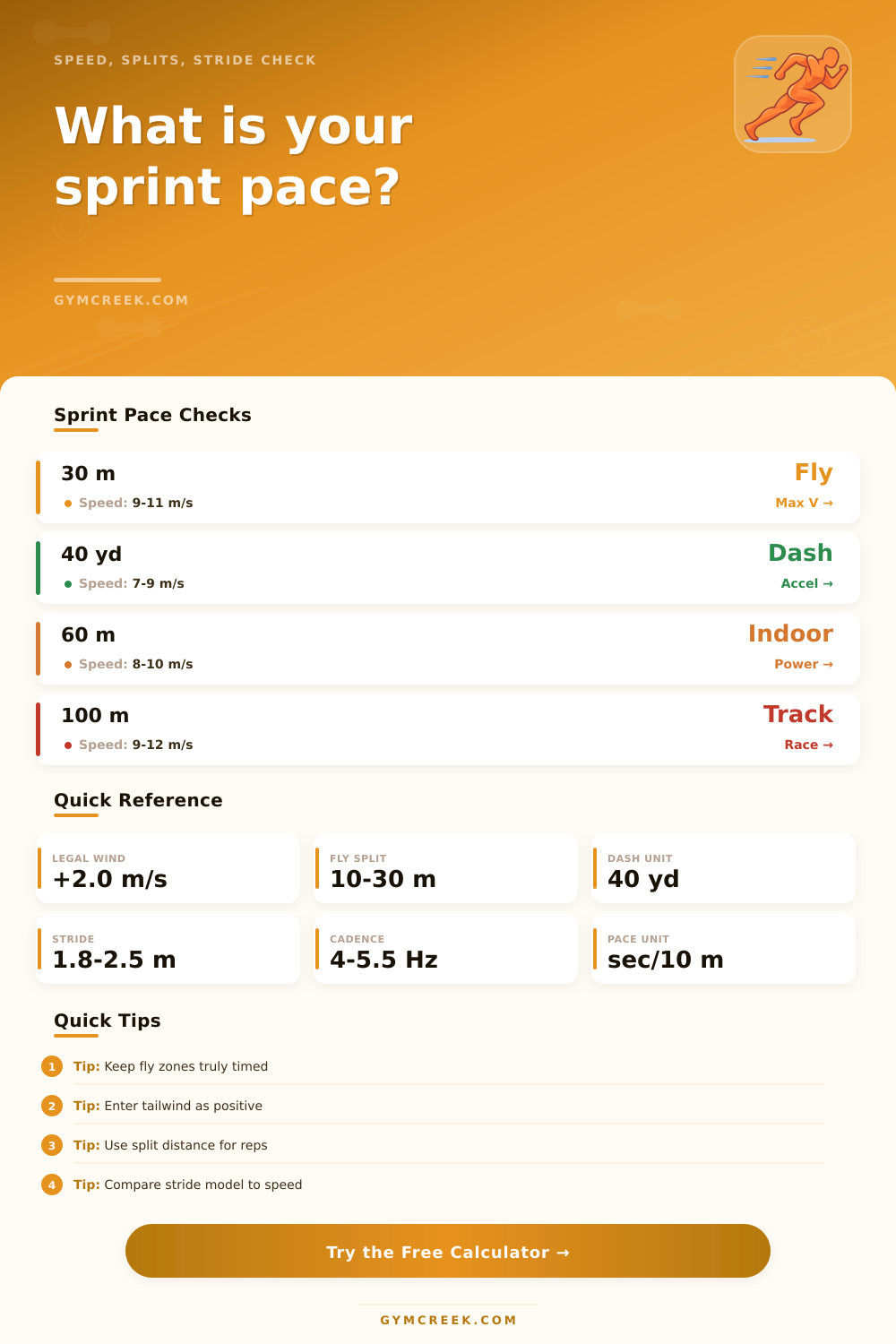
Convert sprint distance and time into split pace, speed, wind and surface adjusted marks, flying-start estimates, and stride length/cadence checks.
📌Presets
Presets are examples only. Edit every field to match the actual timing gate, hand-time, race clock, surface, wind, and stride data you want to compare.
🏁Sprint Inputs
Sprint pace snapshot
Enter sprint details to calculate speed, splits, stride match, and adjusted comparison marks.
📊Pace Metrics
📑Reference Tables
| Checkpoint | Cumulative | Segment | Segment speed |
|---|---|---|---|
| 10 m | --- | --- | --- |
| 20 m | --- | --- | --- |
| 30 m | --- | --- | --- |
| 40 m | --- | --- | --- |
| Metric | Value | Use | Notes |
|---|---|---|---|
| sec/10 m | --- | Reps | Track cones |
| sec/100 m | --- | Race pace | Equivalent |
| mph | --- | Combine | Speed |
| km/h | --- | Track | Speed |
| Start | Best use | Split shape | Offset note |
|---|---|---|---|
| Blocks | Race marks | Slow first split | Reaction included |
| Three-point | 40 yd dash | Power start | No gun reaction |
| Standing | Training reps | Smoother open | Coach timing varies |
| Flying | Max velocity | Nearly even | Run-in matters |
| Relay fly-in | Exchange zones | Fast first split | Do not compare to blocks |
| Metric | Developing | Competitive | Elite cue |
|---|---|---|---|
| Stride length | 1.5-1.9 m | 1.9-2.3 m | 2.3 m+ |
| Cadence | 3.8-4.4 Hz | 4.4-5.0 Hz | 5.0 Hz+ |
| 30 m fly | 3.4-3.8 s | 3.0-3.4 s | <3.0 s |
| 10 m fly | 1.1-1.3 s | 0.95-1.1 s | <0.95 s |
💡Coaching Tips
A 100-meter sprint time is not a single number; rather, a 100 meter sprint time is affected by many different variable. Variables like the type of start, the wind speed during the sprint, and the type of track surface will impact the sprint time record on a clock. For instance, two sprint times may be recorded as the same number of second, but those times for the same sprinter can still differ if one start type is used instead of the other.
An understanding of these different variables impact sprints will allow an individual to transform those raw sprint times into a useful measurement for training. The calculator on this page will translate raw sprint times into comparable marks. To use the calculator, the user will enter the distance that was sprinted, the clock reading for that sprint, and the conditions of the sprint.
What Affects 100 Meter Sprint Times
Based on these initial input, the calculator will produce adjusted times for wind and track surface, a projected sprint distance in 40 yard marks, and an estimated sprint speed based on the start type used during the sprint. Each of these initial inputs will have an impact upon the results that the calculator displays. The start types that can be entered into the calculator will have an impact upon the results of the calculation of sprint performance.
Because acceleration is not linear during a sprint performance, sprints that use a block start will take longer than sprints that use a flying start. As such, the calculator will apply a different mathematical curve to each of these start type. For instance, using hand-timed starting marks for standing starts will contrast against automatic block start time for the same sprinters; using these different methods to time the starts will prevent the development of incorrect comparison between the sprinters.
Wind and the track surface will also impact the start and sprint time. For instance, the wind will reduce sprint times if the sprint occurs in a tailwind, while sprint times will be increased if the sprint occurs on a soft track surface. The calculator will account for these variable, as well as remove these variables from the raw time to allow for comparisons between different sprints.
Although the impact of both tailwinds and track surfaces will have an impact upon the sprint times for shorter distances, the impact upon those times will become more pronounced as the distance that is sprinted increase. The calculator will utilize the stride length and cadence of the sprinters to provide a consistency check for the times entered. For instance, if an athlete enter their stride length and their cadence in the calculator, the calculator can multiply those two values to determine a modeled sprint speed for the athlete; that speed can then be compared to the timed sprint average.
If both numbers is similar, the stride length and cadence are considered to be reliable inputs for the sprint times. However, if the two values are not similar, one of those measurement is likely incorrect. The split distance may allow an individual to view the sprints in a different way.
For instance, if a split distance is selected for the sprint, the calculator will generate a table that displays the splits in addition to the overall sprint time. These splits can allow an individual to view if the sprinters were able to maintain their speed for the middle of their sprint, or if they tended to fade during the later portion of their race. This information can be of use when setting up tracking gates for sprints on grass or turf area.
The tables located on this calculator can provide additional context to the sprints of interest. These tables include information on the typical stride lengths for sprinters, typical cadence rates for sprinters, splits for different start types, and pacing information for sprints of different distance. These tables can be used to provide context for the measurements of stride length and cadence for sprinters of different ages and events.
While the calculator can provide information regarding an athlete’s sprint times under a variety of conditions, the actual act of sprinting involve a variety of variables that the calculator cannot measure. For instance, an athlete’s reaction time will vary based upon their condition when starting the sprint, timing by human starts will introduce human error, the number of frame per second for any video will impact the frame in which the sprint start is timed, and the start of the video will impact the start of the sprint time. Thus, while the calculator provides an estimation of an athlete’s sprint performance, that estimate is not a certified measurement of those performances.
One of the most common error in measuring sprint times is assuming that any time is directly comparable to any other time. For instance, an athlete that sprints 100 meters in 11.8 seconds while starting from blocks will have a time that is not directly comparable to 11.8 seconds for the same sprint distance with a tailwind and with a flying start. However, the calculator will make clear the differences between these two times.
Additionally, another of the most common errors is to enter the labeled distance for a sprint event instead of the actual distance that the sprint was measured for. Any errors in distance will lead to errors in calculated speed and distance that are displayed by the calculator. Thus, it is recommended to measure any distance with a wheel or tape measure to ensure that the distance is entered into the calculator as an accurate measurement.
The calculator can be used to aid in the planning of training sessions for sprinters. For instance, if a sprinter desires to train to reach a specific velocity for sprinting, the calculator can help to indicate whether the stride and cadence of that sprinter can support that velocity. If the modeled velocity for the sprinter is too low to reach the target velocity, the coach or sprinter can develop a plan to increase those variables during training.
Because of the importance of both the wind and the track surface for sprint performances, the calculator factors these two variables in the same way that the start types are factored. For instance, splits that use a tailwind faster than 2.0 meters per second are not legal for sprint records or qualifying distance for competitions; thus, the calculator will make clear any splits with such high tailwinds. The same is true of track surfaces; sprint times on turf will always be slower than on a synthetic track surface, but the calculator will make clear the difference between these two types of tracks.
The projection of sprint performances into 40 yard distances can be useful for a variety of reasons. For instance, many high schools and colleges use 40 yard sprints to measure the speed of their athletes. Thus, being able to project an athlete’s 100 meter sprint to 40 yards will provide that athlete with an estimate of their 40 yard sprint split.
However, it should of been noted that this projection is only an estimate of that athlete’s 40 yard sprint split. If the calculator is used regularly, athletes can develop a habit of collecting their sprint performances and conditions for those sprints. These conditions will help the athlete to recognize improvements in the athlete or to recognize that certain track surfaces may cost the athlete time.
While the calculator will mathematically calculate the differences between variables for sprints, athletes must provide the judgment regarding those calculation.