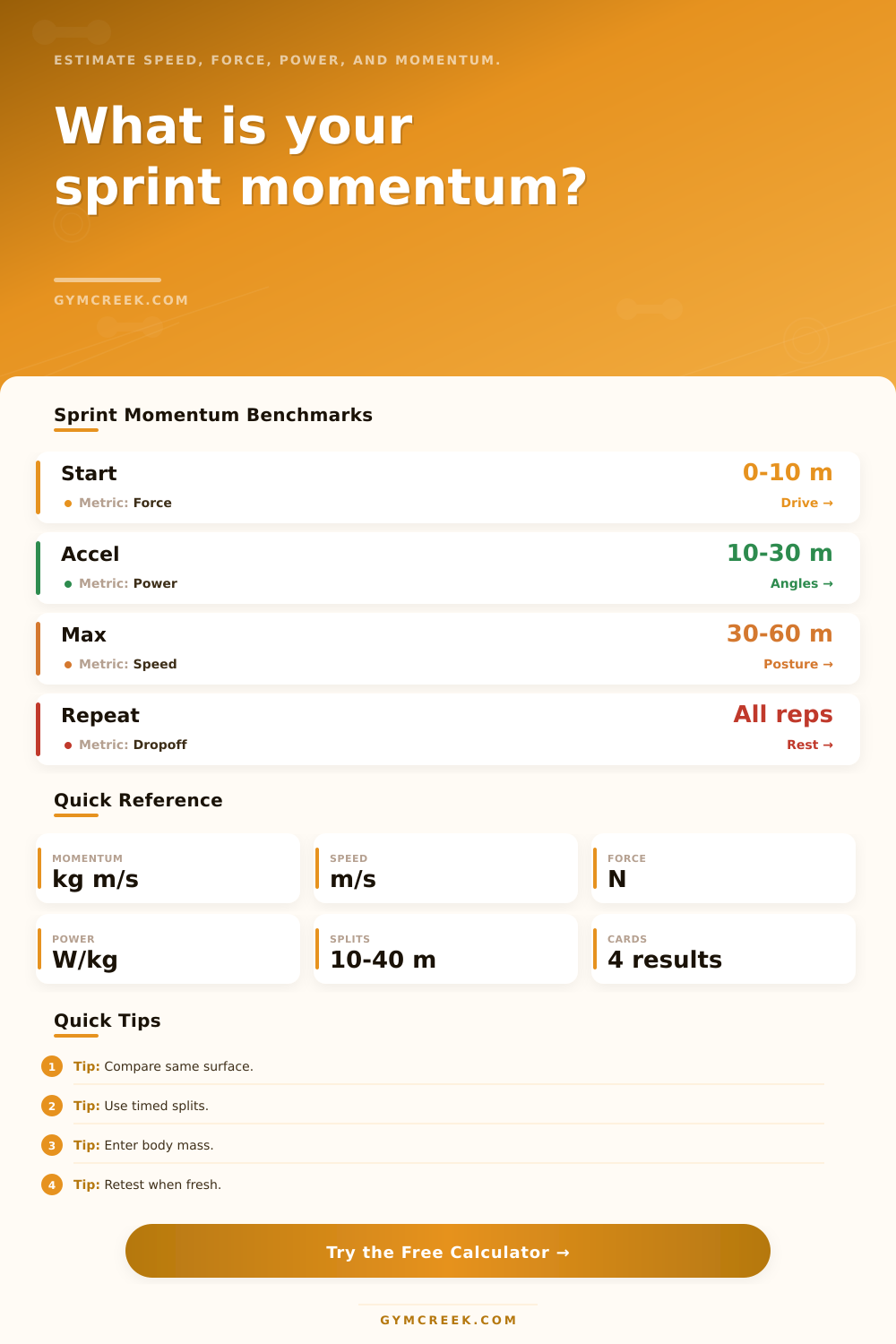
Sprint Momentum Calculator
Estimate sprint momentum from body mass and adjusted sprint velocity, then compare force, kinetic energy, power, and split quality for repeatable testing.
📌Presets
Each preset loads a realistic athlete size, sprint distance, split, timing method, surface, wind, and testing focus.
⚙Calculator
Sprint momentum snapshot
Enter body mass, distance, total time, and split time to calculate sprint momentum.
📊Sprint Metrics Grid
🧮Formula Cards
Mass in kilograms times adjusted sprint velocity in meters per second.
Movement energy rises quickly because speed is squared in the formula.
Split acceleration comes from distance and time using constant acceleration.
Normalizes estimated sprint power so athletes of different sizes can compare.
📑Reference Tables
| Momentum Band | Typical Output | Who It Fits | Main Context |
|---|---|---|---|
| Under 450 kg m/s | Light or developing | Youth, return phase | Build timing consistency |
| 450–650 kg m/s | Moderate field output | General athletes | Useful team benchmark |
| 650–850 kg m/s | High sprint output | Fast field athletes | Blend speed and mass |
| 850+ kg m/s | Very high output | Power-speed athletes | Needs strong decel skill |
| Sprint Input | What It Controls | Best Practice | Common Error |
|---|---|---|---|
| Body mass | Momentum and force | Measure same day | Using old weight |
| Total time | Average velocity | Use full distance | Mixed timing methods |
| First split | Acceleration force | Mark exact distance | Late stopwatch start |
| Wind and surface | Comparison correction | Record each test | Ignoring conditions |
| Testing Scenario | Distance | Momentum Use | Watch Closely |
|---|---|---|---|
| 10 m start | 10 m | Impulse and force | First step quality |
| 20 yd field test | 20 yd | Acceleration carry | Surface match |
| 40 yd combine | 40 yd | Mass-speed blend | Timing method |
| 60 m sprint | 60 m | Speed endurance | Late deceleration |
| Formula | Variables | Output | Use |
|---|---|---|---|
| Velocity | d / t | m/s | Average sprint speed |
| Momentum | m × v | kg m/s | Mass-speed comparison |
| Split accel | 2d / t² | m/s² | Start force estimate |
| Impulse | F × t | N s | Force over split time |
💡Tips
Speed and momentum aren’t interchangeable: You can run as fast as you like, but unless you’re moving your mass with purpose, all you’re doing is quivering in place. That is the bottom line for an athlete running a 40-yard dash or a linebacker attempting to shed a block. Its importance cannot be denied. Speed relies on velocity, while momentum relies on mass and velocity. Most athletes never consider this when obsessing over their clock time.
Enter the simple formula for momentum… Velocity multiplied by mass, and you’ve got yourself a story stronger than what a stop watch can tell. Plug in your sprint times and body weight into this calculator, and let it do the math for you, you don’t have to guess at wind direction, surface friction, or how those factors can affects your real world output.
What Momentum Is
To help understand what’s happening, let’s start with the distinction between the starting phase and the finishing stretch. You need force to accelerate, but force is governed by amount of ground available to push off. When you enter your starting time into the tool, you are basically capturing how much force are used right at the start of acceleration. For example, if you have a fast 10-meter start, that means you generated significant impulse (force applied over a short duration). This means you was able to apply force effectively during the most important initial steps. This is where many people fall short. They go after top speed instead of laying down the foundation, as a result they don’t generate enough “punch” to quickly break contact and redirect momentum.
A reference table on the page shows how different athlete type prioritize one aspect over the other based off their sport. Surprisingly, body weight does factor in heavily here. Just because an athlete moves quickly doesn’t mean he or she has as much momentum as someone who’s bigger but moves moderately fast. That’s one reason we tend to see defensive linemen dominate the line even though they may be slower to get out of the gate on a 40-yard dash test. They’re so heavy their velocity gets multiplied into a collision force that lighter players can’t match.
The tool factors this in. After you plug in your weight in kilograms, the tool converts it into standard momentum units and shows how you rank compared to some broad benchmarks. It is not necessarily about being heavier, but rather about moving the weight you have with a purpose.
The numbers alone aren’t everything. Your speed is affected by how much grip you have (wet grass versus rubberized track), so it’s important to take context into account too. And then there’s wind resistance. Particularly during longer sprints, which can build up more drag over distance. To establish a good baseline of what you’re capable of, you’ll want to make adjustments for those factors. You might establish your baseline in ideal conditions and then attempt to repeat it on a rainy Saturday, the dropoff will be steep. With the calculator, however, you’re able to input surface and wind information to even out all of this stuff, allowing you to compare apples to apples when testing yourself on different days.
The last part of the puzzle is fatigue management. It’s relatively simple to stay fast on one rep, but repeated-sprints are a different beast. The dropoff metric helps you estimate how much momentum you lose when you go back for another burst after a short rest. That’s the purpose of the dropoff metric. How much do you lose? This is key in any sport that demands covering ground quickly, such as field sports. It also requires doing that all over again within minutes. High dropoff suggests an inability of your aerobic system to maintain enough output via anaerobic activity. You’ve got the engine, now you just don’t have the fuel tank to keep going.
So overall, what’s this all about? It is about momentum. You can’t run fast if you don’t know how to turn, stop, and exert force when needed. Let these metrics guide your training. Run with a deficit in mind based off what your numbers show you. Do you lack speed endurance through the end of a workout, or do you need to work on starting faster? The answer lies in the data. You should of run fast, pick up the weight, and let physics speak for themselves.