Sprint Conversion Calculator
Convert one sprint mark into estimated 30m, 40-yard, 60m, 100m, and 200m times while accounting for start type, timing method, wind, acceleration profile, and confidence.
📌Sprint Presets
Each preset loads a realistic sprint test and recalculates the full conversion table immediately.
⚙Conversion Inputs
Sprint conversion estimate
Enter a sprint mark to estimate comparable sprint distances.
📊Converted Sprint Marks
📑Reference Tables
| Source | Strength | Weakness | Use |
|---|---|---|---|
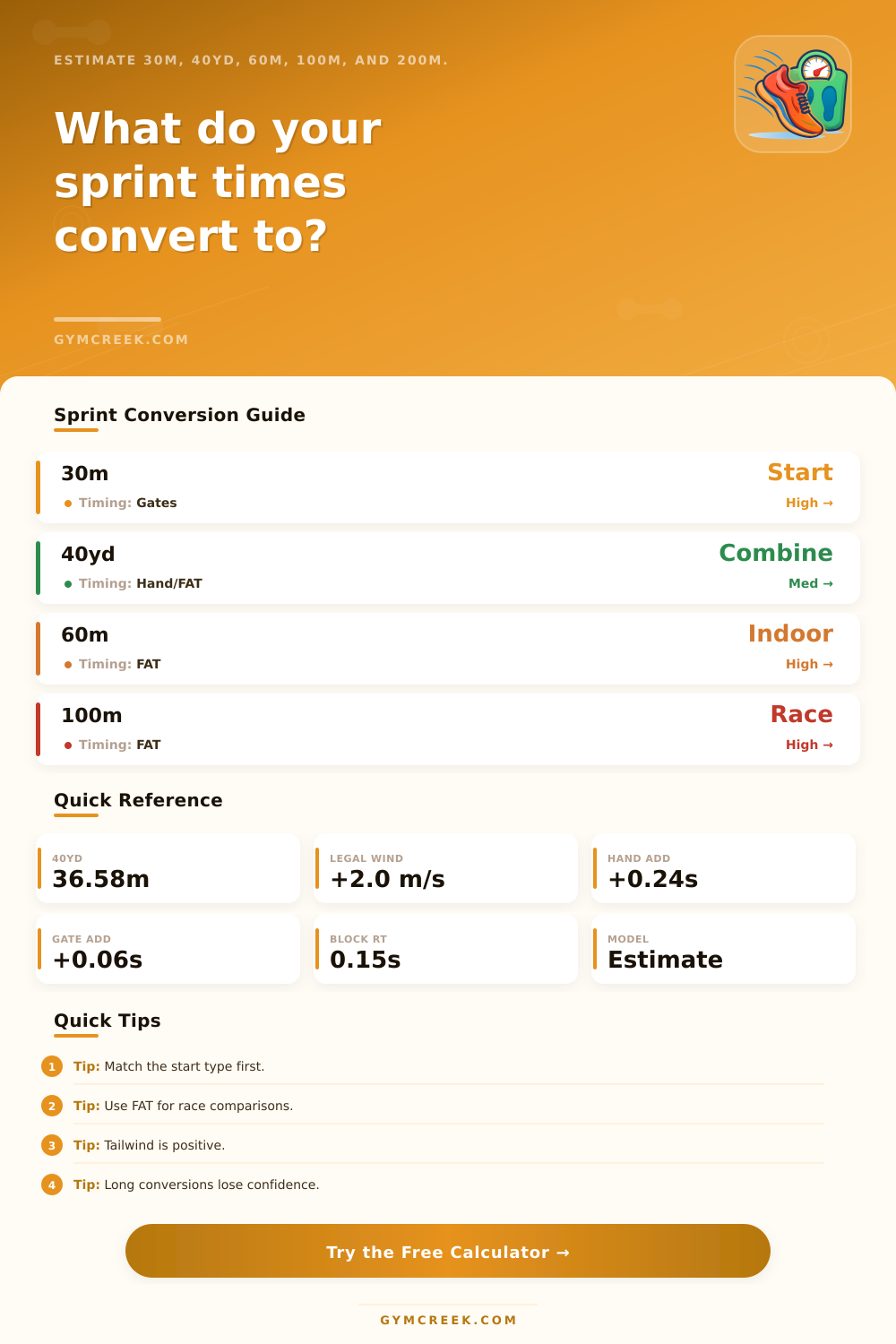
| 30m | Acceleration | Long projection | Starts and field sport tests. |
| 40yd | Combine style | Timing varies | Football and recruiting comparisons. |
| 60m | Race reliable | No bend finish | Indoor-to-100m estimate. |
| 100m | Race complete | Needs wind | Best source for 200m conversion. |
| Timing | Adjustment | Confidence | Note |
|---|---|---|---|
| FAT | +0.00s | Highest | Best for race marks. |
| Video | +0.08s | High | Depends on frame rate. |
| Gates | +0.06s | Medium | May miss reaction time. |
| Hand | +0.24s | Lower | Often too fast for sprints. |
| Start type | Model role | Short effect | Long effect |
|---|---|---|---|
| Blocks | Includes reaction | Normal race | Best for 60m to 200m. |
| 3-point | Combine start | Quick first step | Adds uncertainty to 100m. |
| Standing | Training start | Slower launch | Good for repeat tests. |
| Flying | No acceleration | Not a start mark | Low long-distance trust. |
| Formula block | Variables | Output | Caution |
|---|---|---|---|
| Normalize | Timing, start, wind | FAT-like source | Approximate corrections. |
| Sprint curve | Distance, profile | Equivalent base time | Uses model fitting. |
| Extend | 100m, fatigue | 200m estimate | Bend skill matters. |
| Confidence | Source, method | Trust score | Not official ranking. |
✅Conversion Notes
Sprint times may seem as simple as looking at a stopwatch to determine an athlete’s sprint times. However, sprint times does not necesarily mean the same thing when the settings change for those sprints. A 40-yard dash start from a three-point start will differ from a 30-meter sprint from a flying start on turf.
There are several variable that will affect sprint times, such as the start type, the way that the split times is calculated, the impact of the wind, and the type of track that is used for the sprints. Without adjusting for these variables, the sprints will provide misleading information to athletes, coaches, and recruiters about an athlete’s true sprinting ability. Converting one sprint time to another will pose some challenge.
What Affects Sprint Times
For example, a hand-timed 4.5-second 40-yard dash from a three-point start will not be the same as a 4.5-second fully automatic 40-yard dash from start blocks. The hand-timed sprint will typically take 0.25 seconds longer due to the three-point start leaving out the reaction time that start blocks include. Additionally, if there is a tailwind or a slower track surface for the sprint, the sprint time will also be more farther from the recorded sprint time for ideal conditions.
The calculator can perform the math for these variables once the user inputs the information for each sprint. The type of start will impact the recorded times for sprints. For instance, start blocks from the gun will include a reaction time to the start of the sprint.
Therefore, start blocks are best suited for 60- and 100-yard sprint distances. If athletes starts from a standing start or a first movement start gate, they will record a faster time by the same distance. Flying starts for sprints will eliminate the acceleration of the sprint for the athlete.
Flying starts are used for maximizing the velocity of sprinters but will provide no information about the athlete’s start from the line for races of this nature. The method used to time the sprint will impact the sprint times. For instance, fully automatic timing will record the time that the athlete’s torso pass the starting line but will also start at the same time as the start gun.
In contrast, hand-timed sprints will start when the sprinter is first seen in motion and will end when the sprinter is seen crossing the finish line. The difference between these methods is typically 0.25 of a second for sprint distances under 100 meters but may be different than different sprinters. Training sprint gates may not be as accurate as automatic timing gates.
Training sprint starts may start after the athlete’s first movement and may not accurately time their finish line. Video frames may be more accurate for sprint times, but the video frame timing will also require adjustment before it can be compared with official sprint times for competitions. Additionally, the impact of the wind and the type of track used for sprints will impact the recorded time for athletes.
The sprint time calculator will account for tailwinds (positive numbers) and headwinds (negative numbers). If an outdoor sprinter runs on a track with a tailwind of 2 meters per second or more, official track records for 100- and 200-meter dashes will not be eligible for that athlete. However, the tailwind will impact shorter distance for athletes.
A synthetic track will allow athletes to maintain their spikes better than a turf or grass track. Additionally, at higher altitudes, there is less drag on sprinters, which will impact the sprint times for longer distances. When using the calculator, the user must also determine for what purpose the calculated sprint time should be used.
For instance, converting a sprint time from 30 meters to 100 meters will have less confidence in the results. The further that the calculated sprint distance is from the sprint distance that is measured, the more assumption have to be made about an athlete’s maximum sprint velocity. An additional input will be required for the athlete’s finish strength if converting their time for 200 meters.
This extra input will allow the calculator to make an adjustment for the athlete’s ability to maintain their sprinting speed for longer distances. Coaches may make some common mistakes when using these sprints results. For instance, a sprint time recorded on training grounds is less reliable than an official sprint recorded on sprint blocks on a fast track.
The sprint time calculator will reflect this with a lower confidence score for less reliable sprints. The number that is displayed on the sprint time calculator is not a ranking of the athlete’s sprint abilities but provides information to the user about the reliability of that sprint time. Another mistake by coaches is to not account for the start type of sprints.
For instance, a soccer player will have measured their 30-meter sprint from a first movement start but will be compared to sprint times for football recruiting that use three-point starts. The start types differ enough that the calculated 40-yard sprint will differ from the 30-meter sprint. This issue can be avoided by adjusting the start types for sprints before calculating them with the calculator.
The same issue can be seen for athletes who compete in various track events. For instance, an athlete who excels in indoor 60-meter sprints will have less speed endurance to compete in 200-meter sprints. The sprint time calculator can account for this with the fatigue setting for sprinters.
The fatigue setting will adjust only the 200-meter sprint time for these types of athletes. The adjustment will be modest but will allow the calculation to reflect that not all 60-meter sprinters can maintain their speed for 200 meters. Another benefit for coaches and athletes of all ages is using the sprint time calculator to track an athlete’s sprints over time.
Tracking the athlete’s sprints using the same start types, tracks, and sprint timing methods will provide the best information about an athlete’s improvement in sprints. The sprint time calculator can help to compare the different types of sprints athletes may have run on different tracks. However, the most useful information will come from the athlete using the same variables to determine their improvements in sprinting.
Once all of the variable for an athlete’s sprint are accounted for, the sprint time calculator will help to determine their sprint times.