Spoto Press Load Calculator
Estimate your paused-above-chest strength, compare it with bench press 1RM, and choose target set loads using pause height, tempo, RPE, grip width, and rep range.
📌Presets
Each preset loads a realistic Spoto press situation and calculates a target load immediately.
⚙Calculator
Spoto press load snapshot
Enter your set details to estimate strength and choose a training load.
📊Metrics Grid
🔢Formula Cards
1. RPE Reps-In-Reserve
The completed reps are converted into estimated max reps by adding reps in reserve from the set RPE.
2. Rep Max Estimate
The base Spoto estimate uses an Epley-style rep equation before Spoto-specific adjustments are applied.
3. Spoto Difficulty Factor
Pause height, pause duration, lowering tempo, press speed, and grip width change how demanding the set was.
4. Target Rep Load
The target load is selected from adjusted Spoto max, chosen rep range, target RPE, and goal emphasis.
📑Reference Tables
| Spoto Ratio | Bench Link | Meaning | Use |
|---|---|---|---|
| Under 80% | Low | Control gap | Technique sets |
| 80-87% | Developing | Good start | Volume work |
| 88-94% | Strong | Bench carryover | Strength work |
| 95%+ | Very high | Short ROM bias | Check height |
| Pause Height | Demand | Best For | Watch |
|---|---|---|---|
| 0.5-1 in | High | Chest control | No sinking |
| 1-2 in | Standard | Spoto press | Stillness |
| 2-3 in | Moderate | Midrange | Elbow drift |
| 3+ in | Lower | Board-like work | ROM loss |
| Target | Reps | RPE | Load Zone |
|---|---|---|---|
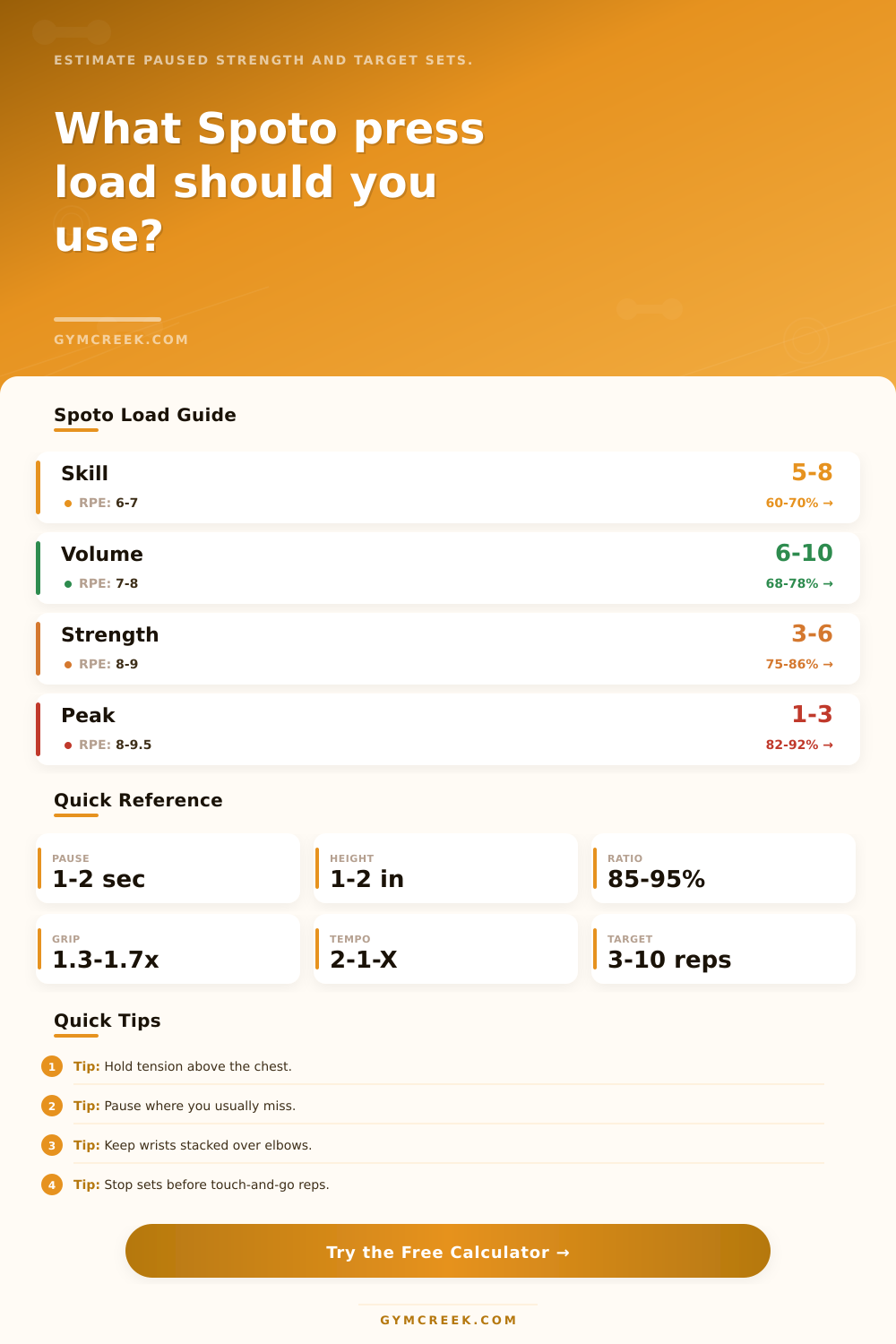
| Technique | 5-8 | 6-7 | 60-70% |
| Volume | 6-10 | 7-8 | 68-78% |
| Strength | 3-6 | 8-9 | 75-86% |
| Peak | 1-3 | 8-9.5 | 82-92% |
| Grip Width | Stress | Carryover | Adjustment |
|---|---|---|---|
| Under 1.2x | Triceps | Close grip | Lower load |
| 1.2-1.6x | Balanced | Most lifters | Neutral |
| 1.6-1.9x | Pec focus | Wide bench | Watch pause |
| Over 1.9x | Shoulders | Specialized | Use care |
🧭Technique Tips
Momentum is a key component in the bench press. Lower the bar, slam into your chest, use the built-up energy to press it back up. Feels great because it is great.
Unfortunately, all that bounce cover up technical flaws. A crappy lockout? No problem. Poor form? Who cares! Physics will pull your ass through the most difficult portion of movement.
How to Use the Spoto Press Calculator
With the Spoto press, there’s no bounce. Coach Mike Spoto gave his name to this variation which has you pausing the bar an inch or so above your chest for one second. Generate force from a dead stop. It is brutally honest training.
For paused sets, most lifters don’t know which weight to go with. Go heavy. You’ll have no leftover energy when your bar touches that bottom position, risking bad form or even injury. Go too light, you’re missing out on strength gains provided by this type of set.
There’s a lot of complicated math involved here. Use the calculator above. Enter your stats, and it handles all the math and conversions for you. It converts your standard bench strength into a safe paused weight with your joint health in mind.
Understanding the inputs is just as important as hitting the calculate button. First of all: knowing what you put into a calculator matters almost as much as pushing the calculate button. You input your one-rep max bench press, which set the foundation for everything else. And then you input information that most generic percentage charts don’t take into account.
How high are you pausing? That makes a big difference, because pausing half-an-inch off your chest is very different than pausing two inches above it. The closer the bar gets to your chest, the more similar it becomes to the normal bottom-position of a bench press. This means you’ll have to use more control and stability. Your estimated strength are adjusted accordingly.
The other key variable in all of this is the lowering portion, or as the eccentric phase is called, its pace. Many lifter rush the bar back down to conserve their energy. Control is key with the Spoto press. Getting into your lowering period will help the algorithm determine how much work your muscles put out prior to pausing. If you slowly lower the bar under control then strictly pause it puts more demand on your anterior deltoids and pectorals than if you simply let the bar fall fast. The calculator takes this into account and adjusts to determine an estimate of your one-rep max.
If you look at your Spoto max compared to your regular bench max, you may be surprised to see that your Spoto max isn’t as high. That’s ok. Ideally it would of fall into the range of 85, 95 percent of what your regular bench max is. Anything below about 80 percent of your bench max indicates you have a pretty large gap in your bottom end stability. You rely too much on the bounce.
The tables on the page spell this out clearly. They give you an idea if you should focus on heavy strength development or more technique work. Surprisingly, it even takes into account grip width. The bigger your grip is, the more leverage it creates and the more it transfers the strain away from your triceps toward your shoulders and pecs. This is why the calculator take into account your grip width compared to shoulder width to adjust its estimation. Because of your narrow grip, the weight will already be less if you’re training with a close grip. The app accounts for this mechanical disadvantage. When you plan your workouts, you won’t be comparing apples-to-oranges.
The tool is easy to use but it’s important to understand how to interpret the results. It provides a targeted load based off your goal and the rep range you want to perform them in. For example if you’re seeking hypertrophy the rep range is going to be higher with a moddern load. Peaking for competition? Heavier load with less reps. Trust the process. Don’t ego-lift. Make sure the pause is strict. The bar can’t sink during the pause or it’s not valid for assessing strength.
Go lighter then expected. Master pausing. Develop the tendon strength that stems from static holds. The added stability and control will translate to your normal bench press over time. The bounce becomes a choice rather than a crutch. In time, you’ll see that’s what the whole point of this variation is about.