Sparring Calorie Calculator
Estimate calories burned during boxing, kickboxing, MMA, wrestling, BJJ, or striking sparring using MET values, active round time, rest time, gear load, and intensity.
📌Presets
Each preset loads a realistic athlete profile, combat style, round structure, rest, active exchange percentage, and effort rating.
⚙Calculator
Sparring calorie snapshot
Enter a valid round structure and athlete profile to estimate calorie burn.
📐Formula Cards
📊Sparring Metrics Grid
📑Reference Tables
| Sparring Type | Base Active MET | Typical Round Feel | Best Input Check |
|---|---|---|---|
| Boxing sparring | 9.5 MET | Footwork, punching, defense | Active exchange percent |
| Kickboxing / Muay Thai | 10.3 MET | Kicks, checks, clinch entries | Gear load and RPE |
| MMA sparring | 10.8 MET | Striking, cage, wrestling mix | Round purpose and RPE |
| BJJ rolling | 8.0 MET | Grips, pressure, transitions | Pauses and positional resets |
| Wrestling goes | 9.0 MET | Shots, sprawls, mat returns | Rest behavior |
| Technical flow sparring | 6.2 MET | Control, rhythm, light contact | Intensity selection |
| Intensity | Multiplier | RPE Range | Use When |
|---|---|---|---|
| Technical / controlled | 0.78x | 3 to 5 | Light contact or teaching rounds |
| Moderate gym rounds | 0.92x | 5 to 7 | Normal partner sparring |
| Hard competitive rounds | 1.08x | 7 to 9 | Pressure rounds with real pace |
| Competition pace | 1.20x | 8 to 10 | Fight simulation or trials |
| Round Structure | Total Work | Rest Count | Common Use |
|---|---|---|---|
| 3 x 2 min | 6 min | 2 rests | Beginner or return session |
| 5 x 3 min | 15 min | 4 rests | Boxing and kickboxing gyms |
| 6 x 5 min | 30 min | 5 rests | MMA camp rounds |
| 8 x 4 min | 32 min | 7 rests | Grappling or wrestling blocks |
| Formula | Variables | Output | Why It Matters |
|---|---|---|---|
| MET calorie rate | MET, kg | cal/min | Main calorie estimate |
| Active minutes | rounds, length, active % | min | Separates exchanges from resets |
| Rest calories | rest MET, intervals | cal | Counts corner and recovery time |
| Mifflin-St Jeor | kg, cm, age, gender | BMR | Resting calorie context |
💡Tips
There’s a special type of hunger after a hard spar. It is a different kind then what happens after a brisk walk. After a fight sport workout, your body craves food. It deeply crave all the available calories because of the odd demands for energy that come with sparring. Adrenaline, heat, impact: it use up glycogen reserves and leaves you feeling hungry. Hungry in a way that feels like a deep, hollow ache, but most people don’t have any idea how many calories they’ve actualy burned.
That’s because these numbers is guesses on your fitness trackers. They’re based off the idea of movement, whereas fighting is an irregular exercise that throws off even the best heart rate monitors. This takes out any guesswork regarding coefficients. All you do is input the type of effort (effort level) and the round structure and then let the calculator do the math for you.
Why You Should Track Your Sparring Calories
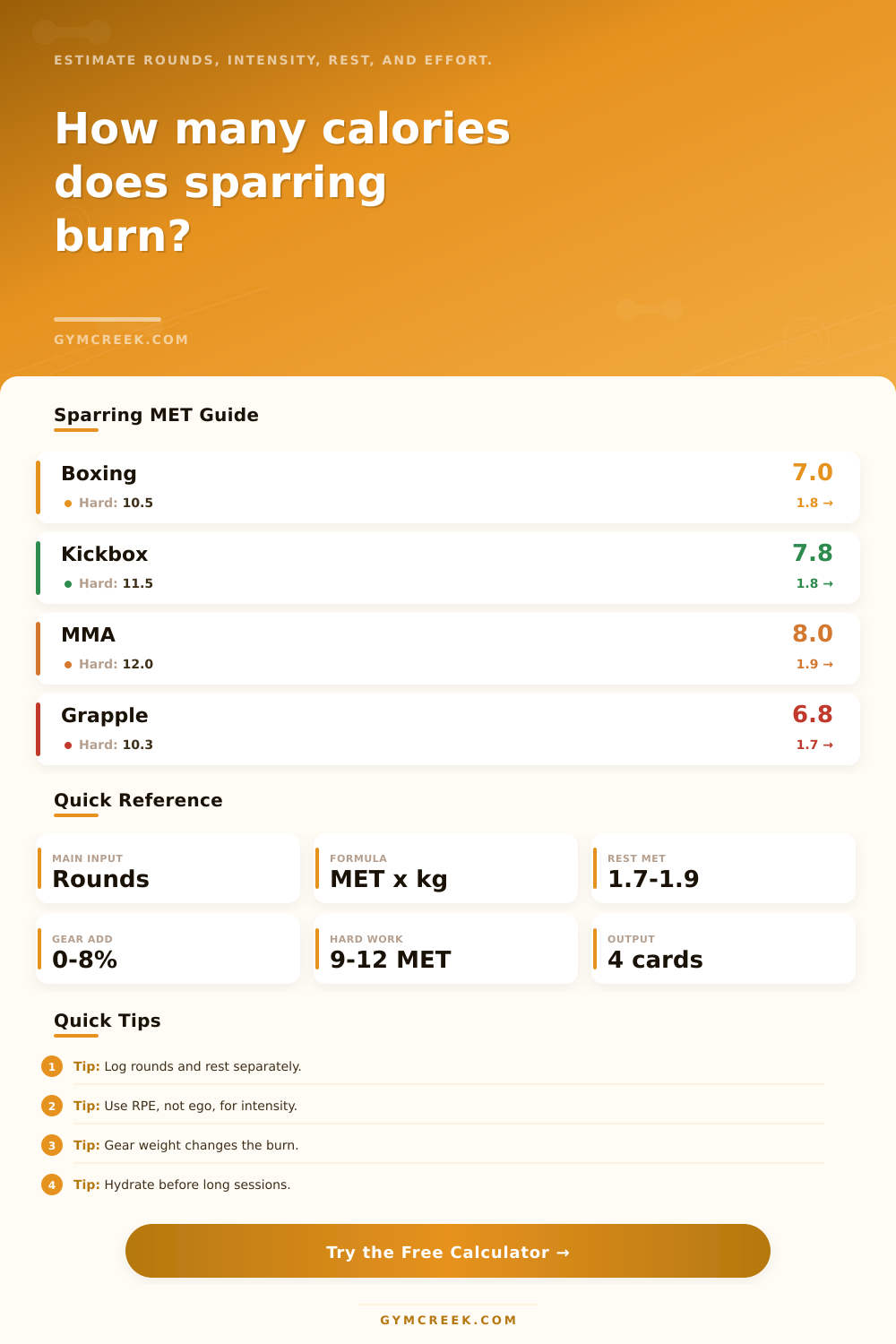
First, what’s the style of combat? Does it involve grappling, MMA, boxing or kickboxing? Each one use a different amount of energy. Kickboxing tends to burn more than pure boxing due to kicking which engages your legs and hips. And grappling, surprisingly, can also be very taxing. That is particularly true if you’re wrestling with someone that want to stay on top of you. The tool divides them up accordingly into separate MET values so you know how much they cost at their baseline before you add movement.
The second variable is intensity. Light contact with technical rounds burns far fewer calories than a hard competitive round. Calories-wise, this makes an enormous difference. Rate your effort truthfully and the estimate gets much more helpful. Because most people are tired, they tend to overestimate how hard they worked out. But being tired doesn’t necessarily show high output; it might be because the workout was poorly paced, or because it was hot outside. To keep your ego in check, use a Rate of Perceived Exertion scale. You’re probably not burning as many calories as you think if you’re mostly standing still but gasping for air.
This directly relates to bodyweight. Heavier bodies weighs more and require more calories for every unit of movement. The calculator will take that into consideration through your kilogram weight value. In addition to that, the tool will consider what clothing and gear you wear while training. A gi, shin guards or gloves add an extra few pounds of weight. That’s not a lot. But six rounds of hard sparring can be tough on the body. This little bit of extra weight adds up. To account for that added effort, we included a gear load adjustment in the calculator. It doesn’t sound like much. But if you’re looking to accurately measure your daily energy balance, it matters.
The calculator also takes into account rest periods. Maybe you’re resting for a minute between rounds in the gym. That’s not a minute spent sitting on a couch. That’s a minute spent standing. You might be walking over to the corner, taking a drink of water, or listening to what your coach says. That movement is low intensity but it still use up calories. Sure, it does so at a slower pace than when you’re working, but it uses them nonetheless. By giving rest time its own MET value, the calculator separates out that “standing while recovering” activity from the “actively drilling between rounds” activity. That allows you to see the entire picture of what goes on in your workout. Not only are you burning calories during the work, but also during the transition. This adds up in terms of time spent and energy.
A good warmup gets your muscles ready and your heart pumping. That could be easy. But it’s still effort. Cool downs also counts as time. Use the tool to add time here. It will treat this time as light combat movement. It gives you a full total for all activity during the session. From there you can compare the active calories to the total calories burned from the whole session. If that ratio is high, then you’re staying engaged. If it’s low, maybe you’re resetting too often or resting too long.
This is all laid out nicely in the reference tables on the page. These show how changing round structures shift the workout load. A higher heart rate can result from shorter rounds with less time off versus a longer round. The point of it is to find the right structure for what you want. Do you want to train for technique? Or do you want to get conditioned? That’s what the calculator doesn’t judge. It simply provides the data so you can make better decisions around your recovery and nutrition.
If you burn five hundred calories, you’ll need to replace those calories. Guess wrong, and you may eat too much or too little. Sparring is a grind. It takes stamina, strength, and concentration. By paying attention to how much you are burning, you take care of that grind. It provides measurable feedback so that you appreciate the exertion it took out of you. It allows you to feed yourself accordingly by giving you a quantifiable piece of information. And then you begin to understand how your input relates directly to your output.
Your efforts equal results. It is a cause and effect equation. It is a feedback mechanism. You burn, measure, and replenish. That’s why tracking your sparring burn matters. It’s about tracking your burn so you can fuel correctly and replace what you burned. It’s about maintaining your energy over extended periods. Once you understand exactly what your body is doing, you learn how to train it more effectively. You no longer make assumptions. Just understanding. That’s the worth of knowing where you stand when you step in the cage. It provides clarity amidst the muck.