Sodium Loss Calculator
Estimate exercise sodium loss from sweat volume, sweat sodium concentration, duration, drinking, urine output, weather, effort, clothing, and athlete profile.
📌Sodium Loss Presets
Presets load complete sweat-test examples with body size, weigh-ins, fluid intake, urine correction, sodium concentration, heat, gear, and effort. Change any field after loading one.
⚙Sodium Loss Inputs
---
---
📊Fitness Metrics Grid
📑Sodium Loss Reference Tables
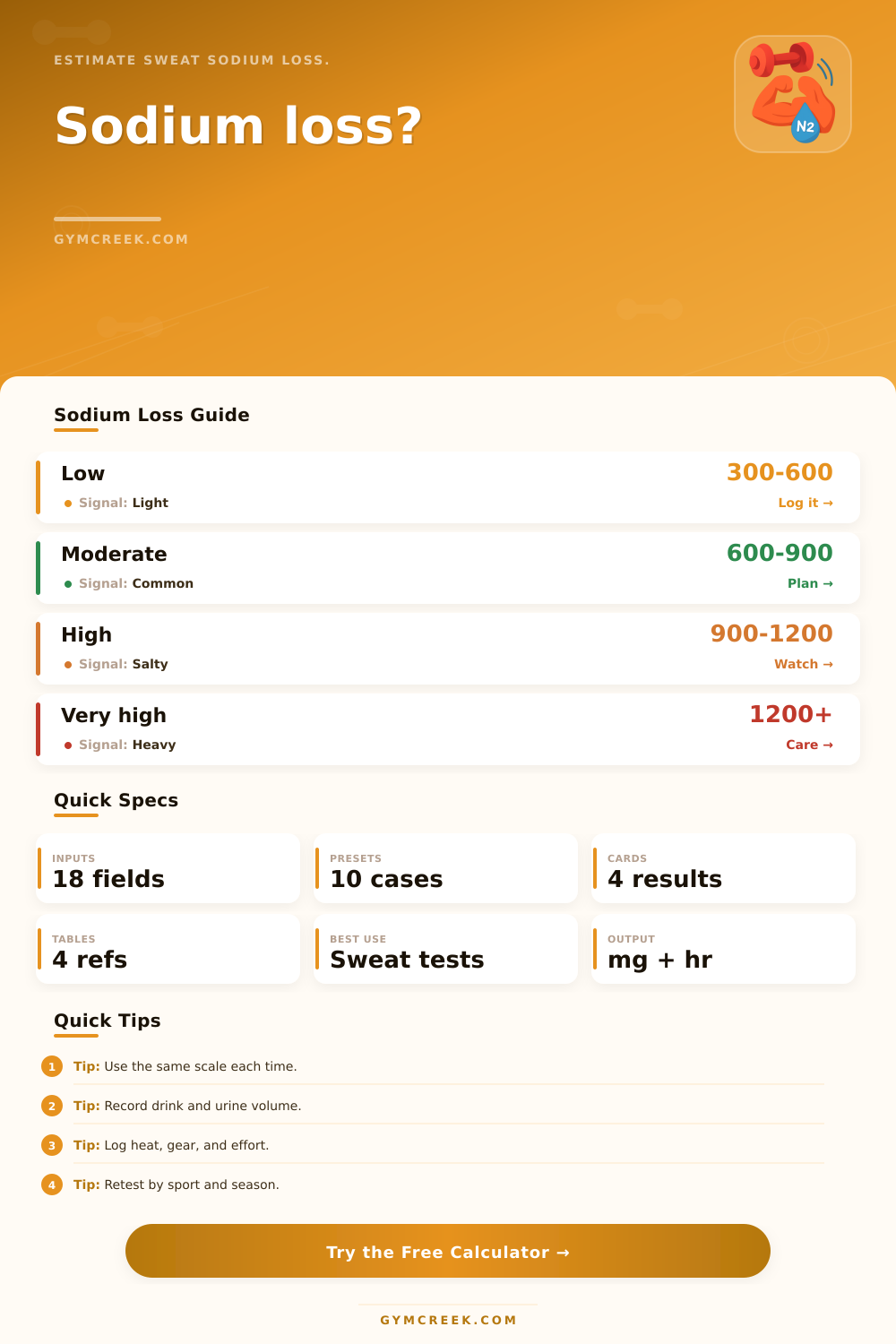
| Range | mg/L | Signal | Use |
|---|---|---|---|
| Low | 300-600 | Light sodium | Often lower salt marks |
| Moderate | 600-900 | Common range | Good starting estimate |
| High | 900-1200 | Salty sweater | Track long sessions |
| Very high | 1200+ | Heavy sodium | Use measured data |
| Rate | L/hr | Fl oz/hr | Common setting |
|---|---|---|---|
| Low | 0.3-0.7 | 10-24 | Cool easy work |
| Moderate | 0.7-1.2 | 24-41 | Steady training |
| High | 1.2-1.8 | 41-61 | Heat or tempo |
| Very high | 1.8+ | 61+ | Heavy heat load |
| Output | Formula | Inputs | Purpose |
|---|---|---|---|
| Gross sweat | Scale + drink - urine | kg, L | Total sweat |
| Sodium loss | Sweat L x mg/L | L, sodium | Main result |
| Salt equivalent | Sodium x 2.54 | mg sodium | NaCl context |
| BMR | Mifflin-St Jeor | kg, cm, age | Fitness context |
| Measure | Value | Per Hour | Training Use |
|---|---|---|---|
| Sodium loss | --- | --- | Enter values above. |
📋Scenario Reference
| Profile | Sweat L/hr | mg/L | Na/hr |
|---|---|---|---|
| Cool gym lift | 0.4-0.7 | 500-800 | 200-560 mg |
| Steady run | 0.8-1.3 | 700-1000 | 560-1300 mg |
| Hot court play | 1.2-1.8 | 800-1200 | 960-2160 mg |
| Long race prep | 1.0-2.0 | 700-1400 | 700-2800 mg |
| Source | Band | Meaning | Action |
|---|---|---|---|
| Estimate | +/-25% | Wide range | Retest |
| Single patch | +/-15% | Useful snapshot | Compare |
| Repeated patch | +/-10% | Better trend | Personalize |
| Lab measured | +/-5% | Strong input | Update plan |
💡Sodium Test Tips
On a long run you might find your brain a little fuzzy and your legs feeling heavy. Often, that’s because of something other than total exhaustion. It’s because your body’s running out of more than fuel. It’s running out of electric signals required for effective muscle firing. Sodium is that signal. Runners don’t pay attention to it until it causes them to cramp. Smart ones watches it from the beginning.
If you know your sweat rate roughly (or own a bathroom scale), the calculator up top does it for you. Weigh yourself before your workout and drink a reasonable amount of fluid. You might also go to the bathroom, but that volume didn’t get sweated out. Then re-weigh yourself after your workout and towel-dry. The difference show you what’s missing.
How to Measure Your Sweat and Salt Loss
But fluids aren’t everything. Sweat contains very different amounts of salt from person to person, so a rough guess leads to poor recovery, while a measured guess lead to a plan. The secret ingredient that trips up most people is the amount of sodium in sweat. Certain athletes has relatively low sodium amounts and shed hardly any salt per drop of sweat. They can go hours without issue as long as they’re chugging plain water.
Some athletes are natural salty sweaters. After a workout, our white residue stains dark clothing, and we know we’ve lost quite a bit of sodium even while exercising moderately. Chugging down water simply dilutes the electrolyte content of our blood more, leaving us in an even greater deficiency then if we hadn’t replaced anything at all.
That’s where this tool comes in: By inputting your unique concentration rate alongside total fluid losses, it’ll turn this raw number into milligrams of sodium lost. And then convert that into grams of real salt (you don’t need milligrams when sprinkling salt on food, duh).
In terms of how hydration works, context matters. You may sweat roughly the same amount during a 45-minute sprint in hot, sticky conditions as you do during a two-hour workout in the gym’s air conditioning. However, it isn’t the same type of physiology. Your body requires cooling and that demand is influenced by things like ambient temperature and humidity. When humidity is high, your body has a harder time evaporating sweat, so it compensates by producing more fluid to help cool down. That causes increased losses overall very quick.
Your clothing choices matter as well. Extra clothes and heavy protective equipment hold heat next to your skin, which causes you to sweat more regardless of how hard you are working. These environmental demands is included in the inputs to reflect this and give you a final number that better represents what happens in reality versus some idealized lab setting.
How do I know if my sweat rates are accurate? Test them more than once! Remember, that snapshot is only based on a patch test taken on a certain day, under certain conditions. There’s a lot of variability: stress, heat acclimation, diet, etc. These things all change how much sodium you excrete.
The table on the page provides general ranges so you can place yourself somewhere in the scale. People who sweat a lot will generally excrete more then a thousand milligrams per liter, while those who sweat a little may lose as little as three hundred to six-hundred. That’s what tells you how many salts to douse your post workout meal with. And it’s what keeps you from getting overhydrated during an event or failing to replace enough salt which can kill your performance.
Perfection isn’t as important as consistency. Consistency is more valuable than perfection. So use the same scale for all measurements. Get that measurement right on the amount you drank. Write down how hard it was, how hot or cold it was and repeat. If you vary your routine dramatically, say from running trails in fall versus racing marathons in summer, re-test yourself. It’s not about nailing exactly x number of milligrams every day. It’s about knowing what your starting point is so you can tweak it based off changes in conditions.
Knowing what you need is half the battle when recovering from exercise. Sodium makes stuff work, water re-hydrates things. If you don’t have sodium, your nervous system won’t function at high intensities or remain coordinated. This gives you a base level to plan out replacements. It also gives you an idea of how many grams of salt you lose during your workout. Then you can use real information to craft your nutrition approach rather than general guidance.
You will have no more guesswork on electrolyte needs or fatigue. Now you’re making fueling plans based off action and not ambiguity.
That white streak isn’t just a mess; it’s data. Followed over time, it turns something you don’t think about into one of the pillars of performance. If you know what you’re putting out there, you can do it on purpose. The signals are intact. Next time, it’ll feel sharper. Legs will be lighter for longer. Mind will be clearer. You becomes the controller of things that traditionally control you.