Sodium Intake Calculator
Estimate daily sodium, sweat sodium loss, fluid concentration, and training replacement targets from your body size, current intake, and session conditions.
📌Presets
Each preset loads a real training and hydration scenario, updates unit labels, and recalculates the sodium plan.
⚙Calculator
Sodium and hydration snapshot
Enter your intake and training conditions to calculate the target.
📊Fitness Metrics
📑Reference Tables
| Context | Sodium target | Best use | Watch point |
|---|---|---|---|
| Baseline AI | 1500 mg/day | General adequacy | Not athlete-specific |
| General cap | 2300 mg/day | Most adults | Medical needs vary |
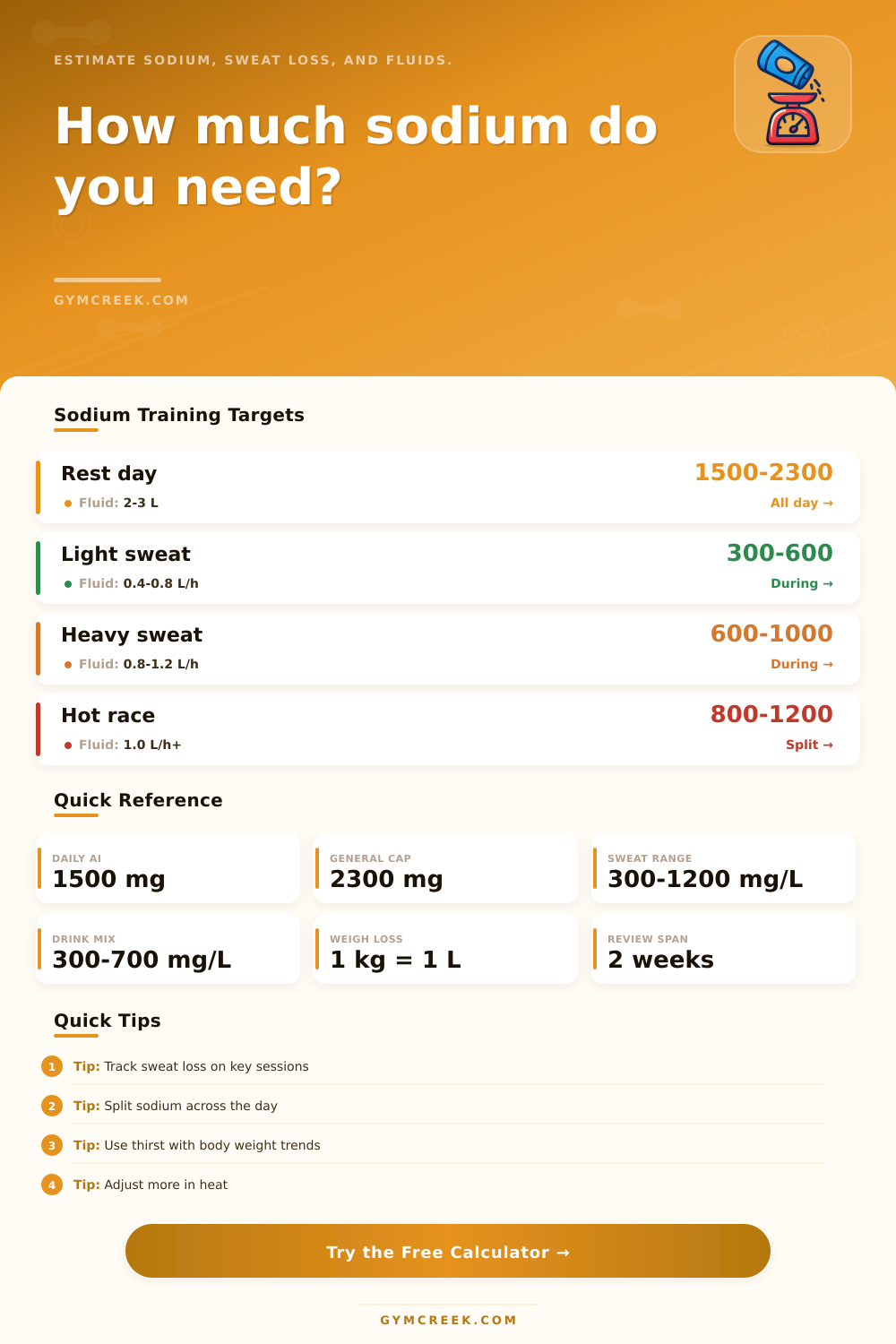
| Training day | Base + sweat | Long sessions | Split intake |
| Heavy sweat | Individualized | Heat or races | Test in practice |
| Sweat sodium | mg/L | Profile | Plan cue |
|---|---|---|---|
| Low | 300-500 | Light salt marks | Fluid first |
| Moderate | 500-800 | Most athletes | Mix or foods |
| High | 800-1200 | Salt stains common | Add sodium |
| Very high | 1200+ | Lab-confirmed | Coach guided |
| Session | Fluid rate | Sodium mix | Timing |
|---|---|---|---|
| Lift only | 0.3-0.6 L/h | 0-300 mg/L | As needed |
| Endurance | 0.4-0.8 L/h | 300-700 mg/L | Every 15 min |
| Hot long run | 0.7-1.1 L/h | 500-900 mg/L | Early and often |
| Ultra / match | 0.8-1.2 L/h | 600-1000 mg/L | Practice first |
| Formula | Variables | Output | Use |
|---|---|---|---|
| Sweat loss | Rate x time | Liters | Session fluid |
| Sodium loss | Loss x mg/L | mg sodium | Replacement |
| Drink mix | mg / liters | mg/L | Bottle target |
| Daily gap | Target - current | mg/day | Adjustment |
💡Tips
Yes, you need to be able to track your splits and your pace, but you also has to control your electrolytes so your legs go. Control this balance of electrolyte and your muscles will fire properly. Lose some sodium or hydration and your muscles will cramp from fatigue. Your body doesn’t run on water; it runs on ions.
Sodium is the spark plug that allows signal from your brain to reach your muscle fiber. When you’re lacking it, your brain sends the signal but your muscle fiber never gets it. So keeping up with your sodium intake should be as important as monitoring your mileage.
Why You Need Personal Hydration Plans
Enter the time you train and your estimated sweat rate into the calculator up top. Then all the math is done for you. You will no longer wonder if you’ve sweated out a half-litre or two in an hour. Everyone’s sweat rate are different. Some folks barely shimmer; others drench their shirt within five minutes. And don’t assume you’re average.
Enter your before and after workout weights, and the tool will figure out the water you’ve lost. One kilogram of weight loss equate to approximately one liter of water. That relationship makes thirst; once a vague feeling, into something concrete: How many litres do I need to replenish right now? It is not necessarily after the workout but during it.
Another surprising variable for most athletes is the sodium level in sweat. Some people sweat barely any salt at all and leave pale white stains on their clothing. Others are very salty and create bright white rings on their shirt. When salty athletes sweat, drinking only plain water further dilute the sodium in their blood. And that leads to hyponatremia.
The reference table on this page breaks sweater types into low, moderate, and high profiles. Knowing which category you’re in alters what you mix in your bottle. Light sweaters may be okay with just fluids. But salty sweaters will need additional electrolyte tabs or even some added salt to maintain blood sodium levels.
There is also an environmental part to that. In humid conditions, your sweat doesn’t evaporate. So your body release additional fluid attempting to regulate its temperature. It accounts for the heat load. Running twenty minutes in sweaty August humidity saps you dry sooner then running sixty minutes in chilly fall air. You must consider the surroundings in addition to the work. If you don’t, you will underestimate your need by several hundred milligrams. That shortage build up across a long training period.
To hydrate, most of us reach for candy-tasting sports drinks that are typically high in sugar and low in salt (which isn’t ideal during intense sweat-fests). Based on the amount you’re losing, it recommends the amount of sodium you should be taking in. Should it be three-hundred milligrams per liter? Or nine-hundred? And there’s no one-size-fits-all solution. A light jogger might be able to get away with it while an ultra-runner might experience stomach cramping. Meanwhile, for someone training in desert heat even those recommendations might come up short.
The only way to truly perform is by making it personal. No need for obsessive attention to every milligram. It’s about consistency as opposed to perfection. During easy workouts use the tool to set your baseline numbers. When you go hard, then stretch those limits. At some point, you’ll drink so much fluid with no salt that it will show up on your stomach. You’ll be bloated, sluggish. On the other hand, if you’re feeling strong and sharp, your strategy is working.
You don’t want to survive the workout; you want to recover quickly enough to train again tomorrow. Keeping sodium keeps fluid where it needs to be in your body, which help that recovery process. In the past hydration science was based off general rules for all people. General rules have never been as powerful than an individual’s physiology. Controlling a big limiter can mean taking charge of understanding your sweat and then drinking based upon your body. Knowing instead of guessing.
What is in your water bottle matters as much or more as how much is in there. The next time you step on the scale post workout keep this simple rule in mind. If you lose a kilogram you’ve gained a liter provided you replenish with proper amounts of salt and fluids. It would of been easier if it was simpler.