Soccer Calorie Calculator
Estimate calories burned from soccer match minutes, position demands, distance covered, sprint count, ball work share, training volume, surface, body size, and MET-based energy logic.
📌Presets
Each preset loads a realistic soccer profile and recalculates the match, drill, ball work, and sprint energy estimate.
⚙Calculator
Soccer calorie snapshot
Enter soccer workload details to estimate total calories burned.
📊Metrics Grid
🧮Formula Cards
Calories per minute = MET x 3.5 x body weight in kg / 200. This drives the match, training, and low-intensity segments.
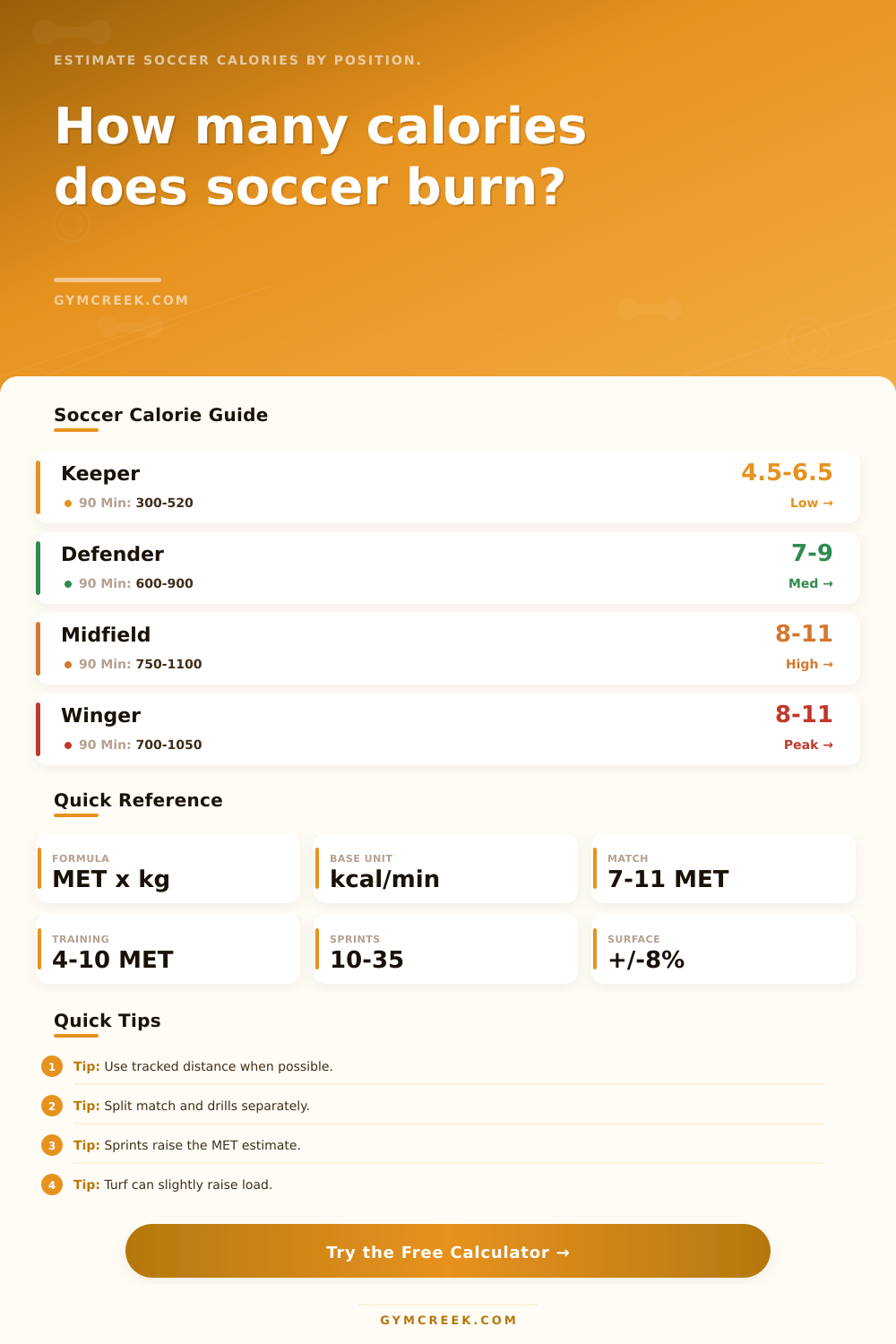
Goalkeepers start lower, midfielders and wide players start higher, then match intensity adjusts the base value.
Tracked distance per 90 and sprint count compare against position norms to raise or reduce match MET.
Ball work, conditioning, and other training minutes use separate MET values before surface and intensity adjustments are applied.
📑Reference Tables
| Position | Base MET | Typical 90 | Sprints |
|---|---|---|---|
| Goalkeeper | 5.2 MET | 2.5-4.0 mi | 3-8 |
| Center back | 7.8 MET | 4.5-6.0 mi | 8-16 |
| Fullback | 9.2 MET | 5.5-7.2 mi | 18-30 |
| Midfielder | 9.6 MET | 6.0-7.8 mi | 16-28 |
| Winger | 9.4 MET | 5.5-7.0 mi | 22-36 |
| Striker | 8.6 MET | 4.8-6.5 mi | 18-32 |
| Training Block | Typical MET | What Counts | Energy Pattern |
|---|---|---|---|
| Technical ball work | 4.8-6.2 | Passing, touch | Steady skill |
| Small-sided play | 7.5-10.5 | Rondos, 5v5 | Stop-start |
| Conditioning | 8.5-12.0 | Shuttles, runs | High output |
| Walk-through | 2.8-4.0 | Shape, tactics | Low output |
| Surface | Modifier | Why It Changes | Use When |
|---|---|---|---|
| Natural grass | 1.00x | Baseline field | Normal play |
| Artificial turf | 1.03x | Faster tempo | Harder cuts |
| Indoor court | 1.05x | More repeats | Futsal style |
| Soft or wet field | 1.08x | More resistance | Heavy grass |
| Sand soccer | 1.18x | High drag | Beach play |
| Formula | Variables | Output | When Used |
|---|---|---|---|
| Match MET | Role, pace | Workload | Played minutes |
| Distance factor | mi/km per 90 | Modifier | GPS estimate |
| Sprint factor | Sprint count | Modifier | High-speed work |
| Mifflin BMR | kg, cm, age | Baseline | Daily context |
💡Tips
Calories are an afterthought for most player. We play for ninety minutes of football, our legs ache and we think we’ve burned enough calories to eat whatever we want. It’s dangerous thinking.
Depending on the position you play, soccer will burn more or less calorie. If you’re standing around like a goalkeeper, then you’ll burn significantly fewer calories compared to a wingback who sprints up and down the field. The difference between those two role can be nearly three hundred calories in a single match. This can be enough to cancel out a whole week of strict dieting if you do not keep track of it corectly.
How to Count Calories Correctly
Your base burn comes from position. Goalkeepers has relatively low metabolism; they wait a lot of the game out. Outfield player do higher intensity bursts over greater distances. Depending upon your own position, the calculator will change energy estimate to match. It understands that the body of a center back is asked for something very different than a central midfielder. Because generic fitness trackers view all of soccer as one type of activity they miss the nuance of who you are on the pitch.
And you should care about the difference. It’s not just about minutes played. It’s also about distance and sprints. One player may play all ninety minutes of the game while jogging around lightly. Another player come on as a substitute in the thirtieth minute. They cover six miles across field and make twenty high speed sprints. Even though they’ve been out there for fewer minutes, the second player will probably burn more calories.
Total distance and sprint counts is used to fine-tune the estimate, so those are the metrics the tool asks for. If you don’t provide those inputs then you’re left with an average (which can be wildly inaccurate). It is better to have an approximate number that takes into account your actual efforts rather than an accurate number that does not take them into account at all.
But there are also nuances to training. Ninety minutes of practice isn’t the same as ninety minutes of a game. During practices, you’ll do short bursts of high-intensity conditioning, technical drills and low-intensity walk-throughs. The calculator allows you to break that down. You can define what percentage of your practice is pure conditioning vs. Ball work.
Why does it matter? Technical drills elevates your heart rate but don’t feel like hard running. Lumping all of your training in the same bucket leads to overestimating intensity of an easy day and underestimating the grind of a hard day.
There’s another subtle factor: surface. Natural grass is the baseline. Then there’s artificial turf, which will have some effect. It usually makes balls cut harder and travel faster. This increase the load a bit. A field with sand or soft, wet turf? That adds even more resistance. Play on a waterlogged pitch or beach soccer, and you’re fighting the ground itself. The tool compensates for that friction.
Again, it’s a very small percentage change. But that small adjustment add up to a big difference in how much energy you use over a full season.
The last important variable is your own body weight. Because you’re hauling more mass around, heavier people burns more calories than lighter people when traveling the same distance. That’s simple physics. The calculator uses your weight to finish the total energy burn equation. In addition, it accounts for your age and height so that it can give you some baseline level of metabolic context from which to understand where soccer activity fits into your day-to-day energy budget.
Not that this is all about the game. This is all about where the game fits in your life. Knowing how many calories you’re burning allows you to make smarter fueling choices. Did you just burn a thousand calories in a tournament double-header? Know that and you’ll know you have to refuel aggressively. Burned four-hundred on a technical recovery day? Adjust accordingly.
The goal is not just to count calories. It’s about matching your intake to your output. That result in more consistent body composition, faster recovery and better performance. What you don’t measure, you can’t manage.
Begin with understanding your position and the actual distance you cover. The rest of the math will fall into place from there. Knowing how much the game costs is the first step towards playing it better.