Snowboarding Calorie Calculator
Estimate snowboard calories from ride time, run difficulty, terrain park share, snow condition, total vertical, fall recovery, rest split, body size, and gear load.
📌Presets
Use a named snowboard-day profile or enter your own ride, park, vertical, fall, and rest details.
⚙Calculator
Snowboard calorie snapshot
Enter ride time, terrain, park share, snow, vertical, falls, and rest to estimate session energy use.
📊Snowboard Metrics
🧮Formula Cards
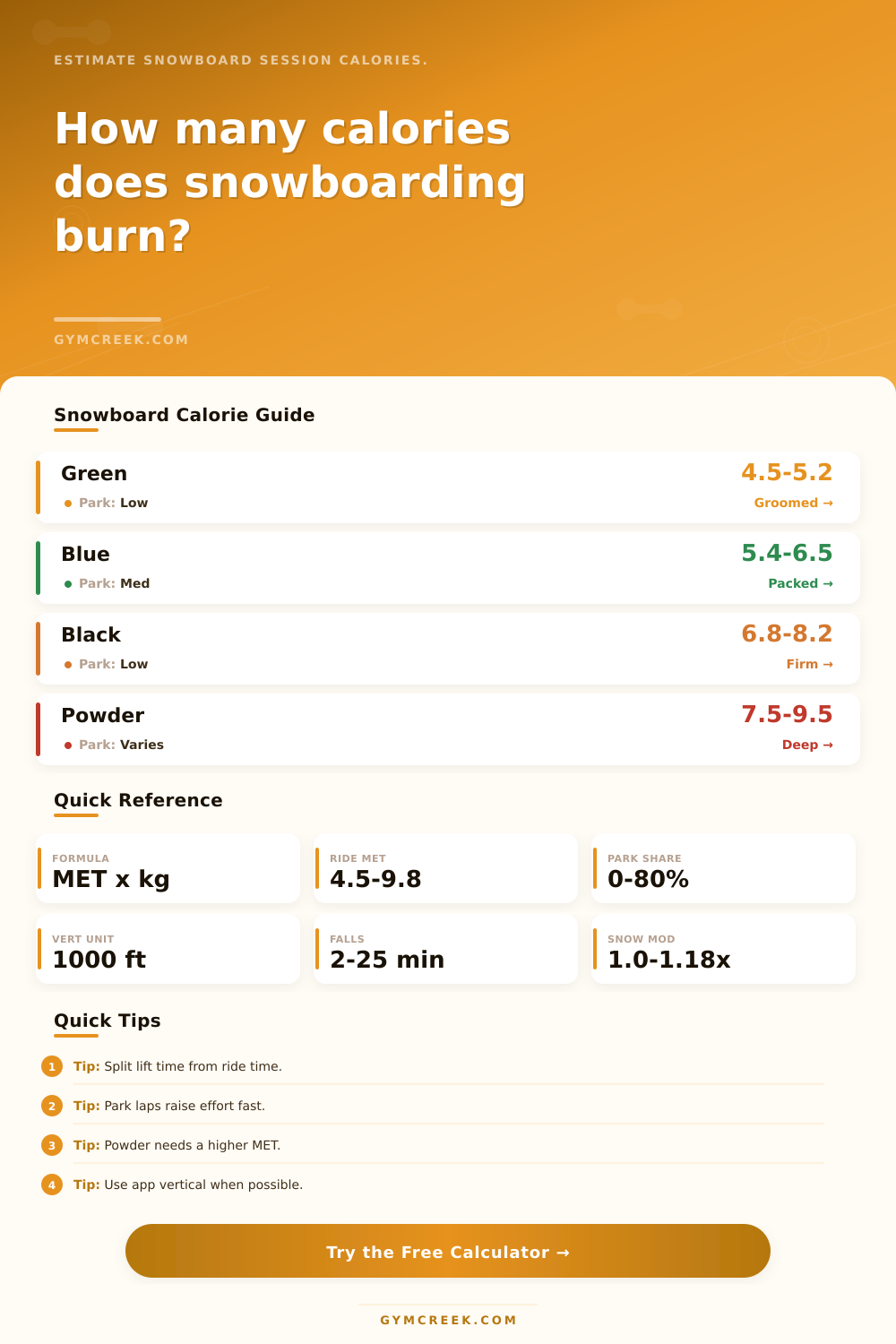
Calories per minute = adjusted snowboard MET x 3.5 x body weight in kg / 200, multiplied by active ride minutes.
Park share splits ride time between run MET and feature MET, then adds a jump, rail, pipe, and repeated-strapping effort modifier.
Vertical descent divided by ride time estimates descent rate, which adjusts effort for long mellow laps or steep high-output runs.
Lift, queue, fall recovery, and lodge rest use separate low MET values so standing time is not counted like continuous riding.
📑Reference Tables
| Terrain | Base MET | Typical Vert | Best Use |
|---|---|---|---|
| Green learning runs | 4.5 | 300-900 ft | New riders |
| Blue groomer laps | 5.7 | 700-1600 ft | Carving pace |
| Black diamond lines | 7.1 | 900-2200 ft | Hard turns |
| Double black steeps | 8.4 | 900-2600 ft | High output |
| Powder and trees | 8.2 | 600-1800 ft | Deep snow |
| Park-focused riding | 7.6 | 200-900 ft | Features |
| Snow Condition | Modifier | Feel | Why It Matters |
|---|---|---|---|
| Groomed | 1.00x | Smooth | Baseline edge work |
| Packed powder | 1.03x | Grippy | More carving force |
| Icy firm | 1.07x | Precise | Tension and braking |
| Boot-deep powder | 1.18x | Deep | Float and recovery |
| Crud and chop | 1.13x | Variable | Balance corrections |
| Spring slush | 1.11x | Heavy | Drag increases |
| Session Type | Ride Time | Park Share | Vertical |
|---|---|---|---|
| Beginner lesson | 20-45 min | 0-5% | 1k-5k ft |
| Casual groomers | 45-90 min | 0-15% | 7k-18k ft |
| Park day | 50-120 min | 35-80% | 3k-12k ft |
| Powder hunt | 55-110 min | 0-20% | 7k-22k ft |
| Freeride day | 80-150 min | 0-10% | 18k-35k ft |
| Formula | Variables | Output | When Used |
|---|---|---|---|
| MET kcal | MET, kg, min | Calories | Main estimate |
| Park blend | Run, park % | Ride MET | Feature laps |
| Vertical rate | Feet, min | Load factor | Run speed |
| Mifflin BMR | kg, cm, age | Baseline | Daily context |
💡Tips
The calculator will help you estimate amount of calories you expend during a day on the slopes. Simply input your body weight, the terrain you’re riding, and how long you’ll be out there.
The calculator also distinguishes between when you’re actively downhill riding and when you’re simply waiting in line for a lift or standing still. When you’re inactive, your caloric burn decrease dramatically.
How the Calculator Works
METs = Metabolic Equivalents: How much oxygen does my body use? METs is used as part of the estimate. These are units that represent amount of oxygen consumed while doing an activity. The higher the MET, the harder you’re working. A typical green run might be a 5-MET, like a brisk walking pace. A double black diamond or powder run will push it closer to 8 or higher.
Depending on what conditions you choose for your trip, the calculator change the baseline based off the conditions you’ll encounter. Groomed snow provide consistent, minimal resistance. Slush or choppy snow will take additional leg work to stay upright. Although you may not gain any more vertical drop, you will end up burning a few more calories overall.
Park riding causes a unique kind of fatigue. It’s the hiking back up the feature, the drop-in repetition, and the flat landing skate job. Plug that number into calculator as percent of your session you spend in the park. Because it elevates your effort level rapidly through those park laps, this tweak make everything more intense. Sure, maybe you aren’t on strictly downhill as much, but power required to rip rails and jumps keeps your heart rate high. If you don’t account for this variable, you will underestimate how many calories you are burning during the day.
This is one of those things where there’s only so much a number can tell you. You could rack up 20k vertical feet and another rider could too. But maybe you took lots of short, steep runs and had to wait a long time for the lift. And maybe they linked together some really long gentle runs and didn’t stop much. Probably the second one was burning more consistant calories.
This is why the tool looks not only at the vertical that you’ve covered but also how fast you covered it. In other words, the tool look at how many vertical feet you dropped during your active ride time. If you’ve got a big vertical, but a small ride time, then the system understand that you were burning hard and fast, but not very long. If you rode around for a long while, it will assume that you burned pretty consistantly for all that time. Simple online counters won’t be able to account for this, because they’ll simply multiply your weight times some generic activity factor.
Time to recover is another variable that matters. Getting up, clipping in, scraping snow off your base, all take time. Those minutes are low-intensity but they contribute to total session time. The calculator separates those minutes from on-bike time. It figures that sitting around in the lodge or waiting in line for lifts uses less energy. That’s because otherwise you’ll overestimate the final number. An hour spent sitting there drinking coffee will feel like high-intensity exercise… And your total calories will reflect it. Separating lift time from ride time provide a more true picture of how much you’re working.
Your body’s energy consumption depends on snow conditions as well. Constant tension in your knees and ankles plus precise edge control when riding on ice take a lot of energy. When riding in powder, powerful leg movement keep the board floating, which again, use energy. The tool applies a modifier based off these conditions. Vertical drop isn’t everything; it’s about how hard your muscles has to work to keep you upright. Just because you had a day of fighting your way through slush doesn’t mean that day was any less physical than a day spent carving hardpack.
Here’s the final output. This is the total calories burnt. It also includes a breakdown of calories spent actively riding versus the rest of the session. This will help give you an idea of how you broke down. That can be important if you’re trying to plan out what you eat for a big day on the mountain, or keep track of how you’re progressing with your fitness.
Don’t get too hung up on the actual number. Use it as a guideline. What you really want to know is how you feel when you’re working hard and how you feel when you’re just tired. Understanding that difference allow you to ride smarter and recover better.
You might discover that those park days are more work than you thought. Or maybe you’ll see that you burn more calories in a short but aggressive day then you do on a long and lazy one. Either way, it will help you better know what your body does when you’re riding.