Snatch Grip Deadlift Calculator
Estimate your snatch grip deadlift 1RM, training max, grip-width demand, range-of-motion effect, and weekly pulling volume.
📌Presets
Each preset loads a realistic snatch-grip deadlift scenario and recalculates strength, start-height demand, grip width, and weekly tonnage.
⚙Calculator
Snatch grip deadlift snapshot
Enter a working set to estimate max strength, training load, grip demand, and weekly volume.
📊Fitness Metrics Comparison
📑Reference Tables
| Grip index | Grip width | Likely emphasis | Check |
|---|---|---|---|
| Under 1.60x shoulder | Wide clean-pull style | Less range of motion | May not be true snatch grip |
| 1.60-1.80x shoulder | Moderate snatch grip | Upper back and hinge | Common for taller lifters |
| 1.80-2.10x shoulder | Classic snatch grip | Longer pull and lats | Usually practical |
| Over 2.10x shoulder | Max width grip | Highest ROM demand | Watch shoulder comfort |
| Start height | ROM effect | Strength effect | Best use |
|---|---|---|---|
| 2 inch deficit | Much longer pull | Usually 5-10% harder | Off-floor strength |
| 1 inch deficit | Longer pull | Usually 3-5% harder | Position practice |
| Floor | Baseline pull | Standard estimate | Main benchmark |
| 2 inch blocks | Shorter pull | Usually 3-6% easier | Overload practice |
| 4 inch blocks | Much shorter pull | Usually 6-12% easier | Heavy lockout work |
| Goal | Load zone | Rep target | Weekly sets |
|---|---|---|---|
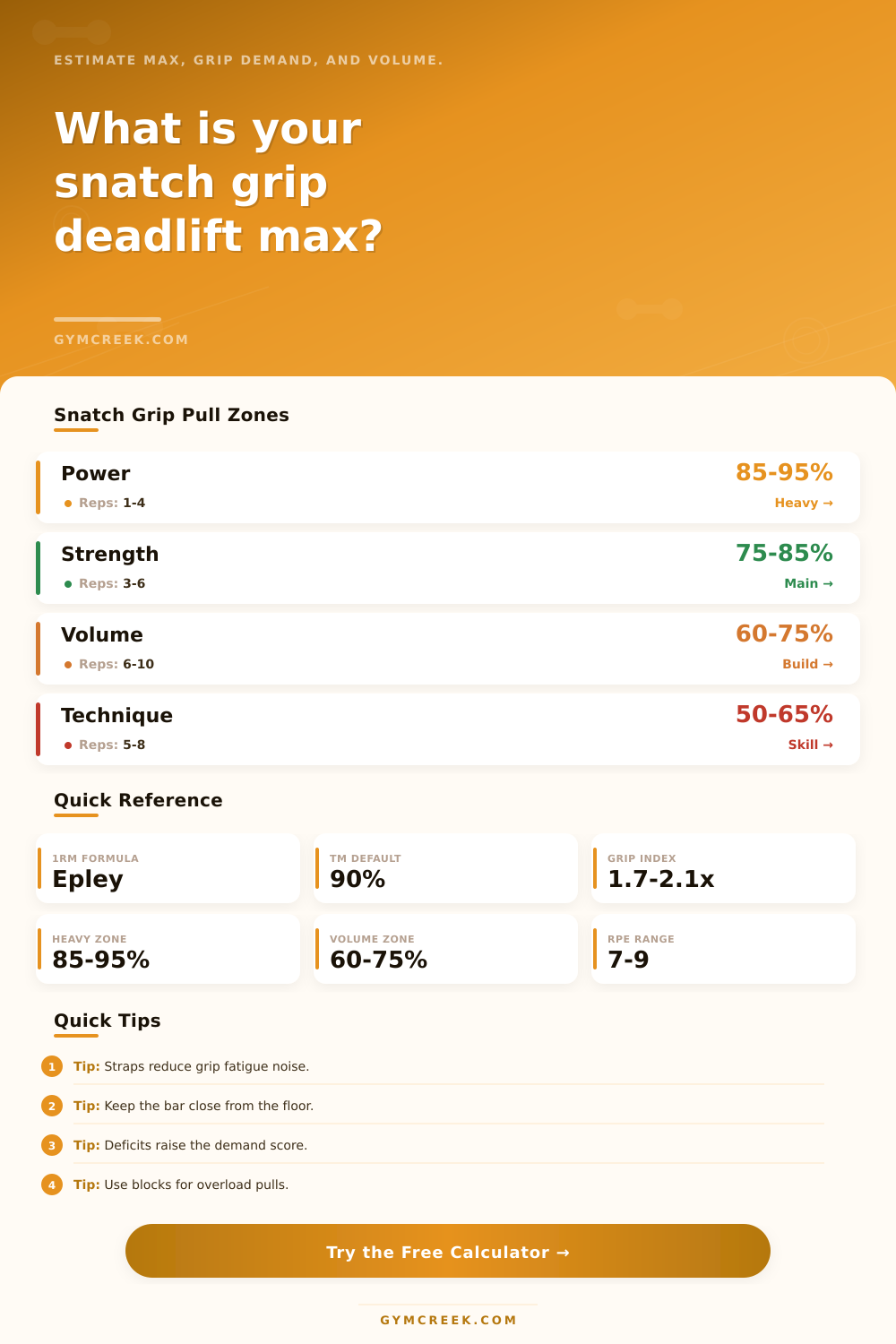
| Block overload | 85-95% 1RM | 1-4 reps | 3-6 hard sets |
| Strength focus | 75-85% 1RM | 3-6 reps | 4-8 hard sets |
| Weightlifting pull | 70-85% 1RM | 2-5 reps | 4-10 quality sets |
| Posterior volume | 60-75% 1RM | 6-10 reps | 6-12 hard sets |
| Position technique | 50-65% 1RM | 4-8 reps | 4-8 crisp sets |
| Formula | Calculation | Best range | Use here |
|---|---|---|---|
| Epley | Load x (1 + reps/30) | 1-10 reps | Main 1RM estimate |
| Brzycki | Load x 36 / (37 - reps) | 1-10 reps | Cross-check estimate |
| RPE reserve | Reps plus RIR | 6-10 RPE | True max adjustment |
| Grip index | Grip / shoulder width | Any lifter | Demand category |
| Strength ratio | 1RM / body weight | Any valid set | Benchmark category |
💡Tips
The snatch grip deadlift is an exercise. With your hands spread so far apart, the elbow stick way out to the side in this move. You can see why folks find this hard to do, it’s all about engaging lats and tension in your upper back. Most folks aren’t used to this body position, though and that’s part of what makes it effective at strengthening shoulders and hips.
After entering information, the calculator (which uses the Epley formula) calculate your approximate one rep max. For reps between one and ten, this method is reliable. You’ll then get an estimate for how much total tonnage you’re lifting per week, and how demanding your workout will be. This takes into account things like remaining energy levels, starting height, and grip width. Those all goes into a demand score and a tonnage estimate based off your current training situation. Then you can use that to determine whether your workouts is actualy helping you get stronger, or just making you sore with no gains.
What Is a Snatch Grip Deadlift?
Start with one variable: grip width. Is it a true snatch grip? When standing upright, does the bar sit in your hip crease with your hands sufficiently wide apart? With such a wide grip there’s very little mechanical advantage for arms when you pull vertically; instead, lats must do most of the stabilizing. That is, you can’t just use upper back or biceps to pull the weight up. The reference table on the page list grip width categorized by an index (measuring the hand spread relative to shoulder width). Anything below 1.6 probably won’t be broad enough to get the desired effect. Shoot for an index of 1.8, 2.1, so lats will be working more to maintain bar proximity to the body.
The lift gets easier as starting height decreases. If you’re starting below floor-level (a deficit), it becomes more difficult because you has a further range of motion to pull through. That’s why it’s tougher on glutes/hips; you need to accelerate over a greater distance until locked out. By contrast, if you’re using blocks to eliminate the dead spot at the beginning, you can use more weight to do overload work. Whether you start on the floor, in deficit, or on blocks influence your estimated max, and the calculator takes that into account. It factors in both how much weight you move and how far that weight travels relative of gravity.
When most lifters do this exercise, it’s an afterthought; something they do at the end of the workout when their tank is empty. That’s a problem because getting the bar path close takes very specific technique during the snatch grip deadlift. If you’re fatigued and your form fail, you’ll injure your lower back… Not improve your strength.
To determine how hard to pull with a wide grip, the tool prompts you to give it an RPE, or rate of perceived exertion. For example, on a scale of 1-10, 8.5 means you have about a rep-and-a-half left in reserve. So if you tend to crank out a wide-grip pull at RPE 10, chances are your technique will break down well before your muscles does.
Most programs suck at volume control: Performing the lift daily isn’t necessary. According to the reference section, most people should of sticking with three to eight hard sets per week for their goals. Doing more than that typically results in less progress because the nervous system take longer to recover from high tension. The calculator will help you stay honest by estimating how much tonnage you can handle each week. Compare it against your total training capacity; if there’s a difference, chances are good you’re doing too much work.
Why does this lift matter? Because it’s specific. The lift mimics the second pull of an Olympic snatch. This doesn’t mean catching the bar overhead but rather gives you all of the same strength benefits while avoiding the stress of a full jerk/clean on the joints. Add some meat onto those lats and shoulders.
Keep the bar close, listen to your body and go by the numbers, not make them go by you. Wide grip pulls aren’t necessarily appropriate for everybody, such as those who lack shoulder mobility. Let the numbers tell you when you’re ready to progress. The key is keeping the tension constant; don’t worry so much about how heavy the bar is.