Sleep Score Calculator
Score a night of sleep from duration, efficiency, REM, deep sleep, awakenings, schedule consistency, resting heart rate change, and morning energy.
📌Sleep Score Presets
Presets fill all eight inputs and calculate a sample sleep score immediately.
⚙Calculator
Sleep score estimate
Enter your night details to calculate score, duration subscore, quality subscore, recovery readiness, and improvement priority.
📊Sleep Metrics Grid
📑Sleep Score Reference Tables
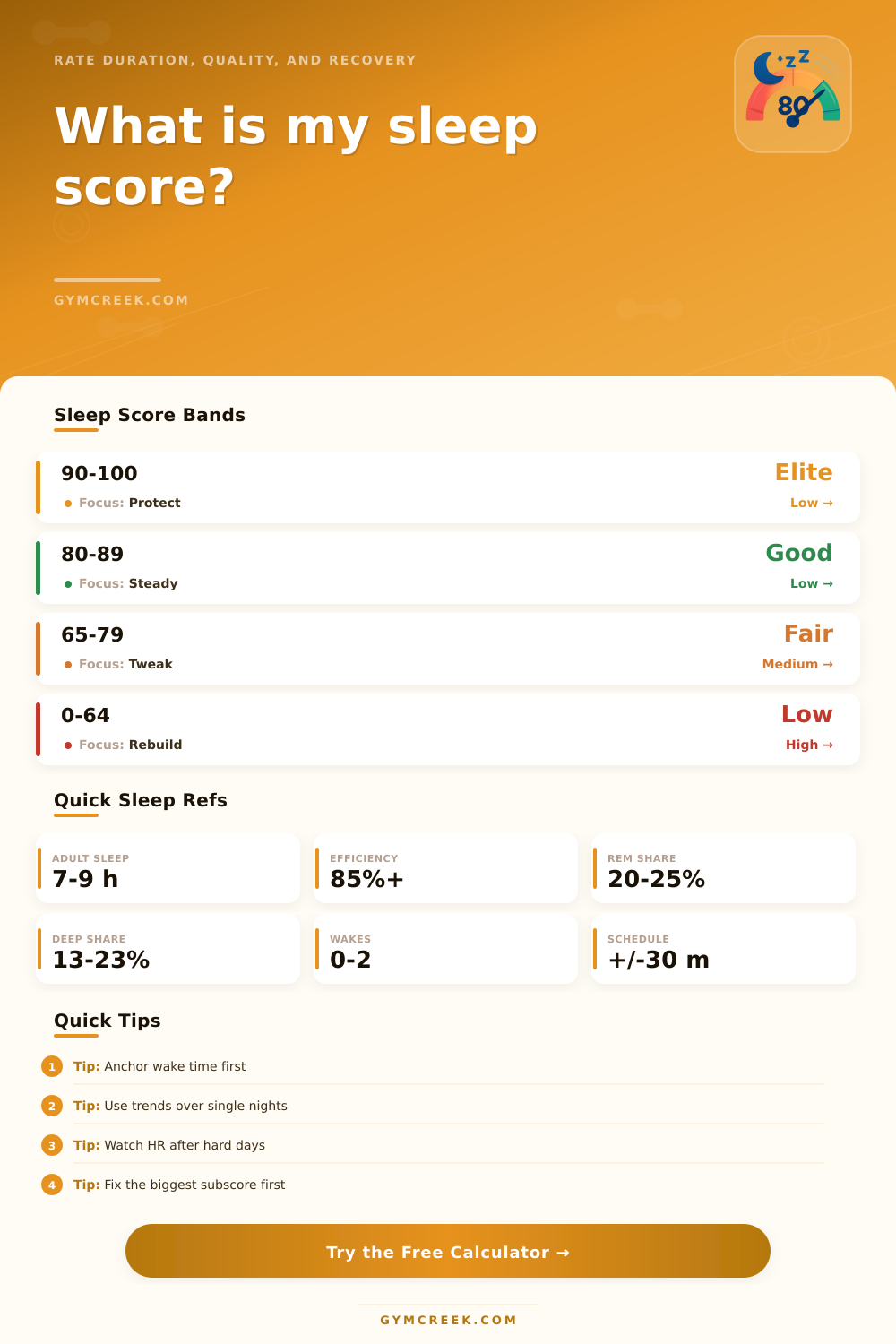
| Score band | Range | Readiness cue | Priority signal |
|---|---|---|---|
| Excellent | 90 to 100 | High readiness | Protect consistency |
| Good | 80 to 89 | Normal training day | Minor refinement |
| Fair | 65 to 79 | Manage intensity | Fix weakest subscore |
| Low | 0 to 64 | Recovery caution | Prioritize sleep basics |
| Input | Best range | Watch range | Score effect |
|---|---|---|---|
| Duration | 7 to 9 hours | Under 6 or over 10 | Drives duration subscore |
| Efficiency | 85% or higher | Under 80% | Large quality weight |
| REM estimate | 20% to 25% | Under 17% | Stage balance score |
| Deep estimate | 13% to 23% | Under 10% | Recovery depth score |
| Improvement priority | Trigger | First action | Why it matters |
|---|---|---|---|
| Sleep duration | Lowest duration subscore | Expand sleep window | More time creates more stage opportunity |
| Sleep continuity | Low efficiency or many wakes | Reduce disruptions | Fragmentation lowers perceived quality |
| Stage balance | Low REM or deep share | Review timing and stress | Stage estimates flag trend quality |
| Recovery load | High HR or low energy | Downshift strain | Morning signals may lag sleep metrics |
| Rule | Weight | Calculator detail | Result affected |
|---|---|---|---|
| Duration rule | 30% | Scores closeness to about 8 hours | Sleep score |
| Quality rule | 40% | Blends efficiency, REM, deep, wakes, consistency | Quality subscore |
| Recovery rule | 30% | Uses HR change, energy, and sleep score support | Recovery readiness |
| Priority rule | Lowest lever | Compares duration, quality, stages, and load | Improvement priority |
💡Sleep Score Tips
To calculate a sleep score, it is necesary to look at much different signals of your sleep. Using just one signal of your sleep, such as sleep duration, will lead to a misleadingly score. The sleep score is useful in that it take into account sleep duration, sleep continuity, and physical readiness in a single number.
By looking at these different factor of sleep, the sleep score can provide a more complete picture of an individuals sleep quality then if only sleep duration was considered. While many individual keep track of the total number of hours they spends in bed, that does not necesarily indicate the amount of sleep they get. Sleep efficiency is a measurement of the difference between the number of hours spent in bed and the amount of sleep time that an individual get.
How a Sleep Score Works
A low sleep efficiency score means that an individual spend a significant amount of time awake in bed and gets less sleep. Scores that reflect sleep efficiency are included in sleep scores for this variable are a major indicator of an individuals ability to recieve recovery from sleep. Other variable include sleep awakenings and sleep schedule drift.
Individuals needs both REM and deep sleep to restore their bodies properly. However, sleep trackers only provide estimates for sleep in these stages. You should use these estimates to recognize trend in an individuals sleep instead of being used as facts to describe their sleep.
For example, an individual that sleeps less in these stage will have harder mornings. These measurements are included in sleep scores to show whether the individuals problems is with sleep stage balance or sleep continuity. Recovery readiness for individuals is a separate measurement within the sleep score.
Heart rate and energy level measurement determine recovery readiness. High resting heart rate indicate that the individual may be under stress or performing heavy training. Low energy levels indicates that the individual is not ready to recover from sleep.
If either of these measurement indicate that recovery readiness is low, the recovery score will be low as well. This score is low because it should reflect the physical strain an individual can stand to extract maximum recovery from sleep. The sleep score can also provide an individual with an improvement priority for sleep.
The improvement priority is the factor that has the most great impact on lowering an individuals sleep score. By focusing on the improvement priority, individuals will find the greatest benefit for their sleep with the least amount of effort. The improvement priority may be sleep duration or it may sleep schedule consistency and stage balance.
By using the improvement priority, individuals can ensure that their sleep score increase. An individuals sleep can be affected by many social and seasonal factor, even if they do not change their sleep habits. For example, seasonal affectation disorder have to do with changes in the number of daylight hours in each season.
Similarly, changes in work deadlines can lead to changes in an individuals sleep numbers. Because these factors can change sleep numbers on a single night, individuals should look at sleep scores over several night to recognize trends. Trends are more useful than single measurement of sleep scores.
A sleep score is not a grade to be earned by individuals in the sleep competition. It does not change an individuals sleep, but it does change the decision they make regarding their sleep. An individual can use their sleep score to determine when to stop using electronic devices, how dark the room should be, or even if they need to increase their training.
By improving one area of sleep, other area will improve as well. While perfect sleep score data is not necessary for individuals to use sleep scores, the inputs is necessary and the changes to sleep habits are required.