Sleep Schedule Calculator
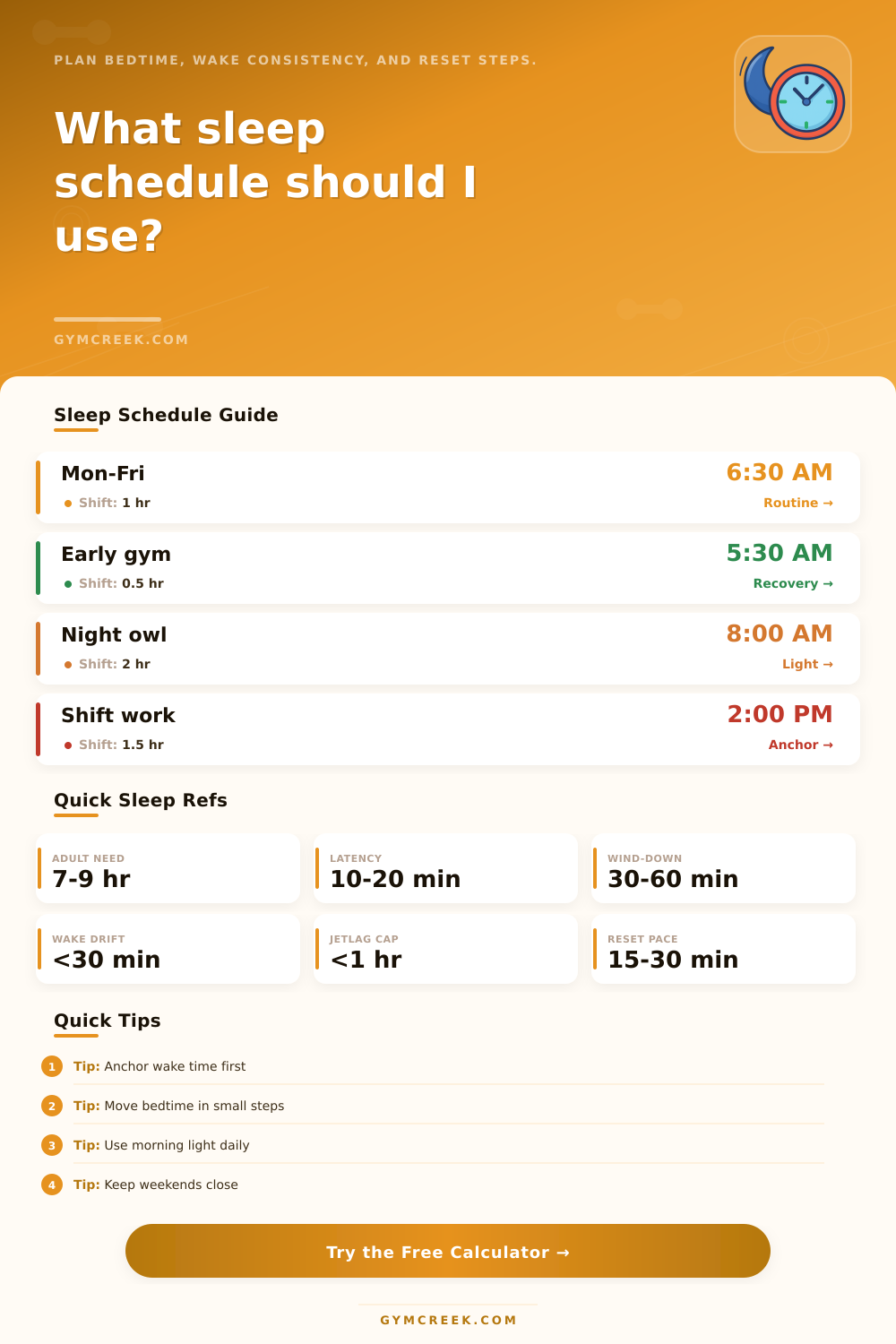
Build a practical bedtime and wake plan from your desired wake time, chronotype, work days, weekend shift, sleep need, latency, exercise timing, and light exposure.
📌Schedule Presets
⏰Sleep Schedule Inputs
Sleep schedule snapshot
Enter your schedule details to calculate a bedtime plan, wind-down time, wake consistency, social jetlag, and adjustment steps.
📊Metrics Grid
🧮Adjustment Steps
| Step | Tonight | Next Target | Action |
|---|
📑Sleep Schedule Reference Tables
| Type | Bedtime Bias | Light Cue | Reset Pace |
|---|---|---|---|
| Morning type | Earlier naturally | Protect evening dim light | 20 to 30 min |
| Neutral | Flexible | Morning light plus dim night | 15 to 30 min |
| Evening type | Later naturally | Strong morning light | 15 to 20 min |
| Variable | Inconsistent | Same light window daily | 15 min |
| Weekend Shift | Flag | Wake Advice | Bed Advice |
|---|---|---|---|
| 0 to 30 min | Low | Keep the anchor | Normal bedtime |
| 30 to 60 min | Mild | Use bright morning light | Move by 15 min |
| 1 to 2 hours | Moderate | Cap weekend sleep-in | Reset over 2 to 4 nights |
| 2+ hours | High | Pick a smaller drift | Shift gradually |
| Exercise | Schedule Effect | Wind-down | Note |
|---|---|---|---|
| Morning | Supports early wake | Normal | Pair with daylight |
| Afternoon | Usually neutral | Normal | Good default timing |
| Evening | May delay sleep | Add 15 min | Use a cool-down |
| Late hard | Higher arousal | Add 30 min | Avoid bright screens after |
| Light Pattern | Clock Effect | Best Move | Risk |
|---|---|---|---|
| Low morning light | Weak wake cue | Outdoor light early | Later drift |
| Balanced daylight | Stable cue | Keep timing steady | Low |
| Bright morning light | Earlier cue | Use after waking | Low |
| Bright late screens | Later cue | Dim 1 hour before bed | High |
✅Schedule Rules
💡Tips
To establish a sleep schedule, an individual must take a systematic approach to understanding the variable that affect sleep. A sleep schedule is difficult to maintain due to the numerous variable that change throughout the week. An individual must understand these variable to create a sleep schedule that work for there body.
The wake time for an individual is the most important element of a sleep schedule. An individual must establish a wake time and then determine the bedtime based on this wake time. An individual can calculate the bedtime required to provide them with enough sleep, but they must also account for the amount of time that it take for an individual to fall asleep.
How to Make a Simple Sleep Schedule
The time between turning off the light and falling asleep is time that is not spent sleeping. Thus, an individual must include the time it take to fall asleep when determining their bedtime. Individuals has chronotypes that determine when they feel alert and sleepy.
Some individuals have chronotypes that make them feel alert in the morning, while others has chronotypes that make them feel alert in the evening. An individual’s chronotype vary from person to person. Thus, an individual’s sleep schedule must account for this.
If an individual ignore their chronotype, their sleep schedule may fail to account for their bodily need. An individual’s sleep schedule should include a wind down window to prepare the body for sleep. An individual’s wake time may change on the weekends, which is known as weekend drift.
Weekend drift disrupt an individual’s body clock. Most individuals will sleep in later on the weekends than they do throughout the week. This is referred to as social jetlag.
Social jetlag can make it difficult for individuals to adhere to their sleep schedule during the week. An individual should try to keep the same wake time every day, even on the weekends. If an individual does not keep the same wake time every day, their body clock will not remain stable and will struggle to adjust to the sleep schedule throughout the workweek.
An individual’s exposure to light and the timing of their exercise can impact their sleep schedule. Exposure to bright screen and the timing of hard exercise can make an individual take longer to fall asleep. An individual’s sleep schedule should account for this by establishing a wind-down buffer before sleep to account for these impact on sleep.
Small shift in an individual’s sleep schedule are more effective than shifting them large amount. An individual should shift their sleep schedule by only fifteen or twenty minutes each night. Shifting the sleep schedule by only fifteen or twenty minutes allow the body to adjust to the change in sleep schedule.
If an individual shifts their sleep schedule by a large amount, they may fall into sleep debt that may cause them to abandon their sleep schedule. The speed at which an individual shifts their sleep schedule should be based off their weekend drift. An individual’s consistency in their wake time is the most important test of their sleep schedule.
If an individual wakes up at the same time on the workdays and on the free days, their sleep schedule has a higher chance of being stable. However, if an individual wakes up at different time on the workdays and the free days, then there is a problem with their sleep schedule caused by weekend drift or improper exposure to light. By understanding how each of these factors interact with one another, an individual can make better decisions regarding their sleep schedule.