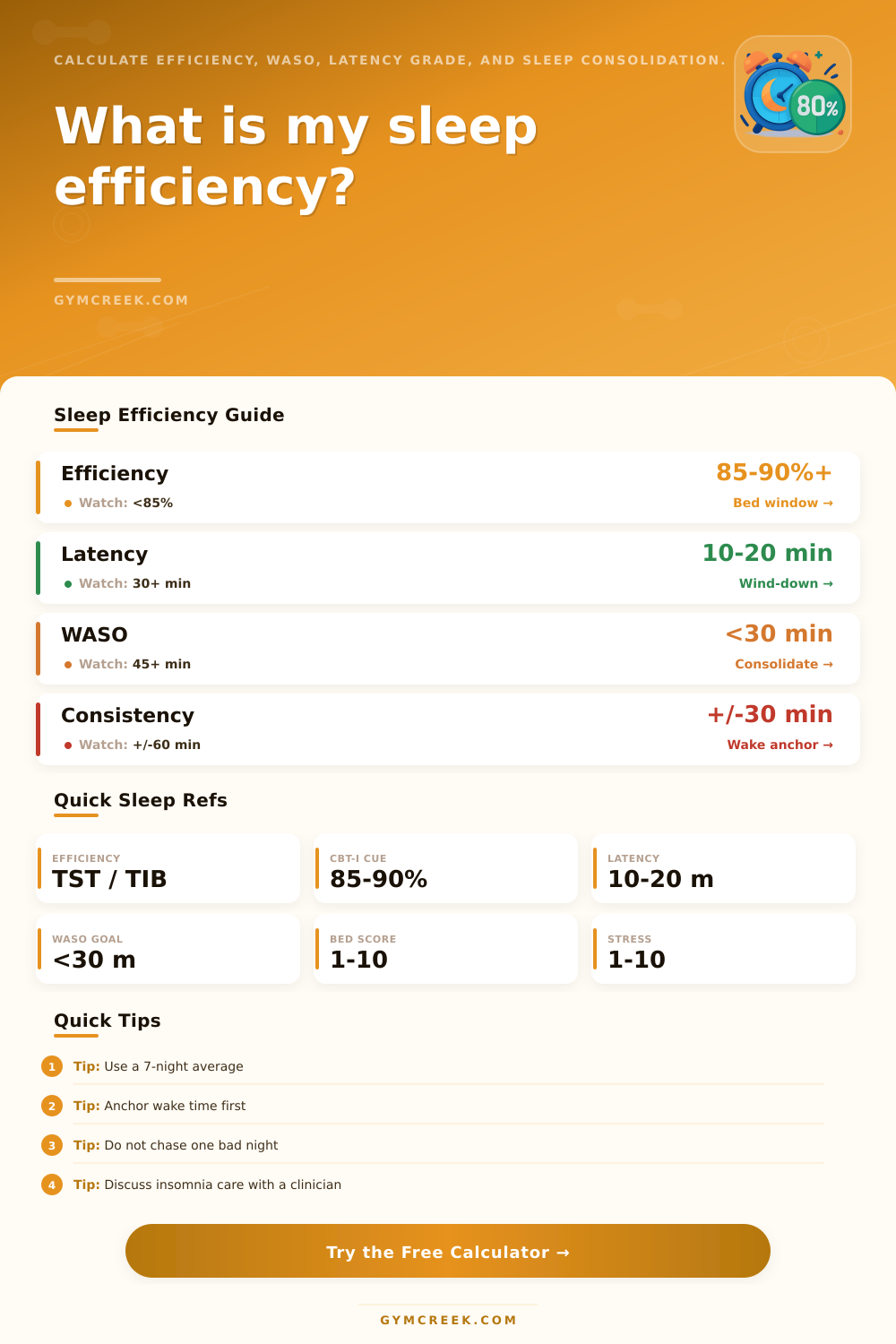
Sleep Efficiency Calculator
Estimate sleep efficiency, wake after sleep onset, latency grade, consolidated sleep score, and a CBT-I style target bed window from one night or a weekly average.
📌Sleep Pattern Presets
Presets fill every input and calculate immediately. Replace them with your own sleep log values before interpreting the result.
⚙Calculator Inputs
Sleep efficiency estimate
Enter a sleep log night or weekly average to calculate efficiency and consolidation.
📊Metrics Grid
📑Reference Tables
| Efficiency | Read | Common meaning | Calculator label |
|---|---|---|---|
| 90% or higher | Very consolidated | Bed window may be tight or sleep drive is strong | Efficient |
| 85% to 89% | Good target zone | Often used as a practical CBT-I style benchmark | Target zone |
| 80% to 84% | Borderline | Extra wake time is diluting the bed window | Watch |
| Below 80% | Fragmented | Sleep log may show insomnia, excessive time in bed, or disruptions | Rebuild |
| Metric | Strong | Watch | High flag |
|---|---|---|---|
| Sleep latency | 10-20 min | 21-30 min or under 5 min | 31+ min |
| WASO | 0-30 min | 31-45 min | 46+ min |
| Awakenings | 0-2 remembered | 3-4 remembered | 5+ remembered |
| Awake load | Under 45 min | 45-75 min | 75+ min |
| Current pattern | Target logic | Example adjustment | Note |
|---|---|---|---|
| Efficiency 90%+ | Consider adding a small amount of time in bed | Average sleep + 30 to 45 min | Only if daytime function needs more sleep |
| Efficiency 85-89% | Hold the current window steady | Keep same schedule for another week | Stability beats constant tweaking |
| Efficiency below 85% | Use a tighter sleep opportunity estimate | Average sleep + 30 min, minimum 5.5 h | Clinical CBT-I should be supervised |
| Severe sleepiness or safety risk | Do not restrict sleep on your own | Seek professional guidance | Driving, shift work, and medical issues matter |
| Rule | Formula or scoring idea | Why it matters | Output affected |
|---|---|---|---|
| Efficiency | Total sleep time / time in bed x 100 | Shows how much of the bed window was actually sleep | Main percentage |
| Awake load | Latency + WASO | Combines sleep-onset and middle-night wake pressure | Breakdown and score |
| Consolidation | Weighted efficiency, latency, WASO, awakenings, consistency, room, stress | One score summarizes continuity and sleep setup | Metrics grid |
| Target window | Average sleep plus a 15-45 min buffer, never below 5.5 h | Mimics CBT-I style sleep scheduling logic | Target card |
✅Practical Rules
💡Tips
Sleep efficiency is a calculation of the amount of time that a person sleep divided by the total amount of time that the person spends in beds. Sleep efficiency is important to calculate as it help to indicate the difference between the amount of time that a person sleeps in comparison than the amount of time that they spend in bed. For instance, if an individual sleep for six hours while spending eight hours in bed, their sleep efficiency will be lower than individual who sleep for eight hours.
Low sleep efficiency indicate that the time that the individual spends in bed is not being used to sleep. Time in bed is the amount of time that a person spend in bed from the time that they turn off there lights until they get out of bed. Time in bed includes both sleeping and awake period.
What Is Sleep Efficiency
Sleep time, in contrast, is the amount of time that the individual sleep. For most individuals, it can be difficult to track sleep time, as most individuals does not measure sleep time. However, the sleep calculator included with this website can calculate sleep time; the calculator will provide the sleep efficiency percentage for you.
Sleep latency and wake after sleep onset are two factor that affect sleep efficiency. Sleep latency is the amount of time that it take for an individual to fall asleep after turning off their lights. Sleep latency is one component of sleep efficiency because sleep latency is a measurement of the amount of time that an individual is awake while in bed.
Wake after sleep onset is the amount of time that an individual is awake after sleeping; this includes any periods in the night when an individual wake up from sleeping. This factor decrease sleep efficiency; the longer that an individual is awake after sleeping, the more lower their sleep efficiency will be. Both of these factors can contribute to a lower sleep efficiency score.
Other factor that may impact sleep efficiency are the consistency of the sleep schedule and the environment in which the individual sleep. An individual who do not sleep at the same time each night may find that it is more difficult for them to fall asleep, leading to lower sleep efficiency. Additionally, factors in the sleeping environment, such as temperature, light and noise can also impact sleep efficiency.
For instance, if the bedroom in which an individual sleep is too loud, they may have an increased wake after sleep onset score, which may lead to lower sleep efficiency. Additionally, stress may also have an impact on sleep efficiency; stress can increase both sleep latency and wake after sleep onset score. Most individuals often target a sleep efficiency score of 80%.
A sleep efficiency score that is lower than 80% indicate that an individual spend too much time lying in bed while sleeping. Many individuals may attempt to increase their sleep by spending more time in bed. However, spending more time in bed without increase sleep will lead to lower sleep efficiency.
Thus, to increase sleep efficiency, an individual should focus upon sleeping for longer period while lying in bed, or focusing upon ensuring that their time in bed match their sleep time. Tracking sleep efficiency allows individuals to monitor their sleep efficiency over time. By monitoring sleep efficiency, individuals can understand how sleep latency and wake after sleep onset impact their sleep efficiency score.
By understanding how these score can impact sleep efficiency, individuals can make change to their sleep to increase their sleep efficiency score. Thus, one goal in tracking sleep efficiency is to understand the relationship between time in bed and sleep time.