Sleep Duration Calculator
Estimate sleep duration, net sleep, sleep opportunity, target gap, and schedule rating from bedtime, wake time, latency, awakenings, naps, age, activity, and buffer.
⏱Sleep Presets
📝Sleep Inputs
Sleep duration snapshot
Enter your sleep window to estimate duration, net sleep, opportunity, target gap, and schedule rating.
📊Sleep Metrics Grid
📑Reference Tables
| Age group | Target range | Midpoint | Planning note |
|---|---|---|---|
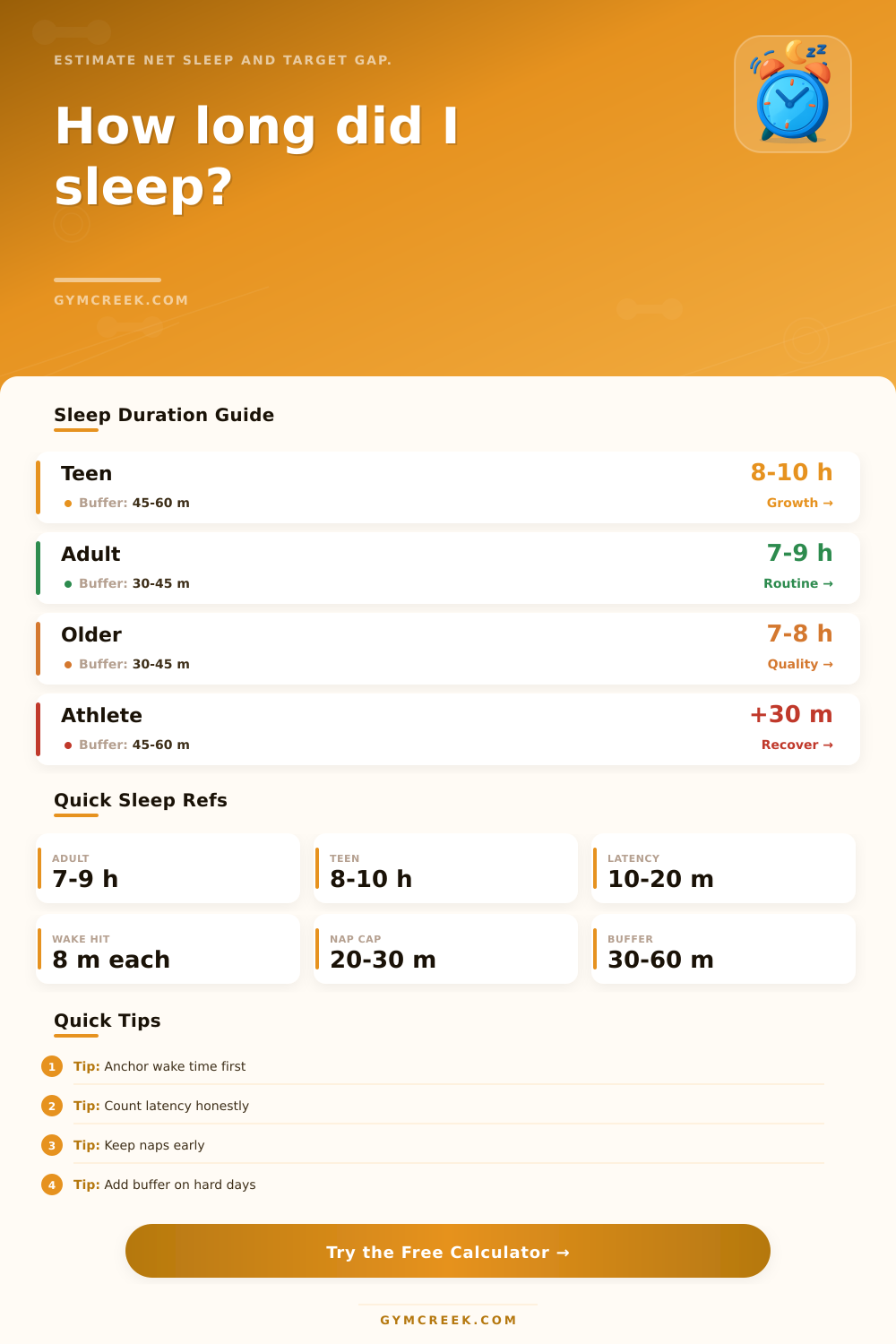
| Teen, 14 to 17 | 8 to 10 hours | 9 hours | Most need longer recovery windows |
| Young adult, 18 to 25 | 7 to 9 hours | 8 hours | Consistency matters more than one late night |
| Adult, 26 to 64 | 7 to 9 hours | 8 hours | Use 7.5 to 8.5 hours as a practical anchor |
| Older adult, 65 plus | 7 to 8 hours | 7.5 hours | Quality and regular timing become more important |
| Load | Added target | Buffer idea | Why it matters |
|---|---|---|---|
| Rest or light day | 0 minutes | 20 to 30 min | Keep the routine steady |
| Normal workday | 15 minutes | 30 to 45 min | Offsets typical mental and physical load |
| Moderate workout | 30 minutes | 40 to 50 min | Supports training recovery |
| Hard or race day | 45 to 60 min | 45 to 60 min | Protects recovery and alertness |
| Rating | Gap | Efficiency | Use this read |
|---|---|---|---|
| Excellent | 0 to 15 min short | 90% plus | Schedule closely matches the target |
| Good | 16 to 45 min short | 85% plus | Minor adjustments may help |
| Borderline | 46 to 90 min short | 80% plus | Move bedtime earlier or trim latency |
| Needs work | 90+ min short | Under 80% | Review window, wakes, and buffer |
| Nap length | Credit used | Timing note | Schedule effect |
|---|---|---|---|
| 0 minutes | 0 minutes | No daytime sleep | Night target stays unchanged |
| 10 to 30 minutes | Full credit | Best before late afternoon | Helps alertness with low inertia |
| 31 to 60 minutes | Partial credit | Can create grogginess | May delay bedtime slightly |
| 61+ minutes | Capped credit | Watch nighttime latency | Do not erase the night target |
💡Sleep Duration Tips
Sleep is often treated as one variable, but sleep is actualy comprised of a number of different variable that determine how much sleep an individual gets. Many individuals believes that the time spent in bed is equal to the time spent asleep, but these two measurements are actually different variable. These two variables is important to separate, as the time spent asleep impacts how an individual feel during the day and recover from any stress that they may have endured.
To calculate the sleep that an individual will obtain during a sleep cycle, there are a number of different variables that is to be taken into consideration. Variables like bedtime and wake time will establish the sleep window that the individual will have, but other factor may reduce that sleep window. The sleep latency can reduce the amount of sleep that an individual obtain due to the time it can take for an individual to fall asleep.
What Affects Your Sleep
Additionally, if an individual wakes up during the night, those awakenings may reduce the amount of sleep that they did get during their cycle. However, naps may help to even out those sleep cycles, though there is a limit to the amount of sleep that can be credit to napping. Additionally, the activity level that an individual performs during the day can impact the amount of sleep that they require throughout the day.
Finally, a buffer is provided for the sleep cycle for the tasks that must be performed during sleeping hour. Based off these different variables, the sleep calculator can provide several number regarding the sleep that an individual will get during a sleeping cycle. The sleep duration will provide the amount of sleep that an individual will get during their cycle after accounting for sleep latency and awakenings.
The net sleep will be the sleep duration plus the nap credit. The sleep opportunity will provide an individual with the total sleep window that they have during a cycle. The target gap will provide the difference between the net sleep that an individual will get and the amount of sleep that an individual need based upon their age and activity level.
Finally, the schedule rating will provide an individual with a general understanding of their sleeping pattern based upon their target gap and sleep efficiency. Understanding these different variables and their impact upon sleep is important for those who wish to adjust their sleeping cycles. For instance, if an individual decides to change their bedtime, but their sleep latency increases, they may still not get enough sleep.
Additionally, if an individual begins to take naps, they may not get enough sleep if they do not change their wake time. The reference table can help an individual to understand the impact of age and activity upon sleep need. Additionally, while the sleep calculator does not directly measure sleep quality, quality can impact sleep latency and awakenings during the sleep cycle.
Sleep quality is related to the number of awakenings that an individual have during the cycle, the stress that they feel during the cycle, the light that enters their bedroom while sleeping, the amount of caffeine that they consume while sleeping, and the temperature of their bedroom. Thus, the sleep calculator does not measure stress, light exposure, caffeine levels while sleeping, or bedroom temperature, though it does indicate the effect of these factors through the measurements of sleep latency and awakenings. The target sleep amount can be neither too much nor too little for an individual to require each sleep cycle, but instead should be an average amount for each sleeping cycle.
Some sleep cycles will allow for an individual to get less sleep than the target amount. However, it is recommended that an individual monitor their sleep cycle over a one or two week period to ensure that they are moving in the appropriate direction. If the target gap is established at a large number of minutes, small changes to an individuals sleep schedule can help to even that target gap.
Additionally, the sleep cycle also includes a buffer for the tasks that an individual must complete during sleep. The sleep cycle may be established during sleep, but various factor can reduce the sleep that an individual will get; sleep latency, awakenings during sleep, and the margin that an individual allow in the morning to wake up can reduce the sleep that they get while sleeping. Thus, an individual plans a buffer that can be incorporated into the sleep cycle, to ensure that they dont oversleep or forget about certain task during sleep.
Thus, the value of the sleep calculator can force an individual to consider each aspect of sleep separately. Considering each aspect of sleep separately will allow for individuals to gain an understanding of where their time is going during sleep; thus, they can make modest adjustment to ensure that they get the sleep that they need. They should of checked their schedule more carefully to avoid errors.