Sleep Debt Calculator
Estimate weekly sleep debt, repayment nights, recovery score, and performance risk from target sleep, seven actual nights, naps, training load, age, recovery days, caffeine, and alcohol.
📌Debt Presets
Presets fill realistic weekly sleep logs and immediately recalculate the estimate.
⚙Calculator
Sleep debt snapshot
Enter your weekly sleep log to estimate debt and recovery risk.
📊Recovery Metrics
📑Reference Tables
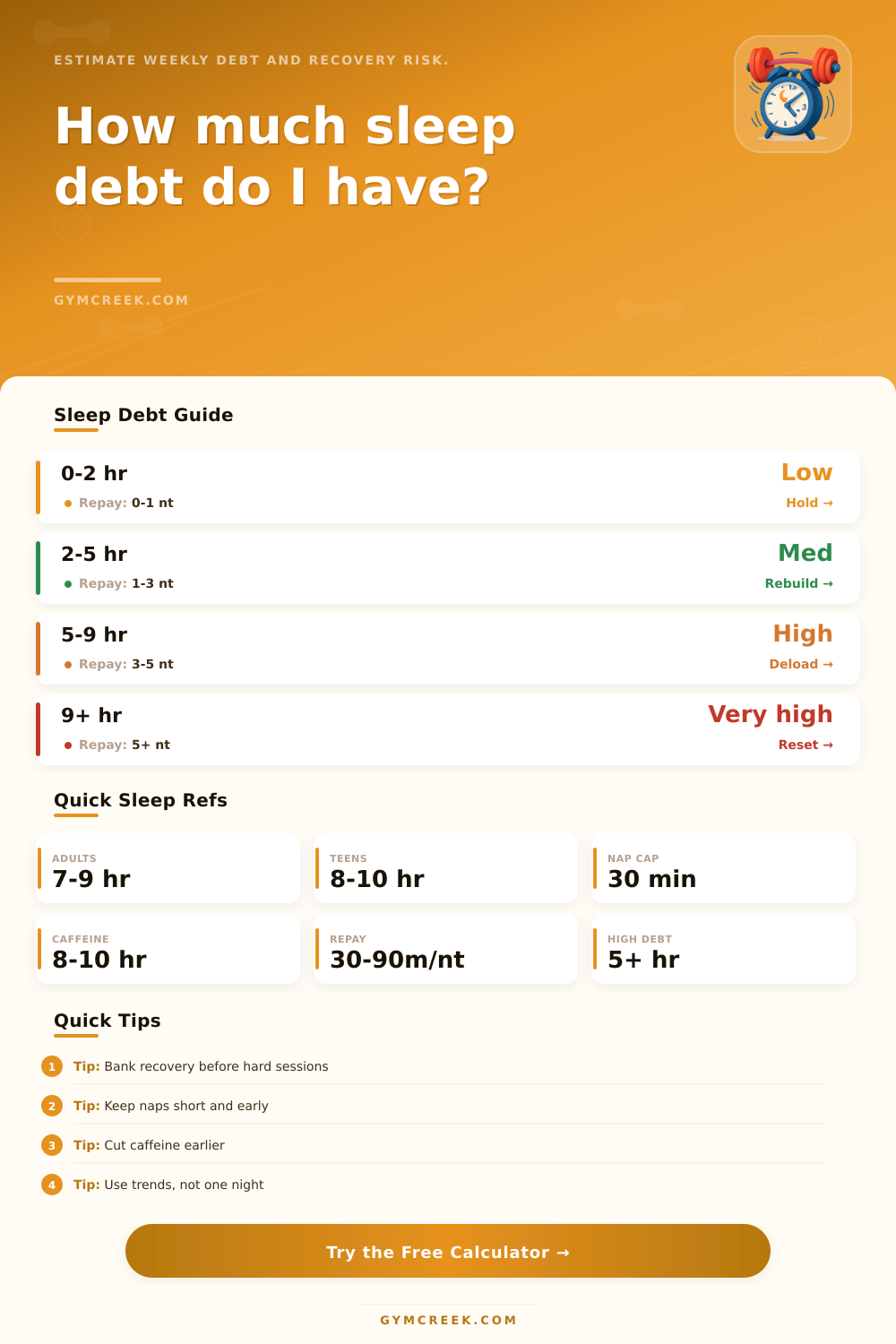
| Weekly debt | Risk | Training note | Action |
|---|---|---|---|
| 0 to 2 hr | Low | Usually manageable | Hold routine |
| 2 to 5 hr | Moderate | Coordination may dip | Add sleep blocks |
| 5 to 9 hr | High | Recovery may lag | Reduce intensity |
| 9+ hr | Very high | Performance risk rises | Prioritize reset |
| Age | Common range | Calculator nudge | Note |
|---|---|---|---|
| 8 to 12 | 9 to 12 hr | Raises need | Growth and school load |
| 13 to 18 | 8 to 10 hr | Raises need | Teen recovery often needs more |
| 18 to 64 | 7 to 9 hr | Uses target | Most adults fit here |
| 65+ | 7 to 8 hr | Stability nudge | Fragmented sleep can matter |
| Extra sleep | Best use | Limit | Calculator use |
|---|---|---|---|
| 30 min/night | Small debt | Easy to sustain | Low recovery days |
| 60 min/night | Moderate debt | Good default | Normal recovery pace |
| 90 min/night | Large debt | Short-term only | High debt cap |
| Naps | Bridge fatigue | Not full replacement | Capped credit |
| Item | Formula | Input | Output |
|---|---|---|---|
| Weekly need | Target x 7 x load | Sleep and training | Adjusted target |
| Nap credit | Minutes x quality | Naps | Debt offset |
| Debt | Need - actual - naps | Sleep log | Hours owed |
| Risk | Debt + stressors | All factors | Low to severe |
💡Tips
Sleep debt are the difference between the sleep that a person need and the amount of sleep that a person receives. If a person dont sleep enough during this cycle, and if that person accumulates sleep debt over many night, there are a variety of effect that sleep debt can have upon the body. Sleep debt can affect the way that an athlete recover from training, it can affect the persons reaction time, and it can even have an effect upon there overall mood.
However, many individual do not feel the effect of sleep debt immediately, but over time, sleep debt can make training feel heavier for those athletes, and it can make it difficult for those individuals to focus on there training. To determine sleep debt for an individual athlete, the athlete must enter their data into a calculator. The athlete must enter the target sleep hour that the athlete gets each night into the calculator, as well as the actual number of hour that they sleep over seven night.
Sleep Debt for Athletes
Additionally, the athlete can enter the number of nap that an athlete takes during the day into the calculator, as well as their training load. The athlete can enter the number of available recovery day for that individual into the calculator, as well as the timing of their caffeine and alcohol consumption. Each of these variable will lead to the calculator providing the athlete with a total sleep debt for that individual for that week, the number of night that it will take for the athlete to repay that debt, the recovery score for the athlete, and the risk signal for that athlete.
The sleep debt calculator utilize each of these variable to provide an athlete with an accurate calculation of their sleep debt because sleep debt is more than just sleep totals for that individual athlete. An athlete that train much will require more sleep than an athlete that does not train as often. Additionally, caffeine and alcohol can disrupt sleep for those athlete who consume these substances late in the night.
Finally, the age of the individual can also have an impact upon sleep debt for athletes because younger athletes requires more sleep than older athletes due to the sleeping needs of younger individuals for growth. The sleep debt calculator incorporate these variables to provide athletes with a more accurate calculation of their sleep debt. While nap credit can help an athlete to repay some of their sleep debt, there are limitation to the amount of sleep debt that naps can help to repay.
While naps of twenty or thirty minutes may help an athlete to repay some of their sleep debt, no nap can replicate the sleep debt that is provided by sleeping for at least seven hour during the night. The sleep debt calculator limit the use of nap credit to ensure that athletes cant become too optimistic about the amount of sleep debt that they can repay through naps during the day. The reference table allow for athletes to understand where their sleep debt falls in relation to other sleep debt amount.
Low amount of sleep debt are generally manageable for athletes with normal sleeping habit. However, moderate amount of sleep debt may affect an athlete’s coordination and their mood. High amount of sleep debt will slow the athlete’s recovery between training session, which is why they enter their available recovery day into the calculator to determine how to repay their sleep debt.
Additionally, sleep debt should be repaid at a conservative pace rather than an aggressive one. For example, adding thirty to ninety minutes of sleep each night is likely to be more effective than obtaining one massive amount of sleep each week because it is less likely to disrupt the athlete’s sleep schedule. There are a variety of variable that may reduce the quality of sleep that an athlete obtain while training.
For example, stress, the temperature in an athlete’s bedroom, and their work schedule can all reduce the quality of sleep that athletes obtain. If an athlete feels that their sleep debt remain high despite attempting to sleep more, those athlete should investigate these variables to ensure that they are not contributing to their sleep debt. Additionally, athletes should also consider how they plan their training session; it is better to schedule a heavy training session after a night of good sleep rather than hoping that one long sleep can erase sleep debt accumulated over the past several week.
There are a variety of change that an athlete can make to reduce their sleep debt. For example, an athlete can shift their bedtime by fifteen minute each night, avoid using screen and caffeine before sleeping, and ensure that any nap that are taken are early and short. The recovery score can provide athletes with an understanding of their level of readiness to perform at their best, but athletes should also monitor their recovery score over a two and three week period to determine if they are beginning to exhibit improvement in their recovery schedule.
Sleep debt can form for a variety of reason for athletes, but there are method for managing that sleep debt. By entering an athlete’s data into the sleep debt calculator, those athlete can become aware of their sleep debt, the reason for their sleep debt, and method for correcting their sleep debt. It is actualy alot of work to manage it.