Sleep Calculator
Plan a realistic bedtime from wake time, age, latency, naps, caffeine, chronotype, and training load.
Your sleep plan
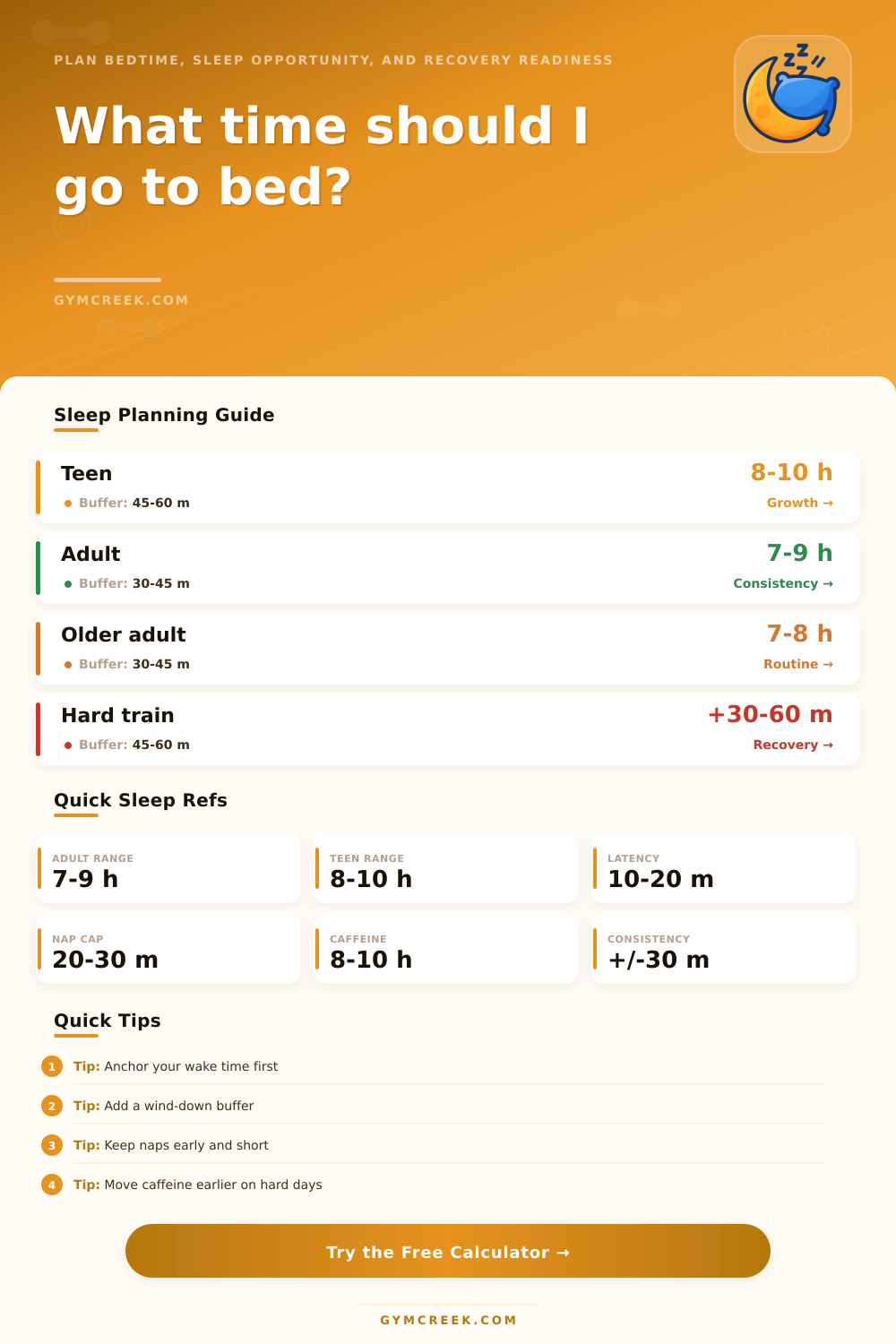
The calculator uses age-based sleep ranges plus schedule and recovery modifiers.
| Age group | Common nightly range | Planner midpoint | When to add more |
|---|---|---|---|
| Teen, 14-17 | 8-10 hours | 9 hours | Growth spurts, exams, heavy sport blocks |
| Young adult, 18-25 | 7-9 hours | 8 hours | High training stress, sleep debt, illness |
| Adult, 26-64 | 7-9 hours | 8 hours | Hard training, demanding work, poor recovery signs |
| Older adult, 65+ | 7-8 hours | 7.5 hours | Fragmented nights or increased daytime sleepiness |
| Chronotype | Planner adjustment | Practical cue |
|---|---|---|
| Morning type | Shift target 15 minutes earlier | Keep bright light soon after waking. |
| Neutral | No timing shift | Protect a stable wake time first. |
| Evening type | Add 15 minutes of wind-down buffer | Dim screens and lights earlier than feels natural. |
| Nap pattern | Useful range | Risk flag | Planner effect |
|---|---|---|---|
| No nap | 0 minutes | None | No adjustment |
| Short early nap | 10-30 minutes before 2 PM | Low | Small recovery bonus |
| Long nap | 60+ minutes | Can reduce sleep pressure | Readiness penalty if bedtime is already late |
| Late nap | After 5 PM | May delay sleep onset | Adds wind-down and latency pressure |
| Training load | Sleep planning rule | Evening caution |
|---|---|---|
| Rest or mobility | Use normal target range | Keep routine consistent. |
| Moderate | Add roughly 15 minutes of recovery margin | Finish intense work at least 3 hours before bed. |
| Hard | Add 30 minutes if possible | Use a longer cool-down and reduce late caffeine. |
| Very hard | Add 45-60 minutes if possible | Earlier bedtime may matter more than perfect sleep stages. |
A sleep calculator is a tool that allows you to calculate your recommended bedtime based on several variable. A sleep calculator is useful in that it can take all of those different sleep variable and turn them into your recommended bedtime. Each of those variables must be input into the sleep calculator in order to determine your bedtime.
One of those variables are your wake time, which is when you would like to wake up each day. Your age group is another variable to be input into the sleep calculator; sleep need are different according to age group. For instance, teenagers need different amount of sleep than adults do due to the difference in the bodily function of each group.
How a Sleep Calculator Works
Another sleep calculator variable is sleep latency, or the length of time that it takes for you to fall asleep. Many people dont account for all of the time it takes to fall asleep, such as time spent on they’re phones or walking to the bathroom. Another variable is the duration and timing of any naps that you take during the day; naps can impact the sleep pressure that your body feel during the sleep cycle.
Additionally, your caffeine cutoff time and training end time is two more variables that need to be taken into account in the sleep calculator. Both caffeine and training impact the amount of time that it takes for your nervous system to settle. For example, if you trained heavily in the evening, you may find it difficult to fall asleep because your body is warm and alert.
Another variable that you can enter into the sleep calculator is your chronotype. Your chronotype indicate whether you are a morning person or an evening person. Those who are morning types typically feel sleep pressure at an earlier time of day than those who are evening types.
By taking your chronotype into account in your sleep calculator, the calculator will adjust your bedtime recommendation according to your bodys natural tendency to allow for better sleep. This adjustment is important so that the sleep schedule that is recommended to each individual is an adjustment that fit into that individual’s body and circadian rhythm. The sleep calculator will output a recovery readiness score.
This score is not just a reflection of how many hour of sleep you get. Instead, the recovery readiness score calculates your sleep schedule, your caffeine intake, and your training schedule to determine your bodys level of recovery for that particular day. For instance, you may have slept for eight hour, but if you woke up late at night following a strenuous workout, your recovery readiness score may be low.
This score reward individuals who have consistent sleep patterns. Consistency is vital to your sleep cycle. Consistency is important because if you shift your bedtime by more than thirty minutes, your body will begin to experience a gap between the sleep that it expects each day to the sleep that it receives.
This gap can lead to fatigue during the day, and it can be difficult to erase that fatigue. By using the sleep calculator, you can determine whether or not you have created this sleep gap, and you can use that sleep calculator to determine how many nights it will take to shift your bedtime by only fifteen minutes to create a consistent bedtime. Many changes in your daily life has the potential to impact your sleep pressure.
Events like travel, illness, and increased training will all impact your sleep schedule, and, therefore, your old sleep plan may no longer work for you. By entering your new wake time and your training load into the sleep calculator, it will calculate the new bedtime for you based on your new sleep reality. The most important habit to develop is to protect your wind-down window.
By protecting your wind-down window, your body will naturaly know that it is time to sleep. If your bedtime is calculated as 10:15, for instance, you should begin to wind down at 10:00. By doing so, your body will have time to naturally decrease its body temperature and to clear its mind of any task it must complete.
Following this habit will not only increase your sleep quality, but will improve your consistency score. Sleep planning can work best if it is flexible regarding changes in your sleep schedule; the sleep calculator allows you to make your sleep target visible, allowing you to maintain your target for your body.