Skull Crusher Load Calculator
Estimate a practical skull crusher working load from your close-grip pressing strength, target reps, equipment, and elbow comfort.
📌Presets
Each preset loads a realistic skull crusher setup and recalculates total load, per-side loading, intensity, and weekly triceps volume.
⚙Calculator
Skull crusher load snapshot
Enter a close-grip bench set and calculate a triceps isolation load.
📊Fitness Metrics
📑Reference Tables
| Target | Reps | Epley Load | Use Case |
|---|---|---|---|
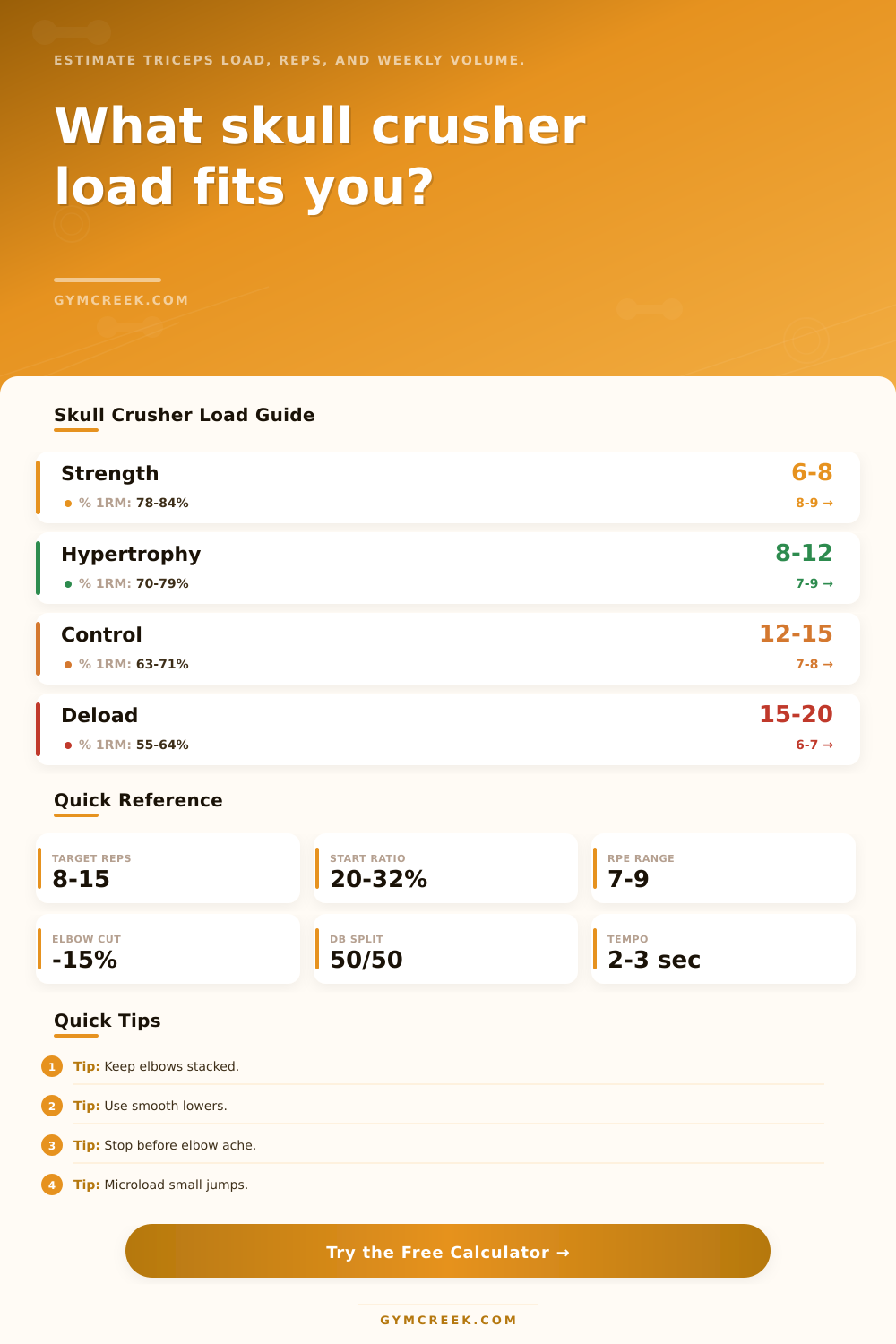
| Heavy triceps | 6-8 | 79-83% 1RM | Experienced lifters with quiet elbows |
| Hypertrophy | 8-12 | 71-79% 1RM | Most skull crusher work |
| Control work | 12-15 | 67-71% 1RM | Better tempo and joint feedback |
| Deload | 15-20 | 60-67% 1RM | Low-stress practice weeks |
| Equipment | Load Model | Adjustment | Notes |
|---|---|---|---|
| EZ-bar | Total bar load | Baseline | Common balance of wrist comfort and load |
| Straight bar | Total bar load | -4% | More wrist and elbow demand for many lifters |
| Dumbbells | Each hand | -6% | Extra stabilization and longer range |
| Cable | Stack reading | +5% | Smoother tension can tolerate slightly more |
| Single DB | Total dumbbell | -8% | Good for simple home-gym loading |
| Experience | CGBP Ratio | Start Point | Progression |
|---|---|---|---|
| Beginner | 20-23% | Technique first | 2.5-5 lb jumps |
| Intermediate | 24-28% | Repeatable sets | Small weekly jumps |
| Advanced | 29-32% | Specific triceps strength | Microload often |
| Very advanced | 31-34% | High skill isolation | Wave load carefully |
| Elbow Status | Load Change | RPE Cap | Best Choice |
|---|---|---|---|
| No issues | 0% | 9 | EZ-bar or cable |
| Minor caution | -5% | 8 | Controlled EZ-bar reps |
| Sensitive | -12% | 7.5 | Cables or dumbbells |
| Irritated | -20% | 6.5 | Very light practice only |
💡Tips
There’s a certain kind of triceps isolation anxiety. Here you are lying down, hands narrow on bar, and weight seems to be more than when you were benching. Momentum has been taken from big muscle group; now it’s just you versus gravity. It’s the harsh nature of the skull crusher.
Triceps isolation doesn’t get any easier. Overuse will lead to pain around the elbows. The goal is to find a load that stimulates growth without frying joints. Try to hit a sweet spot where strength gains are made while still preserving joint health.
How to Choose the Right Weight for Skull Crushers
A good number won’t appear on paper, don’t take a guess just to impress a log. This calculator does all of that (it’s above). You input how much you can press in a close-grip bench position, then how many reps you want to perform. You do not need to convert anything or look up coefficients, because they will be saved for you. And it bases the recommendation based off your pressing strength. Both exercises is driven by the triceps. So now we have a solid starting point.
And it factors in your personal strength level. Percentage-based charts out there aren’t accounting for your experience and leverage. You input what you just did. Then the tool guess how much you could press for an isolated rep. Then it goes down based on your selected intensity level and desired repetition range.
It’s easy to overlook elbow comfort. Flag joint sensitivity and algorithm drops the recommended weight. Muscle fibers heals faster than tendons. So many lifters ignore the discomfort, thinking it’ll subside eventually. That almost never happen. By capping how hard you feel you’re working, the tool backs off the weight.
Long term joint health trump short term gains. You may feel like you’re leaving weight on the table. In fact, you’re guarding the mechanism responsible for lifting. The drop isn’t huge, but it counts in a decade of training.
Load selection depend on equipment choices. An EZ-bar doesn’t need as much stabilization as dumbbells. Controlling the weight require more effort from your triceps. Based off this, the calculator recommends using less per hand with dumbbells. For comparison, that’s the same as all of it stacked on a barbell. Attachments at the cable machine vary the tension. They keep tension constant during the move, so you can load up just a bit heavier. There is no spike in stress at the bottom of each rep. Knowing how they differ helps translate strength from one tool to another. You won’t overestimate what you can do. It’s gradual.
Goals are sorted on the reference table into strength, hypertrophy, and control zones. If you’re after size, you stick to that moderate rep range. That means a controlled eccentric phase. Consistent tension beats volume load. If you’re able to do more reps while maintaining perfect form, up the weight. When your elbows complains, it’s time to take a step back.
Recovery guidelines is based on age and activity levels. More recovery are required for older lifters. If you lead a sedentary lifestyle, more recovery time is necessary as well. This means that your total weekly volume will be adjusted by calculator. This prevents you from overtraining! Chest and shoulder days hammer triceps indirectly. Don’t train your triceps every day. Resting them work better.
Last, be honest with yourself regarding your body. You put in the data, so the tool works off that. If you inflate your bench number, it’ll recommend a heavy skull crusher. If you ignore a pinch in the elbows, it’ll recommend an aggressive load. Take what comes out and use it as a starting point. Tweak based off the weight felt.
It takes precision, it takes patience, but it builds strong arms. It’s not about lifting as much weight than you can. It’s about delivering the correct amount of stress to a specific set of muscles over time. Use the calculator for a smart place to start. Listen to your body for when to call it quits.
Stacked elbows are a must. Control the descent. Leave the heavy lifting up to the data. You should of used it sooner. Actually, you would of loved it. The moddern approach works best. It is most comfortabley when done right. If weight dissapears from your log, don’t worry. Just keep training.