Skiing Calorie Calculator
Estimate downhill skiing calories with run difficulty, vertical descent, lift time, rest time, snow condition, skill level, gear load, and body-weight adjusted MET formulas.
📌Presets
Choose a named ski day profile or enter your own lift-served downhill session details.
⚙Calculator
Downhill ski calorie snapshot
Enter terrain, vertical, lift split, snow, and skier profile to estimate ski day energy use.
📊Ski Metrics
🧮Formula Cards
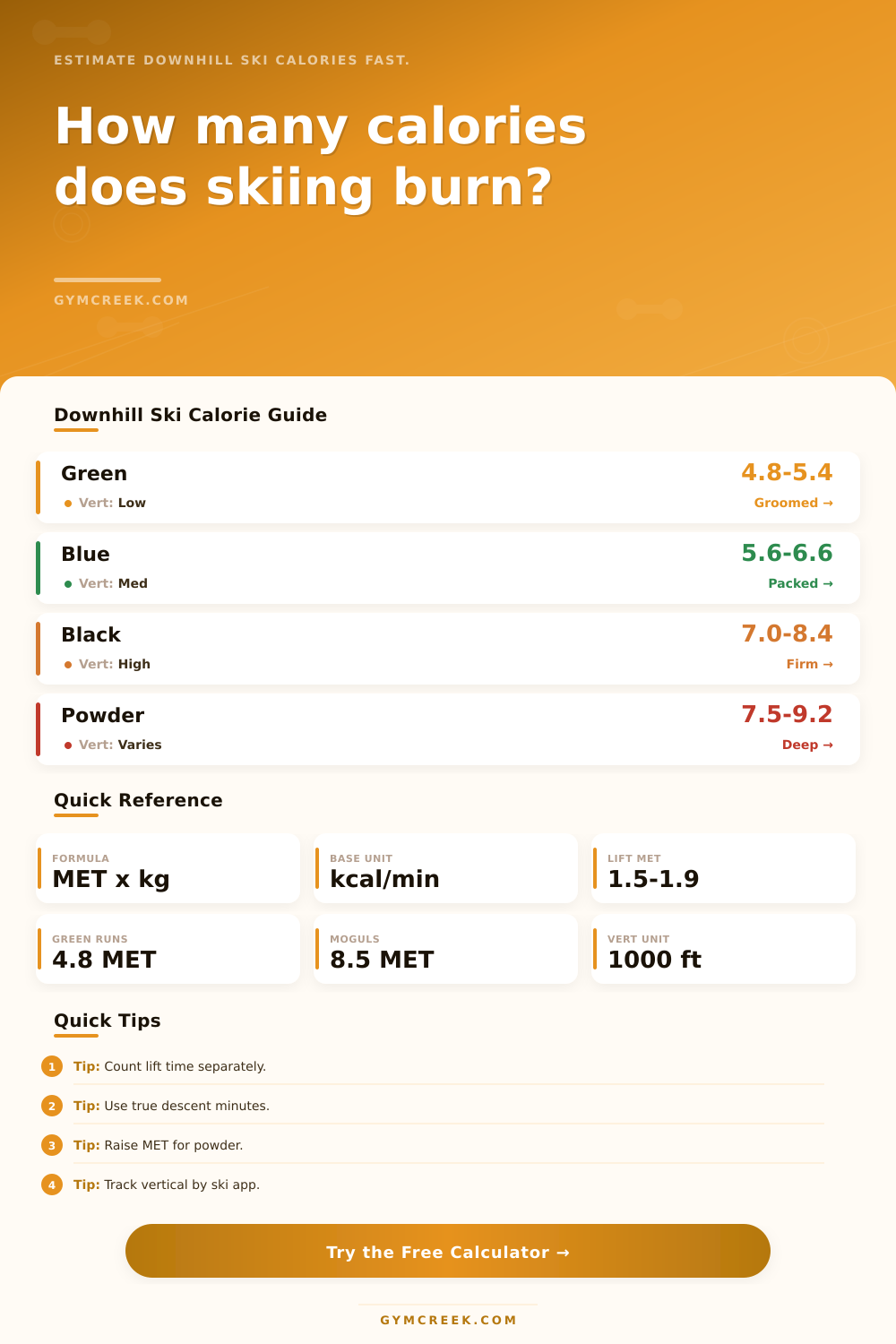
Calories per minute = adjusted downhill MET x 3.5 x body weight in kg / 200, multiplied by true moving descent minutes.
Lift riding, standing in lines, and lodge breaks use lower MET values so the whole ski day is not treated like continuous downhill work.
Total calories divided by vertical descent in 1000 ft blocks shows how costly the mountain profile is for the selected skier.
Mifflin-St Jeor estimates BMR, then the activity multiplier estimates TDEE so the ski session can be compared with normal daily burn.
📑Reference Tables
| Terrain | Base MET | Typical Vert | Best Use |
|---|---|---|---|
| Green groomer | 4.8 | 300-900 ft | Learning pace |
| Blue cruiser | 5.8 | 700-1600 ft | Steady laps |
| Black diamond | 7.2 | 900-2200 ft | Hard turns |
| Moguls and bumps | 8.5 | 500-1400 ft | Leg demand |
| Powder terrain | 8.0 | 700-1800 ft | Deep snow |
| Race training | 9.0 | 400-1200 ft | Intervals |
| Snow Condition | Modifier | Feel | Why It Matters |
|---|---|---|---|
| Groomed | 1.00x | Smooth | Baseline |
| Packed powder | 1.03x | Grippy | More edging |
| Icy firm | 1.06x | Precise | Tension load |
| Boot-deep powder | 1.16x | Deep | More effort |
| Crud and chop | 1.12x | Variable | Balance work |
| Spring slush | 1.10x | Heavy | Drag rises |
| Day Type | Runs | Active Time | Vertical |
|---|---|---|---|
| Beginner lesson | 4-8 | 15-35 min | 2k-6k ft |
| Casual resort | 8-14 | 35-70 min | 7k-15k ft |
| Hard charger | 15-24 | 70-120 min | 18k-35k ft |
| Powder hunt | 8-18 | 45-100 min | 8k-25k ft |
| Race blocks | 10-20 | 25-70 min | 5k-15k ft |
| Formula | Variables | Output | When Used |
|---|---|---|---|
| MET kcal | MET, kg, min | Calories | Main estimate |
| Lift kcal | Lift MET, kg | Break burn | Lift rides |
| Vertical rate | Feet, min | Load factor | Run speed |
| Mifflin BMR | kg, cm, age | Baseline | Daily context |
💡Tips
Then again, there’s a certain hunger that comes from a day on the mountain that feels less like just eating and more like a basic need. It’s how you look at a plate of pasta with such reverence in the lodge and wonder why the burn doesn’t match what you imagined you were doing.
Then you input your weight and vertical stats into the calculator and it does the math for you. Metabolic equivalent units and all those other conversions? Save yourself the guesswork.
Why Skiing Burns Calories
A lot of folks think skiing is just about going down hill, a steady progression of pure gravity-assisted good times. But there’s a lot more mechanic at play. A large chunk of every ski day are spent waiting in lines or sitting on chairlifts. And neither of those activities involve much energy use: They average roughly 1.5-1.9 METS, which means it’s barely higher than if you were sitting in a classroom.
Those ten minutes you spend hanging out on the lift aren’t “intense exercise,” and so if you assume that they are, then your caloric estimate is going to go way up. The tool parses this out (and makes sure to count the lift minutes without inflating them). It differentiates the work of waiting from the work of skiing.
Because a black diamond run at half-speed will burn just as many calories (or maybe even slightly more) than a green run at full-pace, speed isn’t really part of the equation; what matters more is terrain difficulty. Black diamonds requires you to constantly engage the edges and make micro-corrections. Your mind has to process all that visual information at high speeds, and your body must work to maintain your balance. In other words, that mental load equals physical expenditure.
Another issue is powder. Because it’s a type of brake, you have to drive your legs extra hard to keep up momentum. The calculator takes this into account when calculating its energy use, recognizing that fresh corduroy is far less taxing than boot-deep powder.
The last multiplier is weight (not body image, just physics). Metabolism is mass dependent, more mass means you need to spend more energy moving it. Because of this, the calories burned on the exact same run by a 180 pound skier will be greater then those for a 120 pound skier. The output from the calculator scales directly with body weight. People often find this surprising, especially since larger skier may feel like they’re doing less work. There’s no denying how much work it takes to overcome resistance and move mass.
Perhaps the best metric for measuring improvement is the vertical drop (aside from removing the variable of how long you rested or waited between runs). Vertical feet don’t care whether you took a break at any point or were waiting for someone. They also cares less about the variability of run lengths and steepness; it’s not a good way to count runs. To see how all that relates, there’s a table at the bottom of the page with a few examples of terrain types and average vertical descents for each. That puts the number into context, something you might find surprising.
You’re skiing at altitude, which means the thin air makes moderate exertion seem like super-exertion. There’s an altitude band in the calculator to include this physical stress.
Once you understand those variables, you no longer think in hours; you now think in minutes of active descent. And you realize that climbing through powder requires more effort, so the extra calories are worth it. You realize that the uphill part of the lift is all recovery, not work. It’s a shift that transforms an overwhelming set of numbers into a simple energy-spending roadmap. One that enables you to recover properly and fuel accordingly.
The hunger at the lodge doesn’t come as a surprise; it’s a signal. A signal that says, “I just spent X amount of vertical feet and I know exactly how much I paid for this meal.” That means it’s worth it. Every. Vertical. Foot.