Skater Jump Calorie Calculator
Estimate calories burned from lateral jump distance, reps per side, sets, bodyweight, landing control, pace, rest, surface, and unilateral power demand.
📌Skater Jump Presets
Each preset loads a realistic lateral plyometric session and recalculates calories, side-to-side volume, density, control, and power.
⚙Calculator
Skater jump calorie snapshot
Enter lateral distance, reps per side, sets, pace, rest, and landing control to estimate the session.
📊Metrics Grid
🧮Unilateral Lateral Logic
Reps are entered per side, then doubled so left and right landings are counted evenly before calories and volume are estimated.
Side-to-side work uses body mass plus load, jump distance, pace, and a braking factor to estimate average lateral watts.
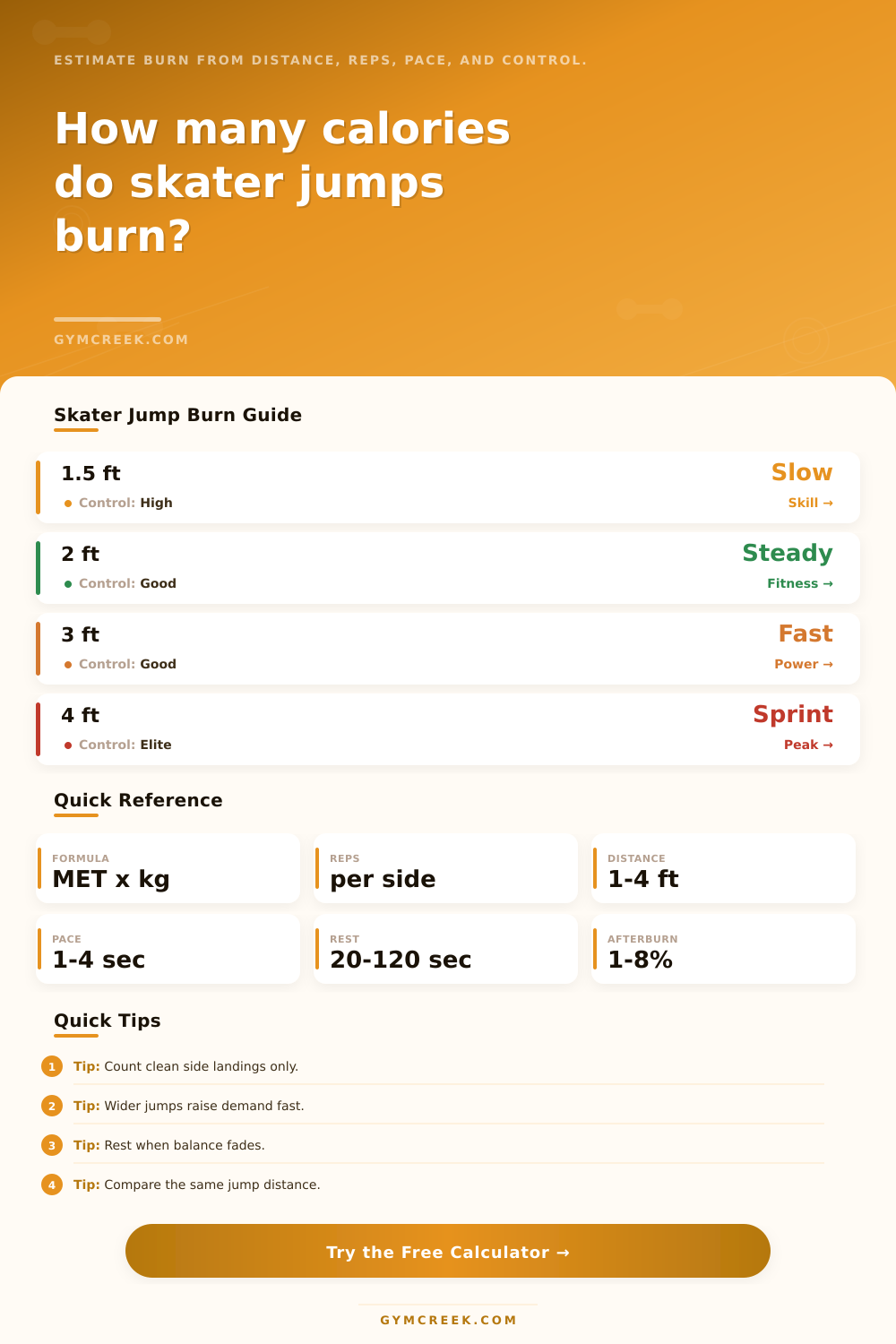
Calories use MET x 3.5 x body weight in kg / 200, then adjust MET for style, distance, pace, landing control, surface, and load.
Landing control, surface, and side asymmetry lower the quality score because unstable landings make calorie targets less useful.
📑Reference Tables
| Lateral Distance | Demand | Best Pace | Training Bias |
|---|---|---|---|
| 1.0-1.5 ft | Low | 2.0-3.5 sec | Balance and warm-up work |
| 1.6-2.5 ft | Moderate | 1.3-2.2 sec | General conditioning |
| 2.6-3.5 ft | High | 1.1-1.8 sec | Lateral power and deceleration |
| 3.6+ ft | Very high | 1.5-3.0 sec | Advanced bounding with full control |
| Skater Style | Base MET | Control Need | Best Use |
|---|---|---|---|
| Step-touch skaters | 4.8 | Low | Entry cardio and balance |
| Standard skater jumps | 7.6 | Moderate | Repeatable conditioning |
| Floor reach skaters | 8.4 | Moderate | Range and trunk control |
| Fast side-to-side | 9.6 | High | HIIT density |
| Power bound skaters | 10.2 | Very high | Explosive lateral power |
| Landing Control | Meaning | Calc Effect | Adjustment |
|---|---|---|---|
| Elite stick | Quiet single-leg stop | Full power | Progress distance slowly |
| Good control | Repeatable landing | Baseline | Hold pace steady |
| Basic balance | Small support taps | Minor caution | Shorten distance first |
| Wobbly landing | Loud or unstable | High caution | Add rest or regress |
| Missed sticks | Extra hops needed | Modify | Stop the set early |
| Formula Piece | Variables | Output | Why It Matters |
|---|---|---|---|
| MET burn | MET, kg, min | Calories | Main session estimate |
| Lateral work | Mass, speed | Joules | Side-to-side demand |
| Duty cycle | Work, rest | Percent | Session density |
| Mifflin BMR | kg, cm, age | Calories | Daily context |
💡Tips
Forward running doesn’t get as much love as lateral movement. While running a mile may be easy for you, jumping laterally are an entirely different story. Skating involve explosive strength followed by rapid braking while maintaining one-legged balance even though it seems simple.
Because distance and technique affect intensity, it’s hard to say how many calories is burned. Enter your lateral pace and distance into the calc, and let it do the math. You will not have to guess about conversion factors or calculate metabolic equivalents anymore.
How to Calculate Calories for Side Jumping
It’s not about size. It’s about width. It takes much more force to jump three feet laterally different than jumping one and a half feet. Your kinetic energy will increase much faster then the size of the gap you must cross, and the same applies when your foot hits the ground. That’s why the tool requests specific lateral distance. Increasing the width of a jump increases the energy used exponentially before adding additional reps.
Many people underestimate how much energy is use during the landing phase. The eccentric load on the lead leg are huge. Wobbling around or taking extra hops to regain stability reduce effective power output and leaks energy.
There’s one hidden variable to consider in plyometric estimates: control. Landing quality affect the M.E.T. Value. Quiet landers maintain greater efficiency and control of power transfer. Wobbly landers gets a lower estimate for the burn because they move less efficienty. You are not burning fewer calories. Instead, a decent chunk of that effort is going toward stabilization instead of propulsion. Knowing this also give you an idea of how well you’re doing. Sure, go ahead and try to hit big numbers. But if you lack landing control, the lateral power number will reflect that lack of efficiency.
Session density is determined by both pace and rest intervals. If I sprint 10 reps without a break, my cardio demand will be high. If I decrease the pace while keeping the same distance, I focus more on strength and muscular endurance. Because the rest period directly impacts the duty cycle, the tool also considers this factor. A high duty cycle occur when you spend more time working vs resting. This maintains a high heart rate and improves the afterburn effect. Unfortunately, pushing the pace causes form breakdown that reduces your lateral distance and lose the desired effect.
The other thing that all these general fitness tools overlook is asymmetry. One foot is nearly always going to be dominant when jumping like a skater. The calculator accounts for differences in distance or control between legs even if they are only five percent. And it’s more than just fair play. It’s a matter of avoiding serious injuries when moving sideways at high speeds. Knowing how much asymmetry you have gives you a better idea based off whether you need to do corrective work or conditioning work. It’s explained through reference tables on the page, where they matches distance ranges with corresponding training bias.
The energy expenditure at the baselines depends on the jump style. Some skaters use a low-intensity step-touch style. Full-kinetic-chain power bound skaters. If you pick the right style, you’re matching the metabolic equivalent of what you’re doing. Then you can add external load such as a weighted vest. This will linearly increase the amount of work, but also the amount of stress on the knees and ankles. To assist in measuring this tradeoff, the tool has a loaded vest option so you can see the price ahead of time. You should of do this before strapping on the weight.
The session burn multiplies when it’s done often. A good maintenance dose is three times a week. Depending on how well you recover, six may be overkill. Use the weekly total from the calculator to help place this particular workout in terms of your overall energy budget. It frames the session in terms of its share of your estimated daily burn. In other words: it helps keep things in check and show you the cumulative load of training.
Jump sideways on Skaters. When you jump, do it for a reason. Jumping is only part of it. Repeat this sequence: stop/start/stop/start etc. Let the numbers be a guide. Listen to your joints for what they say. What feels stable in your ankles tells the story. Train within that set of data. But let your body tell you how far is too far.
Today’s jumps don’t need to be chaotic. They should be under control. If not, then you’re doing something right.