Skateboarding Calorie Calculator
Estimate calories burned from skateboard riding, street spots, park lines, longboard cruises, hill pushes, trick attempts, terrain, session density, and body weight.
📌Presets
Each preset loads a realistic skateboard profile and immediately recalculates the session estimate.
⚙Calculator
Skateboarding calorie snapshot
Enter your skate session structure to estimate total calories, active calories, adjusted MET, and daily energy context.
📊Skate Metrics
🧮Formula Result Cards
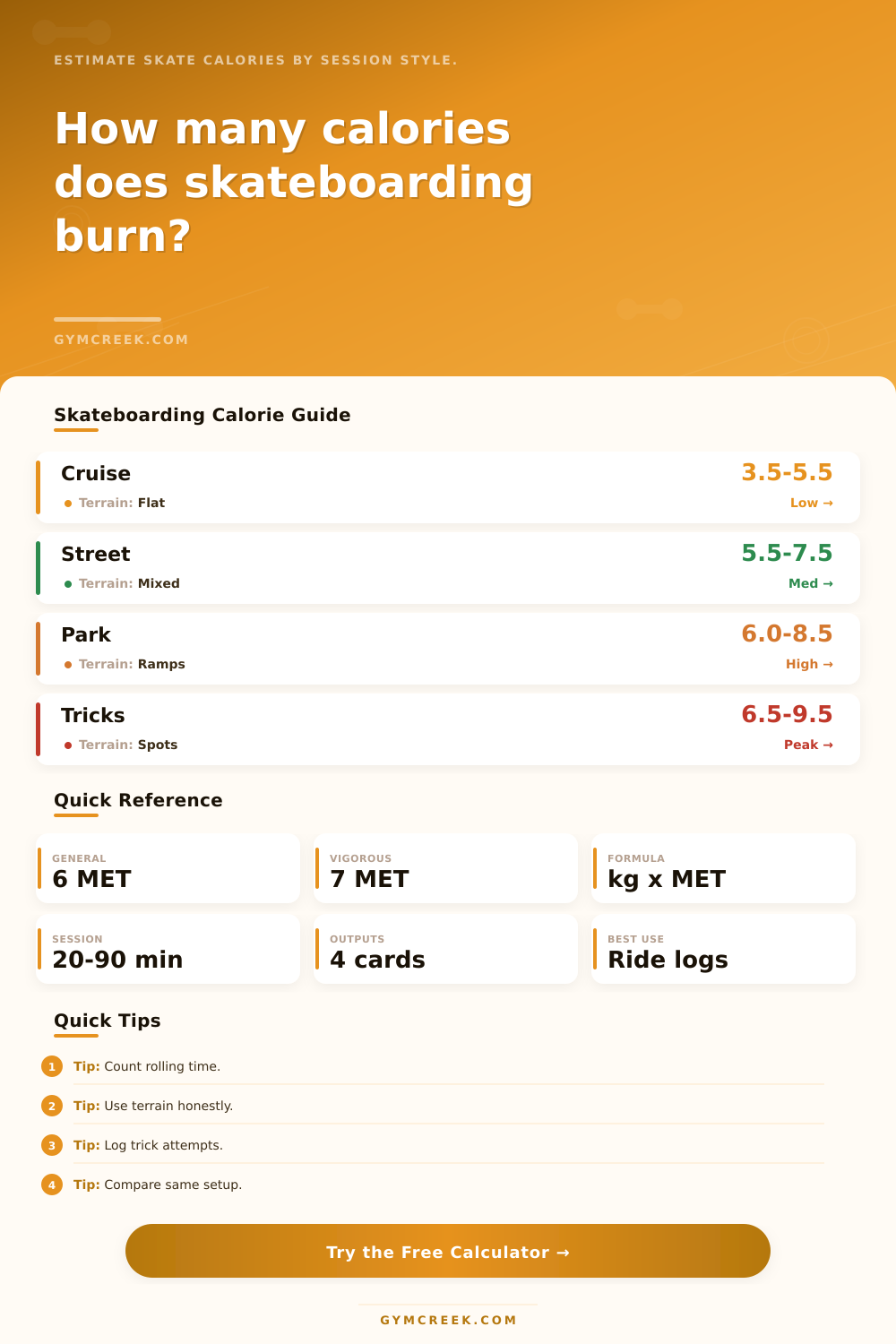
Calories per minute = adjusted MET x 3.5 x body weight in kg / 200. This is the core skateboarding energy estimate.
General skateboarding is anchored near 6 MET, while vigorous competitive riding is anchored near 7 MET before terrain and trick adjustments.
Rolling time uses skate MET. Standing, walking back, filming, and waiting use the selected recovery MET so breaks are counted separately.
Mifflin-St Jeor estimates BMR, then your normal activity multiplier estimates TDEE so the session can be compared with daily needs.
📑Reference Tables
| Session Style | Easy | Moderate | Hard |
|---|---|---|---|
| Casual cruising | 3.5 MET | 4.8 MET | 5.8 MET |
| Flatground practice | 5.0 MET | 6.2 MET | 7.4 MET |
| Street spot lines | 5.8 MET | 6.8 MET | 8.0 MET |
| Skatepark mixed | 5.6 MET | 6.7 MET | 8.2 MET |
| Bowl pumping | 6.0 MET | 7.3 MET | 8.8 MET |
| Terrain | Modifier | Why It Changes | Best Match |
|---|---|---|---|
| Smooth flat concrete | 0.95x | Easy roll speed | Plazas |
| Rough asphalt | 1.08x | More pushing | Streets |
| Mixed street or park | 1.00x | Baseline load | Most sessions |
| Ramps and banks | 1.07x | Climbs and pumps | Park lines |
| Rolling hills | 1.12x | Grade changes | Commutes |
| Trick Density | Attempts | Modifier | Session Clue |
|---|---|---|---|
| Low | 0-10 per 10 min | 0.96x | Cruising |
| Moderate | 11-25 per 10 min | 1.00x | Casual park |
| Busy | 26-45 per 10 min | 1.07x | Trick drills |
| Heavy | 46-70 per 10 min | 1.14x | Street tries |
| Peak | 71+ per 10 min | 1.20x | Filming push |
| Formula | Variables | Output | When Used |
|---|---|---|---|
| MET kcal | MET, kg, min | Calories | Rolling time |
| Recovery kcal | Rest MET, kg | Break burn | Reset time |
| Mifflin BMR | kg, cm, age | Baseline | Daily context |
| Session density | Active %, time | Work split | Skate pacing |
💡Tips
A plan forms in your head as you step onto board. You’re going to spend an hour cruising down boulevard smoothly. Or maybe you’re going to grind out kickflips for an hour on some rough concrete plaza. Either way, both will take an hour. And they’ll both involve the same amount of body weight and the same board. But how many calories do you think you burn during those two sessions?
One session feels like a gentle cardio walk. The other session feel like a high intensity interval workout wrapped in a layer of frustration. That’s the hidden variable in skateboarding fitness. It’s not just about time on feet. It’s about how much effort you put in. This is where most folks gets it wrong. Because skateboarding seems so chill, they think it’s a low-intensity activity that burns a moderate amount of calories at a consistent rate.
Why Skateboarding Burns Different Calories
Guess what? Skateboarding is a stop and go sport. You roll forward for ten seconds and ollie over a gap. Then you land, set up, walk back, and wait for your buddy before you repeat the process. In this case, if you lump entire hour under one activity, your guess will be all over the map. To get an accurate answer, you’ve got to split the active time (rolling) from downtime (standing around). Once you input how you break down your session, the calculator does the rest (saving you the hassle of weighing manualy each moment you push off the ground vs. Stand around). It splits the hour into recovery minutes and active minutes.
Why does this matter? Pushing off the ground use much more energy than walking back to your starting position. Consider the terrain you’re rolling over. At a skate park, that’s smooth concrete which means you can roll further without pushing. On the street it’s rough asphalt, which requires constant propulsion. The tool take all of this into account with its terrain modifiers. When you’re rolling over cracks and bumps, your body has to work even harder to both stay balanced and moving forward. It isn’t just about friction. It has everything to do with micro-adjustments. On an uneven surface, your core and legs is firing constantly to keep you upright. These surface conditions greatly change the amount of energy exerted, according to the reference tables found in the tool. For example, what would be perceived as a moderate effort session on smooth concrete will jump up a notch if the same session occurs on rough asphalt. It is a small difference on paper, adds up fast when you’re out there for two hours.
Then there’s trick density. If you try a single kickflip every minute that’s very different than if you try 20 in 10 minutes. Every failed kickflip costs energy. There are three steps: jump, land, reset. All those burn fuel. You can plug in how many tricks you’re trying in what amount of time. That’s where the nuance comes into play. While a longboarder may be able to put out more calories in an hour of nice smooth distance cruising compared to a street skater who burns them up with failed technical tricks in an hour, it isn’t just about speed. It’s also about impact and repetition. The tool takes that number of tricks into account along with your overall time for a more realistic picture of what you’ve been putting out.
Your body weight matter more than you might think. When you do the same amount of work, the heavier you are, the more calories you will burn. Why? Because it’s physics. Moving mass require energy. Your weight provides an anchor point for the calorie calculation. Gender and age factor in too. That way you get a sense of how that hour on the skates plays out within your day. It isn’t just about the skate session; it is also about how that skate supports your daily metabolism. Did it make up a big chunk of your daily burn? Or was it just a small slice?
If you’re not sure where to begin, try using the presets. They’ll load in realistic profiles based off style. A pro working on a part has different needs than a beginner learning how to get better at flatground practice. The inputs reflect that reality. Tweak them as necessary. Accuracy is the goal. Be honest with your inputs. Don’t be shy. If it took you half the session to wait and film, reduce your active time percentage. The tool will adjust the numbers accordingly.
It provides you with a baseline. That’s useful because you’ll want to track your progress over time. You’ll start seeing patterns. You’ll see what actually makes a difference.
The beauty of skateboarding lie in its mix of athletic skill with artistic expression. That’s why the calories don’t add up to one simple number. It doesn’t work like that. It’s a tale of sweat, persistence, and terrain. And when you get a sense for that story, you can train smarter. You can appreciate your gains. And next time you lace ‘em back up and go to the spot, reflect on what it is exactly that you’re doing there. Are you pushing hard? Drilling tricks? Are you cruising?
That’s what makes the difference. That’s what defines the workout. What defines the burn. And that is what defines the result.