Sit to Stand Test Calculator
Score a 5x sit-to-stand time or 30-second chair stand count, compare age norms, and estimate lower-body power.
📌Presets
Each preset loads realistic chair height, body size, test format, and performance data, then recalculates the score.
⚙Calculator
Sit-to-stand snapshot
Enter test data to score performance and power.
📊Performance Metrics
📑Reference Tables
| Age | Men Low Flag | Women Low Flag | Use |
|---|---|---|---|
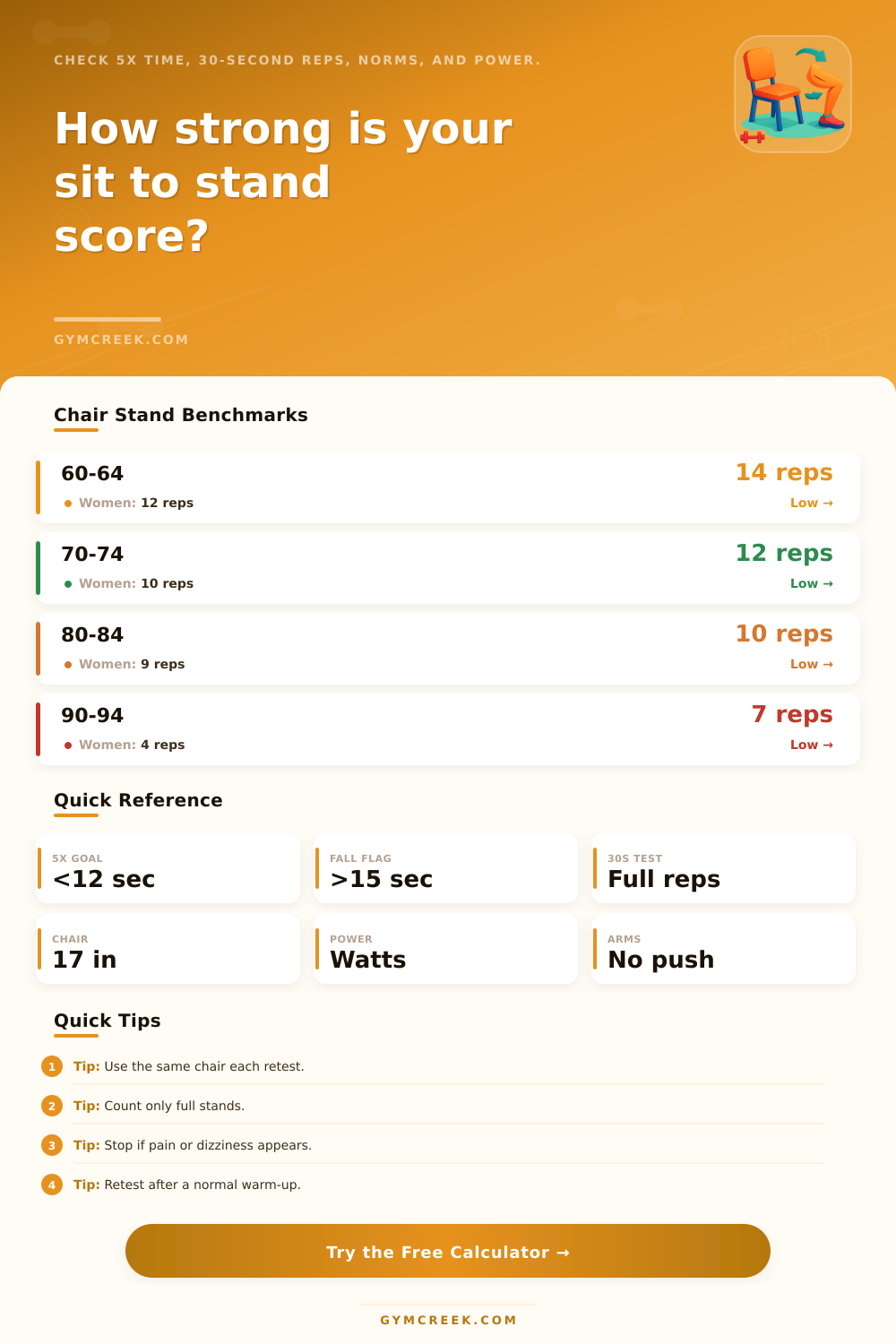
| 60-64 | Under 14 reps | Under 12 reps | 30-second chair stand |
| 65-69 | Under 12 reps | Under 11 reps | 30-second chair stand |
| 70-74 | Under 12 reps | Under 10 reps | 30-second chair stand |
| 75-79 | Under 11 reps | Under 10 reps | 30-second chair stand |
| 80-84 | Under 10 reps | Under 9 reps | 30-second chair stand |
| 85-89 | Under 8 reps | Under 8 reps | 30-second chair stand |
| 90-94 | Under 7 reps | Under 4 reps | 30-second chair stand |
| 5x Time | Interpretation | Signal | Next Check |
|---|---|---|---|
| Under 10 sec | Fast transfer speed | Strong | Track power |
| 10-12 sec | Typical functional speed | Good | Retest monthly |
| 12.1-15 sec | Borderline slowdown | Watch | Check form |
| Over 15 sec | Mobility risk flag | Caution | Use support plan |
| Unable | Assistance needed | High caution | Professional screen |
| Power Metric | Formula Input | What It Means | Limit |
|---|---|---|---|
| Average watts | Mass, travel, time | Work rate across stands | Estimate only |
| Watts per kg | Watts divided by mass | Body-size adjusted power | Chair dependent |
| Work per stand | Mass x gravity x travel | Estimated lift work | COM estimate |
| Rep speed | Reps divided by seconds | Functional transfer pace | Quality matters |
| Scenario | Common Input | Expected Output | Tracking Tip |
|---|---|---|---|
| Clinic screen | 5x time | Risk flag | Repeat same chair |
| Senior fitness | 30-second reps | Age norm gap | Count strict stands |
| Rehab progress | Both tests | Power trend | Watch symptoms |
| Masters training | 30-second reps | Power and pace | Retest fresh |
💡Tips
Mobility means how many miles I can go. No. That’s actualy not what mobility usually mean at all.
Often, it’s: Can I rise from a toilet seat or the couch with ease? It sounds like nothing, but this is what predicts whether you will live independently, and lower-body power is everything. You built that power in your 20s, when you were young, but then you spends the rest of your life sitting down. And when you sit for long enough, power is what makes the difference.
How to Test Your Lower Body Power at Home
Here’s how to measure it, without going to the gym. All you’ll need is a chair, and some self-control. Standing up is a matter of lifting your center of mass against gravity; movement experts have been perfecting this notion for decades. Make yourself do it enough times, and that lift becomes a measure of power… Force times velocity. Why? Because when you trip you don’t care about strength, you care about speed.
So the calculator does the math for you after you input your chair height and weight (no more guessing at conversions). It then converts raw time to something comparable across all ages, so you know whether you’re tracking with your peers, or drifting off toward a risk zone. The typical chair sitting height is seventeen inches. That’s where most people makes a mistake. Using a low stool means you’re testing maximum strength (which could of been dangerous), or a deep armchair means you’re testing comfort, not functionality. When you retest yourself, set everything up exactly as before so the numbers compare apples-to-apples.
To eliminate arm momentum, cross your arms on your chest. Pushing off with your hands alters the physics of the movement and makes the numbers useless when comparing your progress. Only count full stands with your knees fully extended; half reps aren’t really reps at all, they’re disguised warm-ups.
Because it involves sitting down and standing up as many times as possible in thirty seconds, the thirty-second version of the test is great for measuring endurance different than pure strength. So if you see a decline in this score with age; particularly among the fifty-plus crowd, it’s usually more attributable to fatigue than anything else. According to the reference table, the required rep count gets progressively lower with every advancing year of age, so even though your relative status may be the same, a guy in his seventies requires less then a guy in his sixties to stay there. And that’s nothing but a testament to physiological adaptation, not failure. Being able to plot yourself on that curve will help you establish appropriate expectations for your workout.
But the five-repetition timed test is another way of looking at things: How fast can you get off your behind when necessary? Time yourself doing five complete stands. If you’re a typical older adult, anything less than 12 seconds is probably fine; anything over 15 tends to be a red flag in clinical testing because it may indicate that getting up from a dinner table or a bed isn’t as easy as it used to be. That doesn’t signify impending doom, however. It simply means pay attention to your lower body power.
Another piece of the puzzle is power estimation, which considers your weight and how far above or below ground you go to calculate an approximation of watts produced through your motion. For example, a heavier individual must generate more absolute power to achieve the same speed as someone lighter. Realizing this will keep you from feeling inferior to others. They probably weigh less than you do, so you shouldn’t hold them to your standards anyway. Instead, use your own trendline over time as a point of reference, rather than being discouraged by someone else’s score around the corner. One number doesn’t tell the whole story.
For example, if your pain rating goes up while your power output stays the same, that’s a red flag to dig deeper into. The calculator also takes those details into account. It asks about your balance confidence and symptoms. If you have a high symptom score, the recommended zone will lean toward caution no matter what rate of movement you report. It won’t let you hurt yourself in pursuit of better performance numbers (because safety > speed when you’re playing with an older body).
In the end, though, it’s a mirror of where you really sit (and stand) in real time, and no excuses allowed. The data points tell you something; if you’re finding more power in your stands, go harder at training; if you’re losing power, ease back a bit. If you’re seeing gains in stand-up speed, that will mean more balance and less falling over in day-to-day life. Use a good chair and cross your arms, and get yourself up. It’s easy until you have to do it a lot, which is why we should measure it, right?